In any functioning democracy, matters of national defense are inherently governed by confidentiality. Military operations, intelligence activities, and strategic partnerships often operate behind closed doors. Yet when secrecy becomes the default rather than the exception—especially on issues of public interest—it inevitably breeds suspicion rather than trust.
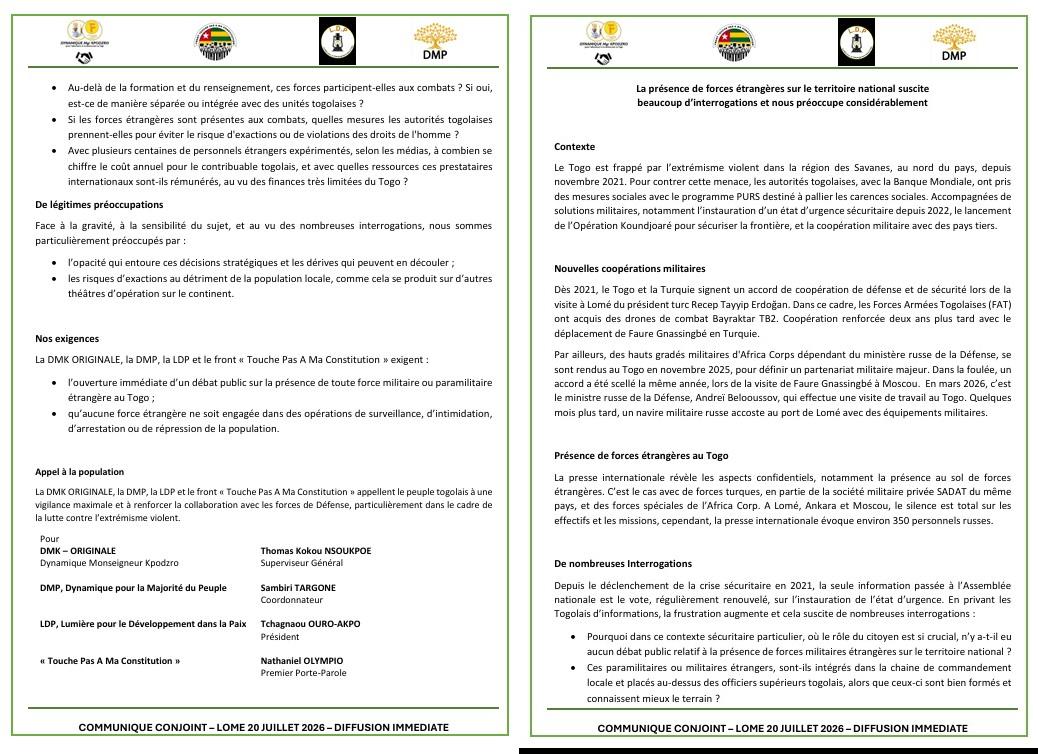
In Togo, reports from independent observers and international media have highlighted the presence of foreign military personnel on national soil. Among the identified nationalities are Russian and Turkish forces. Should these reports hold true, they introduce a host of legitimate questions demanding clear responses from government authorities.
Is foreign military presence a safeguard or a political crutch?
Beyond the immediate imperatives of national security, the opacity surrounding these foreign deployments fuels deeper concerns. Analysts suggest that the Togolese administration, led by President Faure Gnassingbé, may be turning to external military support not solely for defense purposes, but as a calculated measure to reinforce political stability. With persistent criticism over governance failures—including economic hardship and institutional restrictions—rumors of potential coups, whether popular or orchestrated from within, have intensified.
Critics argue that these foreign military partnerships are not primarily aimed at protecting the nation’s borders, but rather serve as a lifeline for a regime intent on maintaining power at all costs. The lack of transparency only amplifies such interpretations, leaving room for speculation about the true intentions behind these alliances.
Unresolved operational and legal ambiguities
The exact nature of these foreign personnel’s roles remains unclear. Are they deployed to train Togolese armed forces, gather intelligence, provide strategic advice, maintain military equipment—or perhaps even serve in executive protection roles for state leaders? Without official clarification, conjecture quickly fills the void.
Another critical issue concerns their operational involvement. Are these foreign troops merely advisors, or do they participate directly in internal security operations? Do they conduct joint field missions with local forces, or is their presence strictly confined to technical support and training facilities? Clarifying these distinctions is essential to understanding the scope and legitimacy of the agreements in place.
Equally important is the question of legal accountability. In nations hosting foreign military personnel, established frameworks typically define the rights, obligations, and oversight mechanisms governing their activities. What legal provisions has Togo enacted to regulate these deployments? What safeguards exist to prevent abuses and ensure compliance with national laws and international obligations?
The economic burden of secrecy
Financial transparency is another pressing concern. How many foreign military personnel are currently stationed in Togo? What is the duration of their deployment? What financial burden does this cooperation impose on public funds? Are these costs borne by Togo’s national budget, the partner countries, or through specific cooperation agreements? Citizens, whose taxes fund public policy, are entitled to transparent disclosure of such commitments.
It is important to note that skepticism toward foreign military cooperation does not imply opposition in principle. Many countries rely on international partnerships to enhance their defense capabilities against shared threats. Togo, too, faces complex regional security challenges, including terrorism in the north, which could justify defensive collaborations.
Transparency as a cornerstone of public trust
Ultimately, public trust is built on openness. When a government clearly communicates the objectives, legal frameworks, and operational modalities of foreign military engagements, it curbs misinformation, speculation, and conflicting narratives. In a region marked by chronic political instability and shifting security alliances, accurate information remains the most effective response to public concerns.
While national security imperatives must be respected, authorities can still provide sufficient insight into the purpose, safeguards, and responsibilities involved. Transparency in defense policy is not a luxury—it is a pillar of legitimacy. When foreign military presence raises as many questions as it answers—and appears intertwined with efforts to entrench political control—it becomes incumbent upon the government to clarify the situation. In a democracy, silence is not a sustainable communication strategy; it inevitably paves the way for doubt.