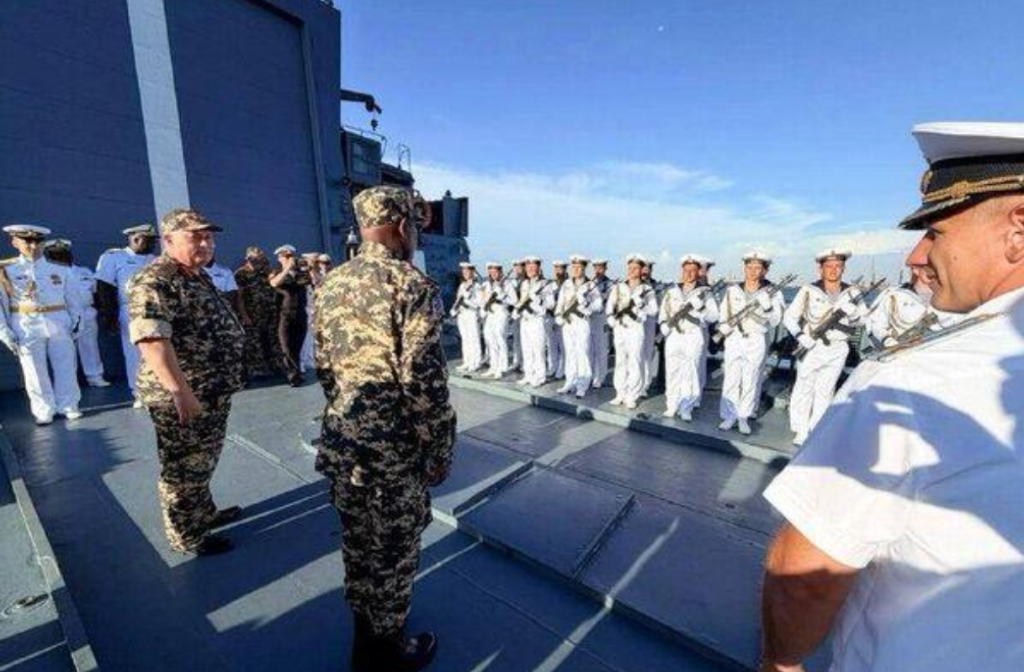
Behind the official narrative of a routine maritime training mission, the docking of Russia’s Perekop training vessel in Walvis Bay on October 20, 2026, reveals deeper currents in Moscow’s strategic ambitions across Africa. While the Russian Ministry of Defence framed the visit as a routine exercise for naval cadets, the logistical and diplomatic ripple effects of this stopover suggest a far broader agenda—one that extends beyond pedagogy into the realms of military presence, alliance-building, and long-term influence.
The dual nature of naval training missions
At first glance, the Perekop’s seven-day voyage—covering over 1,800 nautical miles—appears to be a standard outreach effort by Russia’s Baltic Fleet. Cadets aboard the vessel logged nautical miles, practiced navigation, and studied open-sea routing. These are legitimate training objectives, consistent with the ship’s designated role.
Yet naval training is never merely academic. Such campaigns provide a platform for diplomatic engagement, offering opportunities to meet local commanders, tour port facilities, and establish lines of communication. When deployed in regions like southern Africa, where Russia maintains a modest naval footprint, these voyages serve as low-cost, high-visibility tools to project presence and cultivate ties.
The port of walvis bay: africa’s atlantic gateway
Walvis Bay occupies a unique position along Africa’s southwestern coast. As one of the region’s few deep-water ports capable of handling large vessels, it offers logistical advantages that are hard to ignore for navies operating in the South Atlantic. For Moscow, regular access to such infrastructure means shorter transit times, reliable refueling, and simplified maintenance—critical factors in sustaining long-range deployments.
Analysts tracking Russian maritime strategy point out that Walvis Bay is not yet a permanent base. There is no treaty, no dedicated Russian facility, and no indication of a long-term lease. However, the Namibian government’s engagement with the visiting officers may lay groundwork for future agreements. Even a single well-received stopover can normalize routine access, making subsequent requests for extended support easier to justify.
What walvis bay offers—and what it doesn’t
A well-equipped port can serve as a staging ground for joint exercises, humanitarian assistance, or disaster relief. But a single ship visit does not equate to a naval base. For Russia to secure permanent berthing rights or operational support, it would need to formalize arrangements through bilateral agreements—something not yet evident. Until then, Walvis Bay remains a potential asset, not an operational hub.
Diplomacy in motion: building influence beyond the ship
During the Perekop’s stay, Russian naval officers met with Namibian counterparts and embassy representatives. These exchanges, though routine, are strategically significant. They signal interest, build trust, and can open doors to broader defence cooperation—including arms sales, joint training, or technical exchanges. Moscow has pursued such partnerships across the continent, positioning itself as an alternative security partner to Western nations.
Namibia, for its part, has not publicly committed to aligning exclusively with any bloc. Like many African nations, it balances relations across major powers to secure investment, aid, and military support. In this light, the Perekop’s visit can be seen as part of a calibrated outreach effort—one that strengthens ties without obligating commitment.
A symbolic message to the west
In an era of heightened global tensions, naval diplomacy serves a dual purpose: practical utility and symbolic signalling. The Russians know that a ship in foreign waters broadcasts presence. Every port call, every joint exercise, reinforces the message that Moscow retains options outside its immediate sphere.
While the Perekop is a training vessel—not a destroyer or frigate—its deployment sends a calibrated signal. It demonstrates Russia’s ability to operate in distant waters, navigate international waters, and engage with partners beyond traditional alliances. It’s a reminder that, despite sanctions and economic constraints, Moscow is still projecting power on a global stage.
Why symbolism matters
Symbolism is a currency in great-power competition. A training ship’s stopover may not alter local defence dynamics, but it reaffirms Russia’s claim to be a player in African maritime affairs. It keeps the idea of Russian capability alive in the minds of regional leaders—and that can shape future decisions.
Intelligence and cooperation: separating fact from speculation
Given the ship’s advanced navigation systems, observers naturally wonder whether the Perekop is gathering intelligence. Could its crew be mapping coastal waters, monitoring traffic, or evaluating infrastructure for future use? Possibly. But there is no public evidence to confirm such activity.
Similarly, could the visit pave the way for intelligence-sharing or joint maritime exercises? It’s plausible. But without concrete follow-up—such as shared drills, information exchanges, or follow-on visits—any such claims remain speculative. Naval visits often create opportunities; they rarely confirm them outright.
The road ahead: what comes after the goodbyes
The true measure of Russia’s ambition in Walvis Bay will not be measured by a single ship’s arrival, but by what follows. Will future Russian naval ships call at the port? Will there be recurring training exchanges, port calls by combat vessels, or agreements on logistical support? Those developments would indicate a deeper strategic intent.
For now, the Perekop has departed. Its impact remains uncertain. But one thing is clear: every such stopover shifts the calculus of presence. When a foreign navy becomes a regular visitor, even unofficially, it changes local perceptions—and that, in turn, can reshape diplomatic and military realities over time.