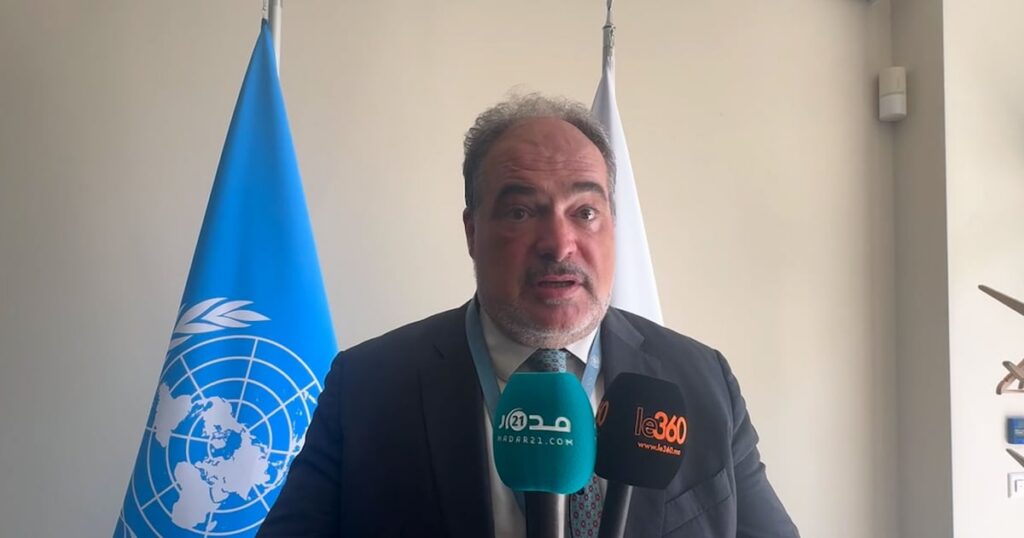
The United Nations Population Fund (UNFPA) and Morocco are deepening their collaboration around key priorities in human rights, health, and gender equality, with a strong focus on field-level interventions and support for public policies.
This was underscored by Alfonso Barragues, deputy director of the UNFPA liaison office, on Tuesday 23 June in Geneva, following a meeting with El Habib Belkouch, the interministerial delegate for human rights, held on the sidelines of the 62nd session of the Human Rights Council.
Among the main pillars of this partnership are improving maternal health and reducing mortality linked to pregnancy and childbirth. UNFPA also aims to strengthen the fight against violence against women and girls, as well as against harmful practices affecting their rights, notably early marriage.
The programme places particular emphasis on expanding access to sexual and reproductive health services. For Alfonso Barragues, the goal is to ensure equitable coverage across the entire territory by bringing these services closer to communities through a reinforced network of healthcare facilities. “Access for women and girls to health services, including sexual and reproductive health, must be guaranteed throughout the country, not only in hospitals but also at primary health centres,” he highlighted.
Beyond sectoral themes, UNFPA supports Moroccan institutions in designing and implementing public policies. This assistance is provided to several ministerial departments, including those for Education, Health, and Social Protection.
Alfonso Barragues noted that the organisation is committed to “assisting the relevant ministries in formulating and implementing public policies”, confirming a cross-cutting and integrated approach.
A partnership rooted in the field
This cooperation is based on a strong belief that the real impact of public policies depends on their implementation at the local level. UNFPA reiterates its engagement with women’s and youth organisations, in close coordination with Moroccan authorities.
In this context, the partnership with the Interministerial Delegation for Human Rights follows a logic of monitoring and applying international recommendations, turning commitments into concrete actions on the ground. “For us, the partnership with the DIDH is a strategic partnership,” he added, illustrating UNFPA’s desire to engage in a sustainable dynamic alongside Morocco for the promotion and effective implementation of human rights.
You may also like
South Africa’s mass shooting crisis: can Johannesburg and Cape Town ever feel safe again?
Senegal’s December 2, 2026: will Diomaye Faye dissolve parliament or play the long game?
Senegal’s 2026 budget revision: can Dakar still rescue its growth and investment agenda?
Senegal’s 2026 revised budget: a trap vote for Pastef or a necessary evil?
Burkina Faso’s armored vehicles: can Faso Armored’s 300-unit claim survive the scrutiny?