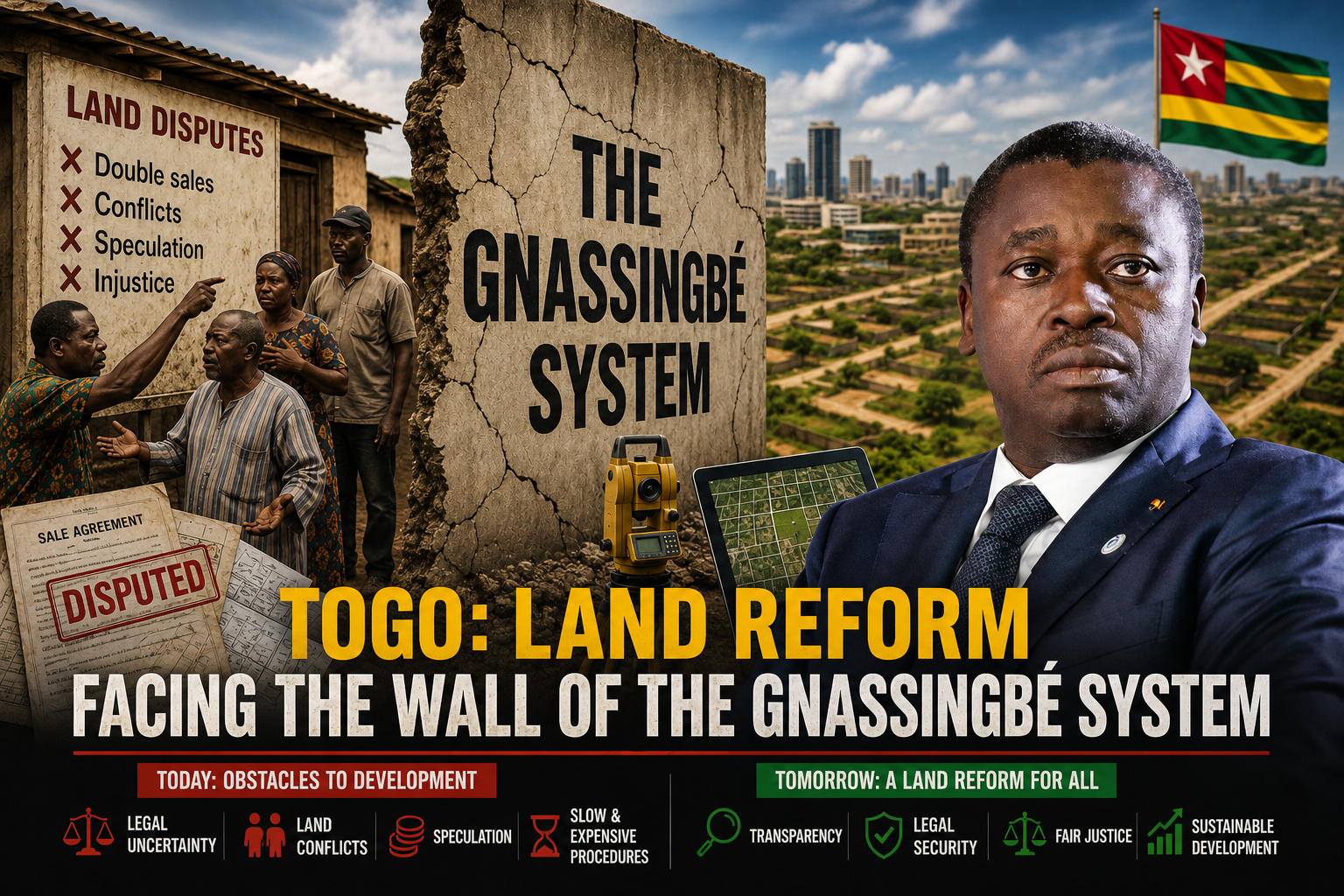
After six decades marked by inconsistent land management practices, the Togolese government is now pursuing a renewed ambition: transforming the land sector into a genuine engine for economic growth. Although this objective is compelling on paper, the practical reality on the ground reveals a far more complex picture. Analysts warn that without addressing deep-rooted structural flaws, this initiative may simply join the ranks of previous reform efforts announced with great fanfare but ultimately abandoned.
The pervasive issue of land disputes
The most pressing concern lies in the persistent problem of land disputes, exacerbated by a series of systemic issues: overlapping sales, ownership disputes, inadequate record-keeping, and opaque transaction processes. How can a country foster sustainable development when private property remains a persistent source of legal uncertainty? A land title or sales deed often fails to provide adequate protection, as a single plot can become the subject of competing claims. This persistent insecurity discourages investment, destabilizes household savings, and occasionally traps individuals in precarious financial situations.
Administrative complexity and inequality
Another critical challenge is the sluggish pace of administrative procedures. For both individuals and businesses, navigating land-related bureaucratic processes can be arduous, costly, and riddled with ambiguity. When access to land information remains restricted and procedures lack transparency, those with financial means, social connections, or a deeper understanding of the system invariably gain an unfair advantage. Reform efforts must therefore go beyond merely increasing the number of issued land titles; they should prioritize universal accessibility to a parcel’s historical records before any transaction is finalized.
The indispensable role of an equitable judiciary
Land disputes that drag on for years do more than create administrative burdens they can shatter families, obstruct inheritances, paralyze land use, and stall economic initiatives. Legal verdicts must be enforced swiftly and equitably, ensuring that outcomes are not skewed by social status, political influence, or financial clout. Without a land justice system that is both accessible and efficient, no administrative reform will yield sustainable results.
The political dimensions of land governance
Political complexities further complicate the landscape. The land sector involves a diverse array of stakeholders traditional owners, families, intermediaries, surveyors, government agencies, local authorities, and influential actors. When certain participants maintain close ties with dominant political or economic networks, conflicts of interest and favoritism become inevitable. A credible reform must dismantle these grey areas rather than perpetuate them under new guises.
The specter of speculation and its social consequences
In rapidly urbanizing regions, escalating land values intensify speculative pressures, leading to multiple sales, encroachments, and manipulative maneuvers. Vulnerable populations lacking the means to navigate a sophisticated market are often the first casualties. Land, once a family asset passed down through generations, is increasingly reduced to a speculative commodity accessible only to those with substantial capital.
Equally significant are the social tensions that frequently arise, pitting relatives against one another, neighboring communities against each other, or different generations over inheritance disputes. Until the integration of customary rights with formal legal frameworks is streamlined, these conflicts will persist. A robust reform must incorporate conflict mediation, preventative measures, and public education on legal procedures.
The potential and limits of digitalization
While digitalization holds promise, it cannot serve as a mere bureaucratic slogan. A reliable, accessible, and continuously updated land database could significantly reduce the risks of duplicate sales and streamline verification processes. However, a digital system alone cannot rectify systemic fraud if data remains incomplete, prone to manipulation, or inconsistently accessible.
The imperative of transparency across all levels
Transparency must extend to every facet of land governance. Who allocates parcels, and by what criteria? Who monitors transactions, and how are violations addressed? What safeguards exist for citizens contesting administrative decisions? Until these questions are thoroughly addressed, public distrust will persist, and each new reform will be met with skepticism.
An economic imperative
A secure land system enables individuals to invest, businesses to expand, financial institutions to assess collateral with confidence, and the state to plan territorial development efficiently. Conversely, insecure land tenure freezes capital, halts projects, and fosters an environment of distrust. The stakes transcend individual landowners; they directly impact the nation’s ability to attract and protect investments.
Thus, the central question is not whether Togo can enact another land reform, but whether it is prepared to embrace the political, administrative, and judicial repercussions of meaningful change. A substantive transformation would demand heightened transparency, decisive action against fraudulent practices, a more expeditious judiciary, stricter administrative oversight, and reinforced protections for the most vulnerable citizens.
Without an unwavering commitment to dismantling entrenched networks, strengthening the rule of law, and purifying the land justice system, any new legislation or reform commission risks becoming little more than a superficial facelift. As long as partisan or private interests continue to overshadow transparency and legal equality, land will remain a source of conflict rather than the economic catalyst it is intended to be.