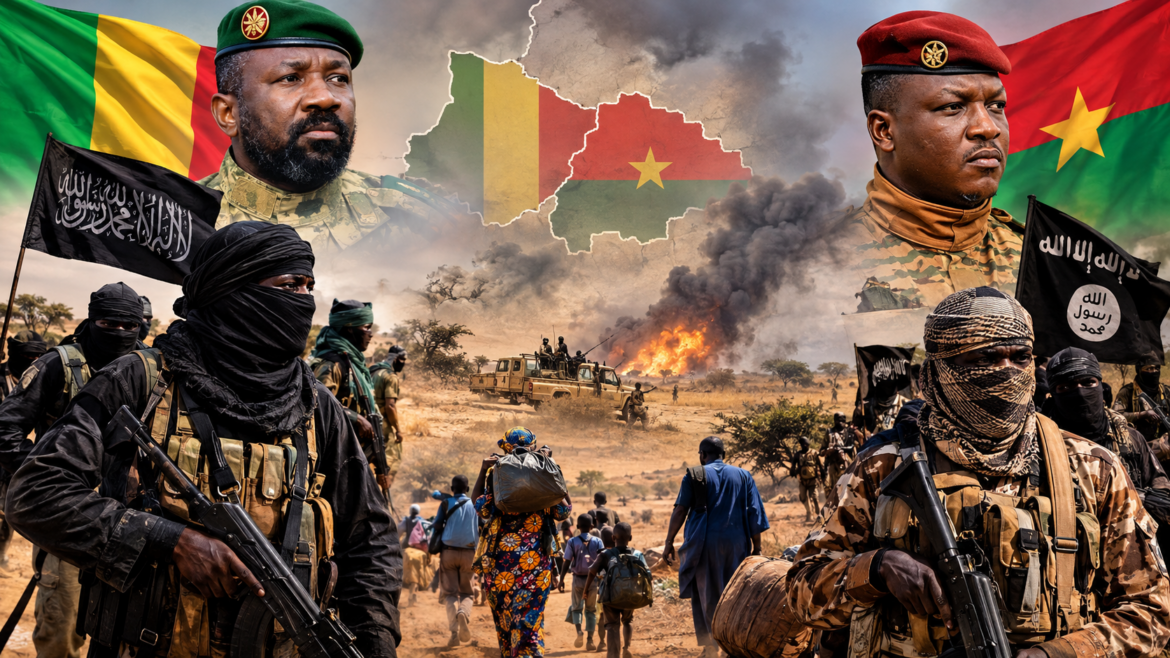
The borderlands between Mali and Burkina Faso have emerged as one of the most volatile arenas of armed conflict in the Sahel. Recent clashes between fighters from the Group for the Support of Islam and Muslims (JNIM), an Al-Qaeda affiliate, and the Islamic State in the Sahel (EIS) underscore the deepening security crisis in this region, where militant factions vie for dominance over land, supply routes, and civilian populations.
Why these clashes reveal deeper systemic failures
At first glance, the fighting appears to be another episode in the broader jihadist insurgency gripping the Sahel. However, the sustained intensity and frequency of these confrontations suggest a more troubling dynamic: the militaries of Mali and Burkina Faso, despite their stated commitment to regaining control, are struggling to assert sovereignty over critical territories along their shared frontier.
The hollow promises of military governance
Both countries have experienced coups in recent years, each justified by the need to restore security and reclaim lost regions from armed groups. Yet, after years under military rule in Mali and Burkina Faso, the threat posed by jihadist organizations remains undiminished. Civilian populations in border communities continue to suffer displacement, economic disruption, and persistent insecurity, raising serious questions about the effectiveness of counterterrorism strategies.
The ongoing battles between JNIM and EIS are not isolated skirmishes. They represent a deliberate expansion strategy by both factions, aiming to extend their operational zones and solidify control over strategic corridors. As these groups enforce their own rules of governance collecting taxes, administering justice, and imposing social restrictions they simultaneously undermine the legitimacy of state institutions that have failed to provide basic security.
The failure to secure territorial sovereignty
For military regimes positioning themselves as defenders of national sovereignty, the inability to curb jihadist influence along the Mali-Burkina Faso border is a glaring failure. Statements from leaders such as Mali’s interim President Assimi Goïta and Burkina Faso’s Captain Ibrahim Traoré emphasize efforts to combat terrorism, yet the reality on the ground contradicts these assurances. Violent clashes persist, suggesting that military posturing alone cannot substitute for effective governance and sustained security operations.
Beyond military campaigns: the multifaceted challenge of counterterrorism
The persistence of jihadist violence cannot be attributed solely to military shortcomings. Countering these groups requires more than troop deployments or aerial bombardments; it demands intelligence-sharing, civilian protection, administrative presence, and economic resilience in affected regions. The Sahel’s border communities, often neglected by central governments, become breeding grounds for radicalization when basic services and security are absent.
Moreover, the rivalry between JNIM and EIS diverts resources and attention away from state-led initiatives aimed at stabilizing the region. As these factions battle for territorial control, they further destabilize an already fragile environment, making reconstruction and recovery efforts nearly impossible.
What lies ahead for Mali and Burkina Faso?
The crisis unfolding at the Mali-Burkina Faso frontier transcends the immediate conflict between two armed factions. It reflects a broader inability of Sahelian states to address the root causes of insurgency: weak governance, porous borders, and the absence of inclusive development. Until these structural issues are addressed, the promise of peace will remain elusive for millions of civilians caught in the crossfire.
The question now facing both countries is not just how to contain the current wave of violence, but how to rebuild trust between state institutions and communities that have long felt abandoned. Without meaningful progress on both fronts, the future of the Sahel’s border regions and the credibility of its military governments will continue to hang in the balance.
By Pierre Tchuente — Journalist