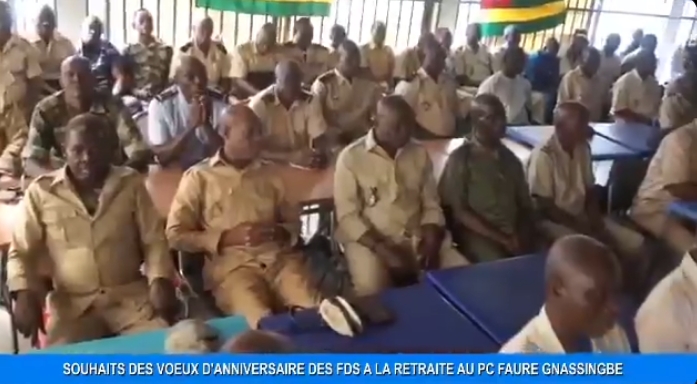
Togo’s increasingly polarized political landscape has seen recent statements, reportedly from groups identified as loyalist militias or paramilitary elements, provoke strong reactions across civil society and the Togolese opposition. Individuals featured in recordings and online discussions have declared their unwavering commitment to «defend the power of the Gnassingbé family until death,» even in the face of significant popular dissent.
Such pronouncements, which appear to disregard the republican duty of neutrality, have reignited discussions concerning the safeguarding of the political sphere and the true character of the current regime’s support structures.
Unconditional loyalty beyond republican norms
The rhetoric employed by these groups signals a clear departure from state neutrality. By explicitly tying their security commitment to the political survival of a presidential dynasty, rather than to the Constitution or republican institutions, these actors are positioning themselves as a “praetorian guard.”
Their public declaration, «If the people no longer want them, we will fight to the very end,» serves as a stark warning.
This recurring phrase in the groups’ pronouncements is widely interpreted as an attempt to intimidate those segments of the population aspiring for change. It also raises critical questions about the potential existence of parallel armed structures or radicalized factions operating within the informal security apparatus.
Civil society and opposition react
Human rights organizations and opposition leaders assert that these statements must be taken seriously. They evoke memories of Togo’s tumultuous past political crises, frequently characterized by political violence.
- Threat to democratic process: The opposition believes these discourses aim to foster a climate of terror, intending to deter any peaceful popular mobilization.
- Call for state accountability: Various advocacy groups are urging public authorities and the official military command to clarify their stance on these elements and to unequivocally condemn such verbal excesses.
The imperative of defense force neutrality
In political analysis, it is crucial to differentiate between official state structures and the zealous actions of pressure groups or private militias. Historically in Togo, the regular army has frequently served as a cornerstone of political power. Nevertheless, the public emergence of groups claiming to act as an “ultimate shield” outside official channels could signify an attempt to privatize legitimate state violence.
To date, official authorities have refrained from making direct comments on these particular statements. Their current approach emphasizes institutional stability and national security in the face of regional threats.
As Togo navigates a complex post-constitutional landscape, the handling of these ultra-loyalist declarations will serve as a crucial indicator of whether the Lomé government intends to foster peaceful political dialogue or lean towards a confrontational strategy.
You may also like
Can OL Lyonnes still top the group after Chelsea stalemate?
Can Togo’s mediation still deliver peace in eastern DRC after Tshisekedi’s latest letter to Gnassingbé?
Mali: did the JNIM ambush on Africa Corps near Niono expose a fatal gap in Russia’s Sahel strategy?
Will Mali’s 73.6 million dollar funding gap decide the fate of millions by 2027?
Niger’s jailing of lawyer Abdourahamane Lirwana: is free speech now a crime in the country?