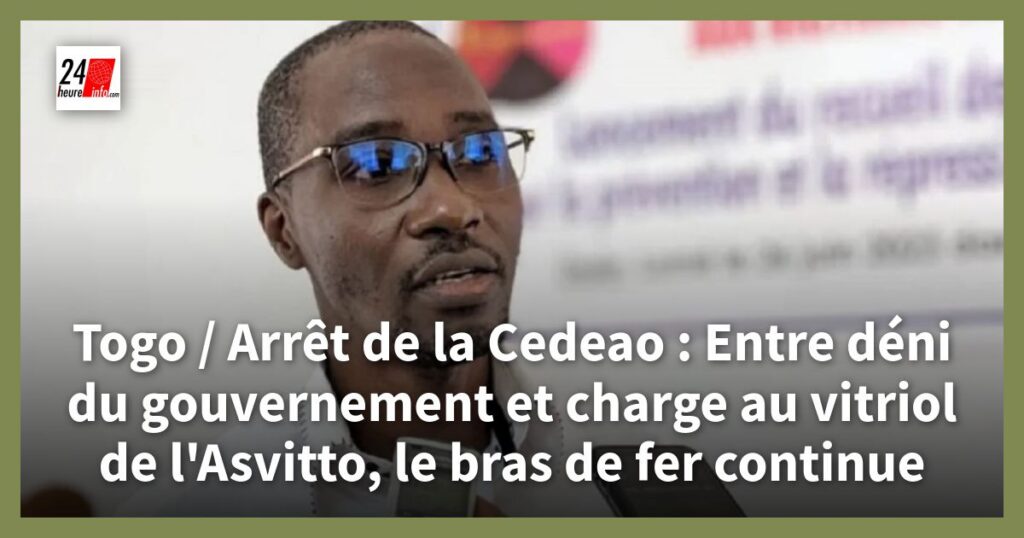
The recent CEDEAO court ruling on constitutional changes in Togo has sparked intense debate in Lomé. While the government dismisses the decision outright, the ASVITTO (Association of Victims of Torture in Togo) has launched a scathing attack, accusing authorities of state-sanctioned criminality.
Government rejects jurisdiction of regional court
Lomé’s response to the ruling was swift and legalistic. Authorities argued that the CEDEAO Court of Justice lacks the power to review national constitutional matters or judge sovereign decisions. This stance effectively seeks to nullify the court’s verdict within Togo’s legal framework.
Civil society fires back with sharp criticism
The government’s rebuttal has failed to sway civil society groups. ASVITTO, in a public statement, dismissed the rebuttal as a futile attempt to evade accountability, warning that those behind what it calls a constitutional coup are “trapped in their own desperation.”
The organization condemned the administration’s pattern of ignoring regional court rulings, stating:
“What remains unchanging is their long-standing habit of disregarding and disrespecting CEDEAO decisions.”
ASVITTO also highlighted the plight of political prisoners still held in Lomé’s jails, despite repeated regional calls for their immediate release.
Call for CEDEAO intervention against state lawlessness
Undeterred, ASVITTO has taken its fight to the regional body itself. The group has urged CEDEAO to take decisive action to enforce its January 2026 ruling (ECW/CCJ/JUD/01/26), which declared Togo’s 2024 constitutional amendment in violation of the African Charter on Democracy, Elections, and Governance.
In a bold statement, the NGO declared:
“This form of state criminality must be stopped across the region.”
Political deadlock leaves prisoners in limbo
The standoff shows no signs of resolution. On one side, the government clings to its legal defense; on the other, civil society demands respect for international obligations. Meanwhile, the detainees remain in legal purgatory, their fate hanging in the balance as rhetoric replaces action.
You may also like
Mali prison overcrowding: Bamako jail holds 10,000 in space built for 600 as mass arrests surge
World Bank brings education, jobs and entrepreneurship open days to Abidjan on 21-22 September 2026
At Tougan, Burkina Faso’s maize farmers sell at a loss and face debts as food sovereignty falters
Niger’s FPL opens its ranks to youth as security crisis deepens
Kidal: 43 dead as strikes wipe out desert water wells in northern Mali