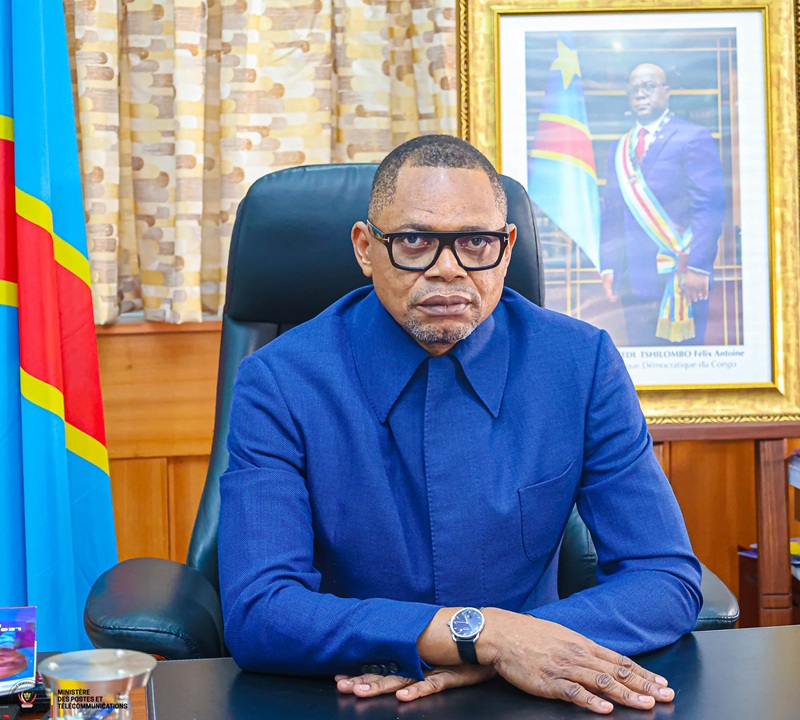
How José Mpanda reshaped the Congo’s postal and telecom sector in one year
Exactly one year after his appointment as Minister of Posts, Telecommunications and New Information and Communication Technologies (PTNTIC) under the Suminwa II government, Me José Mpanda Kabangu has delivered transformative changes to the sector. His strategic interventions have not only restored the Democratic Republic of the Congo’s (DRC) standing in global telecom governance bodies but also revitalized national infrastructure and operational frameworks.
The international comeback: Restoring Congo’s voice in global telecom forums
Upon taking office, Me Mpanda identified critical priorities: reintegrating the DRC into international postal and telecommunications governance bodies, modernizing administrative structures, and fostering a conducive business climate for telecom operators. His first major achievement came within weeks.
A month and a week after his appointment, the DRC regained its voting rights and speaking privileges at the Universal Postal Union (UPU), lost over three decades ago due to unpaid dues. Through direct advocacy with the President and government leadership, Me Mpanda facilitated the clearance of accumulated arrears, restoring the country’s full membership status.
The second international milestone was even more historic: the return of the African Telecommunications Union (ATU) headquarters from Nairobi, Kenya, to Kinshasa. After 34 years of exile following the 1992 Kinshasa unrest, the ATU’s relocation was officially approved during the 7th Plenipotentiary Conference in Abuja, Nigeria, on July 23, 2026. The new Secretary-General, Mr. Kezias Kazuba Mwale of Zambia, will assume office in Kinshasa in January 2027.
This move is unprecedented: in 34 years, 17 ministers had led the PTNTIC portfolio without achieving this goal. Me Mpanda not only cleared over $1.4 million USD in arrears and penalties but also secured an automatic seat on the ATU’s Governing Council, enhancing the DRC’s strategic influence in African telecom policy.
Looking ahead, Me Mpanda is setting his sights on another major objective: securing a seat on the International Telecommunication Union (ITU) Governing Council for the 2027–2030 term. He will officially submit the DRC’s candidacy in November 2026 during the ITU Plenipotentiary Conference in Doha, Qatar.
The ITU is the UN’s specialized agency for ICT policy, spectrum management, satellite regulation, and broadband standards. Its decisions shape global connectivity frameworks. Me Mpanda’s push aligns with President Félix-Antoine Tshisekedi’s vision: transforming the DRC into a connected, technology-driven economy by 2030 and positioning it as Central Africa’s tech hub.
Securing a seat on the ITU Governing Council would unlock access to approximately $1.5 billion USD in funding for 2026–2030, earmarked for critical telecom infrastructure projects, including the national fiber-optic backbone, rural connectivity expansion, data centers, satellite networks, and ultra-high-speed broadband deployment.
Revitalizing the national telecom sector: A new era for PTNTIC
On the domestic front, Me Mpanda has overhauled administrative and operational conditions within the PTNTIC. Within 144 days of assuming office, he delivered a fleet of 10 brand-new vehicles—including three large buses and several jeeps—for the Secretariat General of PTNTIC. This fleet renewal, the first in decades, was hailed by staff, including long-serving civil servants, as a long-overdue upgrade.
He also introduced a revised salary grid, approved a rehabilitation plan for the PTNTIC headquarters building, and restructured the administration’s organizational framework. Furthermore, transparent performance-based promotions were implemented across all levels of the administration, rewarding merit and seniority.
In a decisive move to stabilize the telecom sector, Me Mpanda addressed long-standing legal and judicial uncertainties faced by operators. He issued an official order converting operating licenses for major telecom companies—Airtel, Vodacom, Orange, and Africell—into definitive titles, eliminating legal ambiguities that had hindered investment and service quality.
Additionally, he reduced the 10-year moratorium on Congolese ownership in telecom companies—mandated under Article 40 of the Telecommunications Law—by half, with retroactive effect. This change enables Congolese citizens to hold up to 25% equity in telecom firms and empowers employees to own up to 5% of their companies’ shares, fostering broader economic participation.
Connecting the Congo: Ambitious infrastructure plans to close the digital divide
Me Mpanda’s strategic vision is anchored in large-scale infrastructure development. Drawing from recommendations of the National Post and Telecommunications General Conference, held in April 2026, his administration is spearheading efforts to modernize the country’s digital backbone.
Key initiatives include:
- Fiber-optic expansion: Laying at least 54,000 kilometers of fiber-optic cable to connect all 145 territories, reduce the digital divide, and support the 2030 digitalization agenda.
- Rural connectivity: Constructing at least 30,000 new cell towers or antennas, prioritizing underserved and rural areas.
- Satellite sovereignty: Negotiating with China Unicom for the deployment of a sovereign communications satellite, crucial for national security and universal coverage.
Implementation is already underway. The Digital Transformation Program (PTN), supported by the World Bank and Agence Française de Développement, is financing 10,000 kilometers of fiber-optic cable. Meanwhile, the Universal Service Development Fund (FDSU)—a PTNTIC agency—is funding tower construction using internal resources. Kimbanguist City in Kongo Central has been selected as the pilot zone for the first phase, targeting 3,000 towers.
On August 8, 2026, the FDSU signed grant agreements with the four major mobile operators, each committing to build at least 10 antennas in peri-urban and rural zones. This public-private partnership model accelerates rural connectivity while ensuring equitable service access.
A vision realized: The DRC’s path to digital leadership
Me José Mpanda Kabangu’s first year in office has been marked by bold reforms, restored international credibility, and concrete progress toward national digitalization. His leadership reflects a clear alignment with President Tshisekedi’s ambition: a connected, competitive, and inclusive DRC by 2030.
By reclaiming Congo’s voice in the UPU, securing the return of the ATU headquarters, and pursuing a seat on the ITU Governing Council, he has positioned the DRC as a key player in African and global telecom governance.
Nationally, his focus on infrastructure, administrative modernization, and sector reform is laying the groundwork for economic transformation. With fiber, towers, and satellite networks in development—and international backing secured—the foundation for a digital Congo is being built today.
As the second anniversary of the Suminwa II government approaches, Me Mpanda’s achievements stand as a testament to what strategic leadership and decisive action can accomplish in reshaping a nation’s digital future.
You may also like
As donor fatigue spreads, can Benin’s €544,042 UNAIDS pledge keep the HIV response on track?
Who pays the price when Burkina Faso’s public payroll contracts? Households weigh the cost of 1,917 fewer agents
Libya pushes for direct Tripoli-Yaoundé flights as Cameroon sets up working groups
JNIM seizes three Burkinabè positions in a single day as Traoré’s security record faces hard questions
Chad condemns Ennedi-East airstrikes at un general assembly, warns of retaliation