
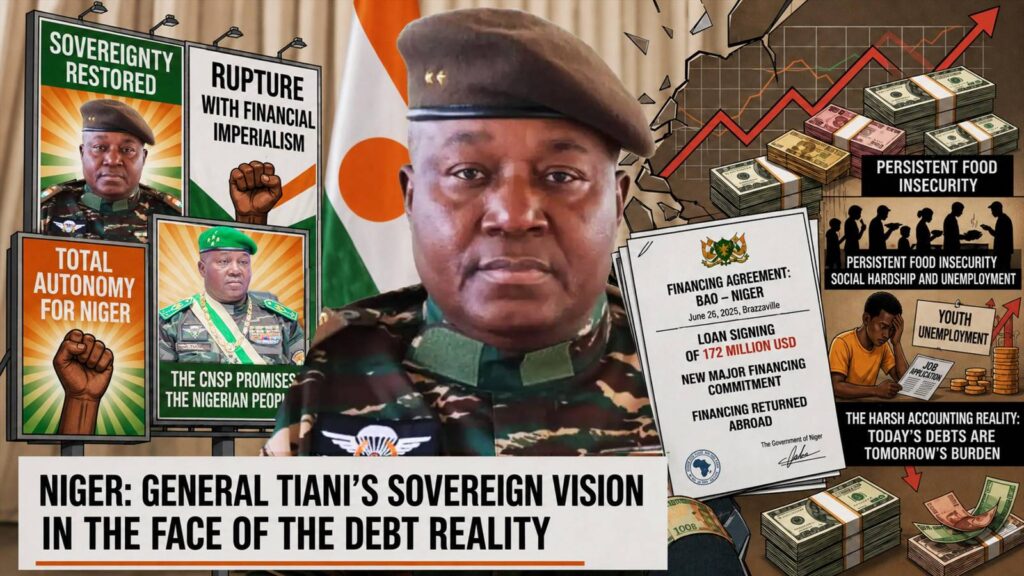
Amidst a backdrop of spirited declarations advocating for “reclaimed sovereignty” and a definitive break from international financial institutions, Niamey now faces the harsh realities of economic constraint. The National Council for the Safeguarding of the Homeland (CNSP), led by General Abdourahamane Tiani, persists in its rhetoric of total autonomy and imminent prosperity for the Nigerien people. Yet, the tangible actions of the regime starkly contradict these claims. Confronted with escalating social distress and an inability to meet basic societal needs, the military administration has reverted to external borrowing to sustain the nation’s ailing economy.
A stark departure from revolutionary promises
The latest instance of this paradox unfolded beyond Niger’s borders, underscoring what many now perceive as a dual discourse emanating from the seat of power in Niamey.
Facts speak louder than rhetoric
On May 26, 2026, during the African Development Bank Group’s annual meetings in Brazzaville, Niger quietly formalized a substantial financial commitment. An agreement was executed between Sidi Ould Tah, representing the financial institution, and Maman Laouali Abdou Rafa, acting on behalf of Niger, securing a funding package amounting to $172 million USD.
The stated objectives of this accord include bolstering youth entrepreneurship in agriculture, modernizing the sector through technological and financial innovation, and fostering new value chains in response to mounting food and climate pressures.
However, the stark contrast between these official declarations and the lived experiences of Nigerien citizens cannot be ignored. How can the promise of a sovereign transition be reconciled with the continued reliance on traditional aid and credit mechanisms? For an increasing segment of public opinion and regional analysts, the answer is unequivocal: the sovereignist transition discourse increasingly resembles a political facade concealing an economic management in crisis.
The chasm between propaganda and reality
On the ground, the disconnect between official propaganda and the daily struggles of Nigeriens is glaring:
- Enduring food insecurity: Despite bold claims of self-sufficiency, household resilience continues to erode under the weight of inflation and supply chain disruptions.
- Social impasse: The much-anticipated economic opportunities for the youth remain elusive, leaving a generation marred by unemployment as the primary victim.
- Relapse into borrowing: The necessity to secure multi-million dollar loans underscores that the state’s coffers are insufficient to finance developmental ambitions through domestic resources alone.
“We are constantly reminded of dignity and the end of dependency, yet the documents signed abroad reveal that the regime cannot survive without the financial support of others,” remarks an economist based in the subregion, who requested anonymity.
A forced pragmatism or an admission of failure?
The acceptance of the $172 million USD funding package implicitly acknowledges the military administration’s inability to independently address the climate and food emergencies gripping the nation. While agricultural development and financial inclusion for youth are undeniably critical priorities for Niger, the reliance on external borrowing under General Tiani’s leadership lays bare the structural limitations of a governance approach isolated on the diplomatic and regional fronts.
For citizens, the urgency has shifted from lofty declarations to the immediate concerns of filling empty plates and stretching meager budgets. As authorities in Niamey attempt to frame each agreement as a triumph, the fiscal reality serves as a sobering reminder that today’s debts are tomorrow’s burdens—a far cry from the illusion of total economic independence once promised.
You may also like
Gabon’s economic management hindered by unreliable public data
Niger: General Tiani faces growing unease within special forces after Russian involvement
Crise au Niger, accord FMI-Sénégal, bataille électorale au Maroc… Les 5 infos qu’il ne fallait pas manquer
Mali : 17 morts dans les rangs des dozos, le JNIM accentue sa pression
Le Maroc, « partenaire stratégique important » de l’UE sur la migration