
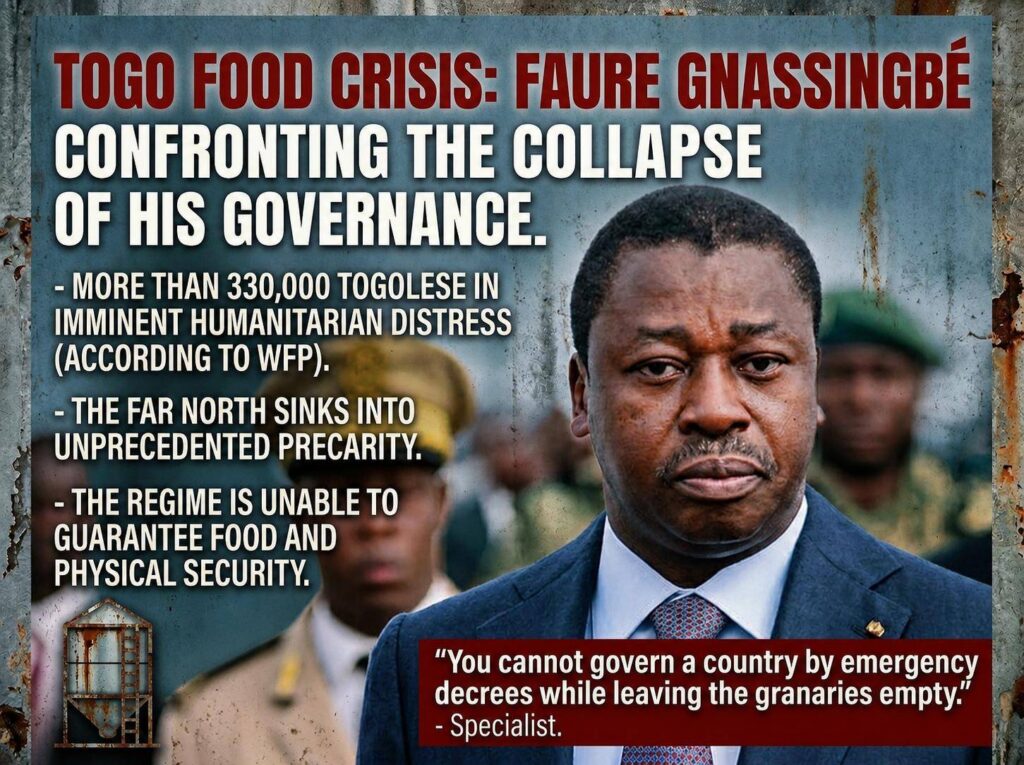
Humanitarian distress deepens in Togo’s northern savannas
The United Nations World Food Programme has issued a stark warning regarding an impending humanitarian catastrophe in Togo, with the extreme northern region of Savanes facing an unprecedented food security crisis. Observers point to systemic governance failures under President Faure Gnassingbé’s administration, which has proven unable to ensure either physical or nutritional security for its citizens.
UN projections reveal alarming scale of hunger
According to the latest assessments by the World Food Programme, over 330,000 people in Togo are at imminent risk of acute food insecurity within the next three months unless urgent intervention is undertaken. These figures, though stark, only begin to capture the human toll of a crisis exacerbated by decades of policy neglect and structural fragility in the region.
A region trapped between insecurity and economic collapse
The Savanes region, Togo’s northernmost administrative area, has long been vulnerable to climatic shocks and chronic underdevelopment. Today, it grapples with compounded crises: a burgeoning terrorism threat, prolonged emergency measures that have stifled local trade, and the destabilizing influx of tens of thousands of refugees from neighboring Burkina Faso. These pressures have crippled cross-border commerce, displaced rural communities, and drained already scarce food reserves—particularly at the onset of the lean season.
Government response falls critically short
Analysts argue that the current emergency is not an inevitable disaster but the result of deliberate policy failures. Despite repeated government pledges to bolster agricultural resilience, half of the households in northern Togo cannot afford even a basic nutritious diet. The administration’s reliance on international aid agencies for survival, rather than implementing effective domestic solutions, highlights a fundamental abdication of sovereign responsibility.
Key shortcomings include the absence of adequate food storage infrastructure, the inability to stabilize staple prices, and the militarized, yet ineffective, approach to managing the northern crisis. “A nation cannot be governed by emergency decrees while leaving granaries empty,” noted a senior West African public policy expert. “What we are witnessing in the North is the direct consequence of economic abandonment coupled with a security impasse.”
The hour for decisive action is now
As the window for averting a full-scale humanitarian disaster narrows, the Togolese government faces an urgent reckoning. While international appeals for emergency funding underscore the gravity of the situation, they also raise a critical question: how long can Togo sustain its inability to deliver public goods by relying on global charity?
For the 330,000 Togolese on the brink of starvation, the era of rhetoric has ended. Survival itself is now at stake in a region that bears the full weight of presidential inaction and strategic missteps.
You may also like
Gabon’s economic management hindered by unreliable public data
Niger: General Tiani faces growing unease within special forces after Russian involvement
Crise au Niger, accord FMI-Sénégal, bataille électorale au Maroc… Les 5 infos qu’il ne fallait pas manquer
Mali : 17 morts dans les rangs des dozos, le JNIM accentue sa pression
Le Maroc, « partenaire stratégique important » de l’UE sur la migration