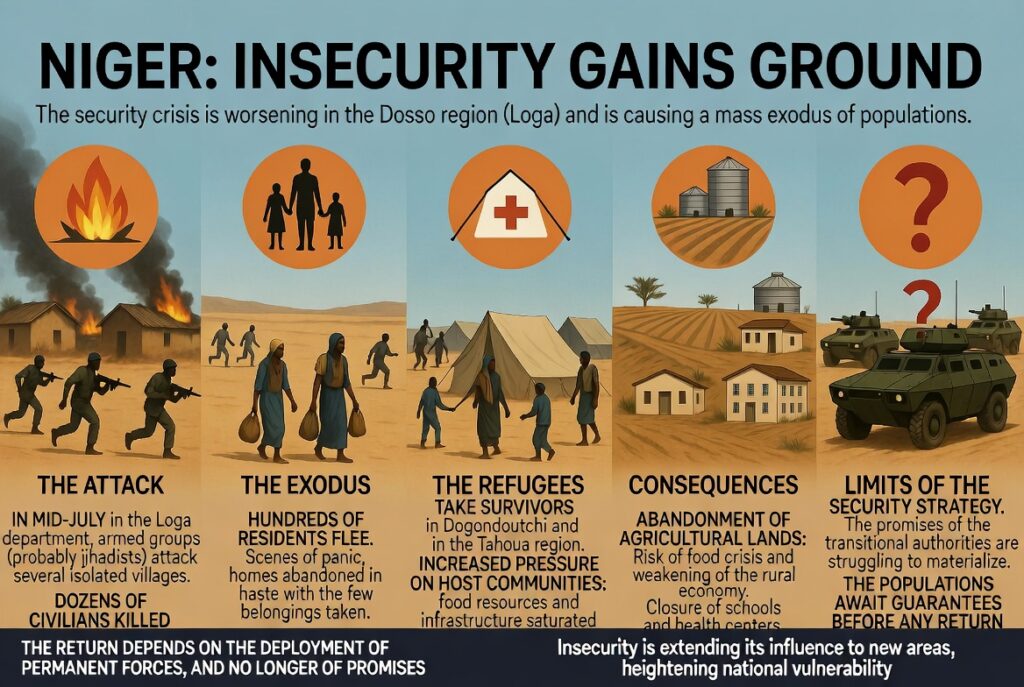
The escalating violence in the Loga area of Niger’s Dosso region has forced hundreds of residents to flee their homes in mid-July, marking another tragic chapter in the country’s deepening security crisis. Despite assurances from military leaders, these relentless attacks have left villages increasingly vulnerable, with civilians paying the highest price.
Witness accounts from the region confirm that jihadist factions orchestrated the raids, inflicting civilian casualties and exacerbating instability. The attackers targeted isolated settlements, exploiting gaps in security measures to instill fear among the population. Survivors recount harrowing scenes of families fleeing in haste, leaving behind homes and possessions, while entire communities descend into chaos.
Those displaced have sought refuge in Dogondoutchi and surrounding areas of Tahoua, hoping to find greater safety. However, their arrival places additional strain on host communities already grappling with economic hardship, limited social services, and food shortages.
The recent displacement crisis lays bare critical flaws in Niger’s security strategy. Since the political transition, authorities have prioritized restoring stability, yet attacks continue unabated in both border regions and inland areas. This persistence raises serious questions about the effectiveness of military operations and troop redeployments.
The human cost of insecurity
The growing number of internally displaced persons signals a troubling shift in the conflict’s trajectory. When families abandon their land, livelihoods, and homes, it reflects a profound erosion of trust in the state’s ability to protect its citizens. For these communities, returning home is no longer simply a matter of ceasefire it demands concrete security guarantees.
Nigerien officials have pledged to reinforce military presence in the region to facilitate the return of displaced persons. Yet skepticism runs deep among residents. Many insist they will only return when security forces are permanently stationed to prevent future attacks. For them, past promises have done little to halt the recurring violence.
Economic and social ripple effects
The crisis extends far beyond immediate safety concerns. Abandoned farmlands threaten food supplies, exacerbate food insecurity, and weaken rural economies already battered by years of conflict. Schools close, health centers struggle to function, and local markets fray, leaving populations increasingly exposed.
Humanitarian needs at crisis levels
Humanitarian needs are reaching critical thresholds. Displaced families urgently require food, clean water, medical care, and dignified shelter. Aid organizations warn that resources are dangerously stretched as the number of internally displaced persons continues to climb across Niger.
The latest surge in violence also reveals an alarming trend: the conflict is no longer confined to traditional hotspots. The expansion of attacks into new areas raises concerns about armed groups’ enhanced capabilities and their ability to exploit security gaps.
For the people of Loga, the path forward is clear: basic safety must be restored before any consideration of returning home. Until that happens, the exodus may persist, deepening the human, economic, and social toll of a security crisis that shows no signs of easing.
You may also like
As donor fatigue spreads, can Benin’s €544,042 UNAIDS pledge keep the HIV response on track?
Who pays the price when Burkina Faso’s public payroll contracts? Households weigh the cost of 1,917 fewer agents
Libya pushes for direct Tripoli-Yaoundé flights as Cameroon sets up working groups
JNIM seizes three Burkinabè positions in a single day as Traoré’s security record faces hard questions
Chad condemns Ennedi-East airstrikes at un general assembly, warns of retaliation