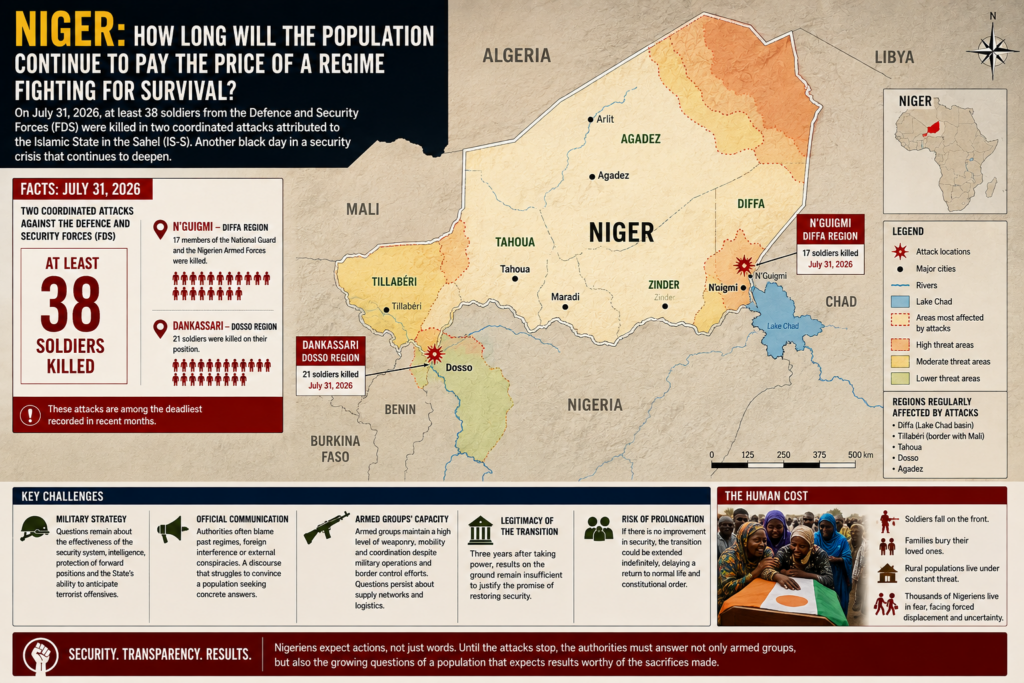
August 2026 marked another devastating chapter in Niger’s ongoing security crisis, as coordinated assaults by the Islamic State in the Sahel (IS-Sahel) claimed the lives of at least 38 soldiers from the country’s defense and security forces.
The first attack, in N’Guigmi, located in the Diffa region, resulted in the deaths of 17 members of the National Guard and Nigerien Armed Forces. Hours later, another assault in Dankassari, within the Dosso region, left 21 military personnel dead at their posts. These coordinated strikes rank among the deadliest in recent memory, underscoring a grim reality: the terrorist threat continues to expand while human losses mount.
Military transition’s security promises under scrutiny
When General Abdourahamane Tiani assumed leadership, the justification for the military takeover hinged on a single, urgent mission: reversing the country’s worsening security situation. The stated goal was clear—restore stability, reclaim territorial control, and safeguard civilians. Yet three years into the transition, the outcomes remain deeply uneven.
Attacks persist across critical zones, from the Lake Chad basin to the Tillabéri, Tahoua, and Dosso regions. Armed groups continue to execute well-planned operations against military outposts, despite repeated official announcements of force restructuring. This pattern raises a pressing question: Are the transition’s declared objectives translating into tangible results on the ground?
Human losses challenge the state’s defensive strategy
Each deadly assault carries implications far beyond its immediate death toll. It exposes vulnerabilities in military intelligence, the robustness of defensive positions, and the state’s ability to preempt terrorist offensives. As attacks escalate, public skepticism grows regarding the efficacy of the current security approach.
Questions arise over the allocation of resources. Are efforts to consolidate political control diverting attention and means from the urgent demands of the battlefield? For a transition founded on security promises, sustained failure to deliver tangible protection risks eroding public trust.
Government narratives fail to quell public doubt
Following each attack, officials frequently point to inherited challenges from past administrations, foreign interference, or external geopolitical pressures. While such factors may contribute to instability, they offer little comfort to grieving families or communities living under constant threat.
What citizens demand are concrete answers: operational shortcomings, corrective measures, and tangible steps to prevent future tragedies. Without visible progress, official rhetoric risks losing credibility, further fraying the bond between state and society.
A conflict that refuses to stall
One of the most alarming aspects of this crisis is the sustained operational capacity of armed groups. Despite military operations and border control efforts, these organizations continue to launch large-scale attacks. This persistence fuels concerns about the effectiveness of measures targeting arms supply chains, terrorist logistics networks, and intelligence gathering.
Without transparent public reporting, misinformation spreads, deepening the divide between citizens and state institutions.
The transition’s defining test
The military’s legitimacy rests entirely on its ability to restore security. Yet, as attacks multiply, the gap between promise and reality widens. Each new assault pushes the prospect of normalcy further out of reach, destabilizes local communities, and delays any realistic return to constitutional order.
Observers increasingly question whether the absence of security improvements could prolong the transition itself. This debate hinges on three critical demands: greater transparency, measurable results, and a credible roadmap for crisis resolution.
The unrelenting human cost
Amid political debates, one truth remains immutable: it is soldiers who fall in combat, families who mourn their dead, and rural communities who endure perpetual fear. Thousands of Nigeriens live daily with displacement, uncertainty, and the shadow of violence.
The transition’s founding pledge was security. Today, that pledge remains its most severe test. Until attacks subside, authorities must answer not only to armed groups but to a population that expects results equal to the sacrifices made.
You may also like
Benin’s rating leap to AA-: the moment regional capital started taking Cotonou seriously
Brigitte Tchede’s Cairo surge: Benin’s discus medal breakthrough that changes everything
Burkina Faso’s armored vehicles: the moment of truth arrives on the battlefield
Togo presses pause on press freedom as a reporter’s sidelining marks a decisive shift
Benin-Rwanda breakthrough: Wadagni’s Kigali mission redefines strategic partnership