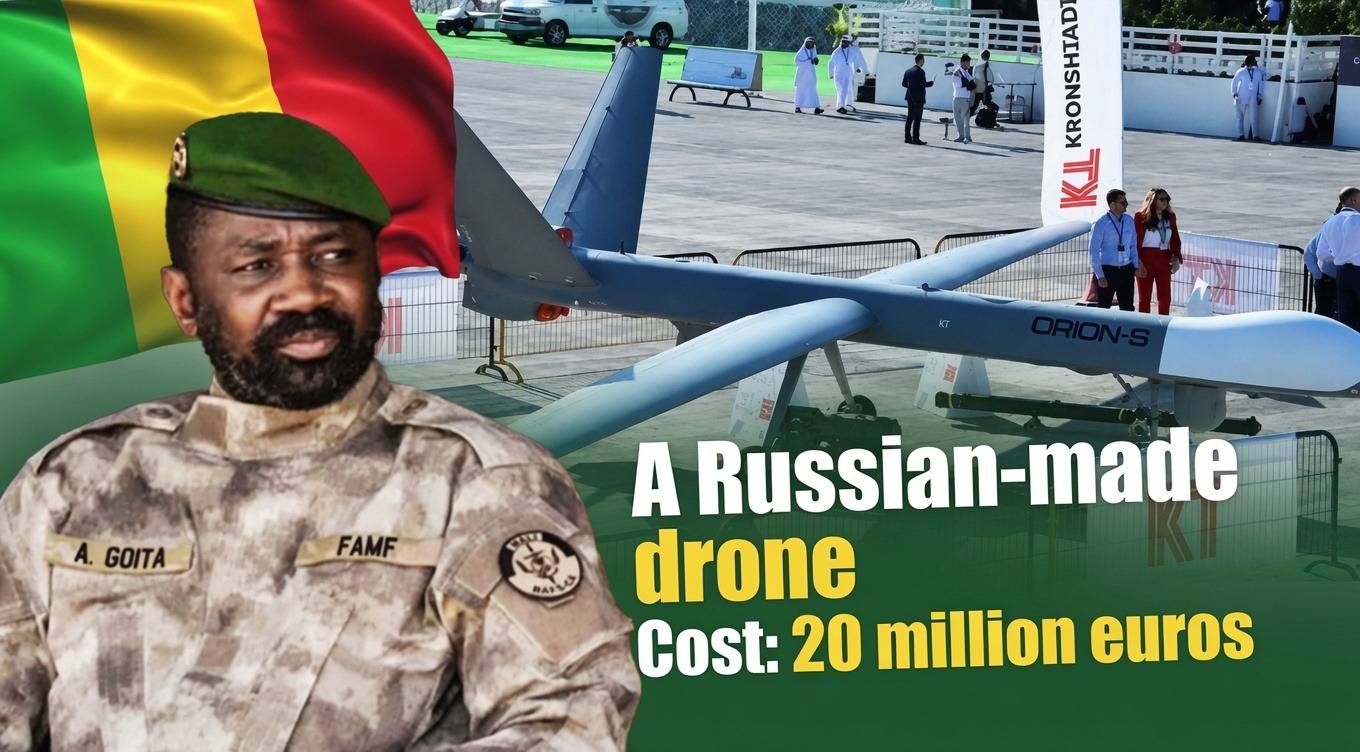
The Malian Armed Forces (FAMa) have recently taken delivery of a Russian-made Orion drone, marking a new chapter in the country’s aerial capabilities. Designed for both reconnaissance and precision strikes, this Medium Altitude Long Endurance (MALE) drone is being hailed by authorities as a game-changer in the fight against armed groups. Yet, behind the optimism lies a harsh reality: its high cost, technical limitations, and strategic mismatches raise serious concerns about its actual effectiveness.
Strengthening ties with Moscow, but at what cost?
The arrival of the Orion drone in Bamako underscores the deepening military partnership between Mali and Russia. This acquisition is the latest in a series of defense agreements aimed at bolstering the FAMa’s firepower. Proponents argue that the drone enhances surveillance over Mali’s vast and often lawless territories, particularly in the northern and central regions. However, critics warn that such an investment may prioritize political symbolism over practical military needs.
The acoustic Achilles’ heel: why noise is a liability in asymmetric warfare
Mali’s conflict is defined by its asymmetric nature—mobile, dispersed, and adaptive armed groups pose the greatest threat. The Orion drone, however, suffers from a critical flaw: it is loud. Its high acoustic signature makes it easily detectable long before it reaches its target, giving enemy fighters ample time to evade or camouflage themselves. This vulnerability is exacerbated by the growing anti-aircraft capabilities of militant factions, which have demonstrated their ability to threaten low- and mid-altitude aircraft.
In a conflict where stealth and speed are paramount, the Orion’s visibility makes it a prime target. The risk of losing this single, high-value asset to MANPADS or concentrated fire is alarmingly high, rendering its combat utility questionable.
A €20 million gamble: is the Orion a waste of resources?
The financial outlay for the Orion drone—nearly €20 million—has sparked intense debate. In a country grappling with severe budget constraints and pressing social needs, such an expenditure is hard to justify. Analysts argue that the same funds could have equipped the FAMa with a fleet of smaller, quieter, and more deployable tactical drones, each better suited to the demands of asymmetric warfare. By opting for a single, high-profile acquisition, Bamako may have prioritized optics over operational efficiency.
The drone’s sticker price is only the beginning. The true cost of operating the Orion includes an array of hidden expenses: state-of-the-art ground control stations, climate-controlled hangars to shield sensitive electronics from the Sahel’s searing heat, specialized fuel, and imported spare parts. Even the expertise required to maintain the system is a financial burden, as Malian technicians must rely on expensive Russian contractors for training and support. Without a sustainable funding stream, this €20 million investment risks ending up as little more than a rusting relic in a hangar.
One drone, one sky: the limits of a lone asset
Mali’s vast terrain—stretching from the deserts of Taoudénit to the forests of Kayes—poses a monumental challenge for aerial surveillance. A single drone, no matter how advanced, cannot be everywhere at once. The Orion’s operational ceiling is further constrained by the need for refueling, maintenance, and rest periods. When grounded, entire regions fall into a dangerous blind spot, allowing militant groups to move freely and regroup. The idea of achieving ubiquitous coverage with one aircraft is a mathematical impossibility; the sky cannot be permanently patrolled by a lone machine.
A call for pragmatic solutions in Mali’s security strategy
The delivery of the Orion drone reflects a broader trend of over-equipping Mali’s military with high-visibility assets. Yet, in a conflict defined by unpredictability and mobility, the introduction of a single, cumbersome, and exorbitantly priced drone seems an ill-advised response. What Mali truly needs is not a handful of expensive symbols, but a diverse arsenal of agile, cost-effective, and sustainable tools tailored to asymmetric warfare. Only then can the country hope to secure its territory and protect its people from the ever-evolving threats that plague its lands.