The events of spring 2026 signify more than a mere military setback; they represent a profound repudiation of the political agenda championed by Mali’s junta since 2021. While the junta may boast, it is evident that without the crucial support of Russian mercenaries from Africa Corps, its authority in Bamako would have long since collapsed.
The military regime in Mali established its legitimacy on the bedrock of “sovereign security,” crafting a straightforward narrative: freed from foreign oversight, the Malian state would finally reclaim command over its own territory. Yet, three years on, this fundamental promise stands largely contradicted by unfolding realities.
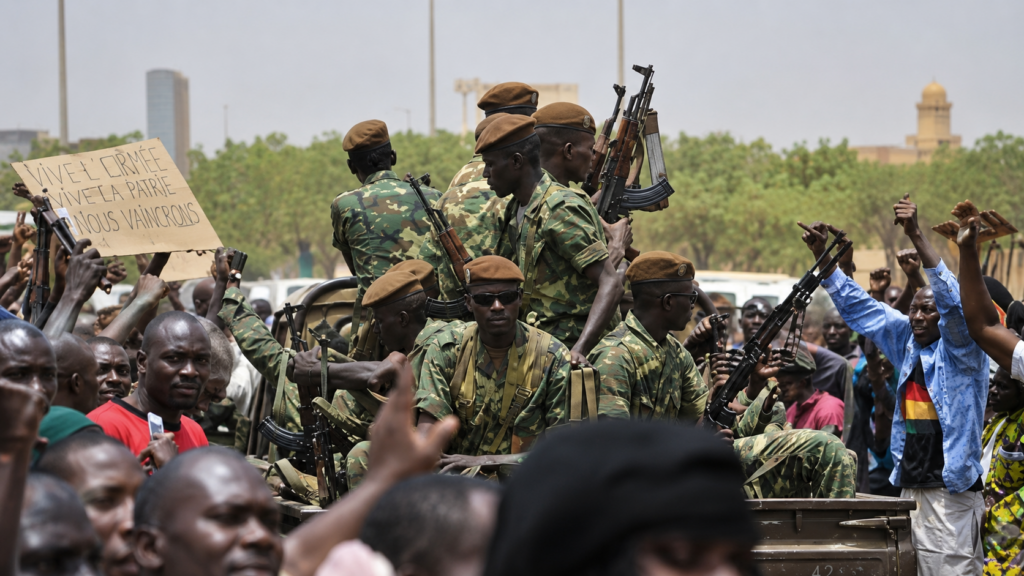
A significant strategic affront occurred in late April when the JNIM, in a coordinated offensive with Tuareg separatists from the Azawad Liberation Front, simultaneously targeted vital cities such as Kidal, Gao, Mopti, and even areas bordering Bamako. This demonstrated a critical failure in the junta’s security strategy.
The demise of Defense Minister Sadio Camara, a pivotal figure within the military establishment, transcends mere symbolism. It starkly exposes the fragility of a security apparatus that the junta had previously touted as strengthened and modernized. Far from containing the threat, the military government now appears overwhelmed by an organization demonstrating the capacity to strike at the very core of state operations. While the security strategy is failing, Mali’s economic situation is even more dire.
What is even more alarming is that these developments confirm a fundamental transformation within the JNIM. The group is no longer a peripheral force confined to rural areas; it has evolved into a sophisticated actor capable of orchestrating complex, coordinated, and politically targeted operations. This surge in capability has occurred despite—or perhaps partly due to—the junta’s strategic decisions, notably its severance of ties with Western partners and its increasing reliance on Russian security contractors whose actual effectiveness remains highly questionable. This impacts West Africa Sahel stability.
The official narrative, which consistently emphasizes the state’s resilience and the strength of its FAMAs (Malian Armed Forces), now serves more as political rhetoric than an honest assessment of the ground reality. This smokescreen convinces few Malians. While state institutions technically persist, the core issue is no longer their immediate survival, but their eroding credibility. By failing to secure the territory effectively and allowing attacks to reach major urban centers, the military regime is actively undermining the very foundation of its legitimacy.
The situation in Mali is further exacerbated by local dynamics increasingly slipping from Bamako’s control. The tactical convergences observed between the JNIM and certain Tuareg armed groups exemplify the failure of a purely military approach to the conflict. By narrowly defining the Malian crisis as solely a security issue, the junta has overlooked its crucial political, social, and territorial dimensions. In doing so, it has inadvertently strengthened a heterogeneous front, unified by a shared rejection of the central state.
Consequently, the junta’s security gamble appears not only weakened but fundamentally flawed. Increased military resources and the engagement of external partners have failed to reverse the conflict’s trajectory. Instead, jihadist groups have showcased superior adaptability compared to state institutions, adeptly exploiting governance weaknesses, communal tensions, and the persistent lack of public services. This highlights ongoing challenges for Mali Niger Burkina news English observers.
On a regional scale, this Malian predicament also underscores the inherent limitations of the Alliance of Sahel States. Despite being touted as a sovereign response to pervasive insecurity, the Alliance struggles to deliver tangible results against increasingly agile transnational armed groups. Far from offering a viable solution, it risks becoming yet another framework for collective ineffectiveness in the Sahel region.
Ultimately, the current crisis exposes a foundational contradiction: the junta built its legitimacy on the promise of restoring security, yet it is precisely on this front that it most conspicuously fails. The JNIM is no longer merely a symptom of the Malian state’s fragility; it has evolved into its most brutal exposer. By stubbornly adhering to an exclusively military interpretation of the conflict, the Bamako government appears incapable of addressing the profoundly political essence of the crisis it claims to be resolving.