On 20 April 2026, General Évariste Ndayishimiye arrived in Ouagadougou for an official visit described as a “friendship and working” trip. The Burundian head of state at the time chaired the African Union (AU).
The diplomatic move aimed to restart dialogue between the continent-wide body and the Alliance of Sahel States (AES). That bloc, bringing together Burkina Faso, Mali and Niger, is currently chaired by Captain Ibrahim Traoré.
This initiative comes amid a context where AES member states have withdrawn from AU institutions. Against this backdrop, the Burundian president visited Burkina Faso, a country run by a junta that came to power through a military coup, to commend efforts to restore security and stabilise the nation — where the leader has publicly stated that democracy is no longer relevant.
Beneath the diplomatic language of “dialogue” and “stability”, does one not detect a form of solidarity between authoritarian regimes that share a rejection of constitutional constraints?
My doctoral research focuses on international sanctions (from the European Union and regional organisations) and authoritarian resilience in fragile states, through a comparative study of Burundi. One chapter looks at other sanctioned countries, notably Mali and Niger. Here I examine the political resources that Mali and Burundi use to withstand external pressure.
A convergence of paths
It is worth recalling that Burundi and the AES states share converging institutional trajectories. Mali, Burkina Faso and Niger were each hit with sanctions from the Economic Community of West African States (ECOWAS) and the European Union after coups in 2020 and 2021 in Mali, 2022 in Burkina Faso, and 2023 in Niger.
Burundi itself faced EU and US sanctions in 2016, after President Pierre Nkurunziza decided to run for a third term deemed unconstitutional. Certain political phenomena precisely demand a cross-regional comparison. This is not about noting superficial similarities; it aims to highlight deep-seated dynamics that operate in convergent ways.
The parallel between Burundi and Mali – two countries thousands of kilometres apart in distinct geopolitical settings – stems from such an approach.
Designating an enemy
In both cases, designating an enemy, whether internal or external, forms a central mechanism of legitimacy and a powerful vector of internal cohesion. This strategy allows for the constant reactivation of the threat according to political circumstances – whether it be a colonial enemy, a regional adversary or a diffuse security threat.
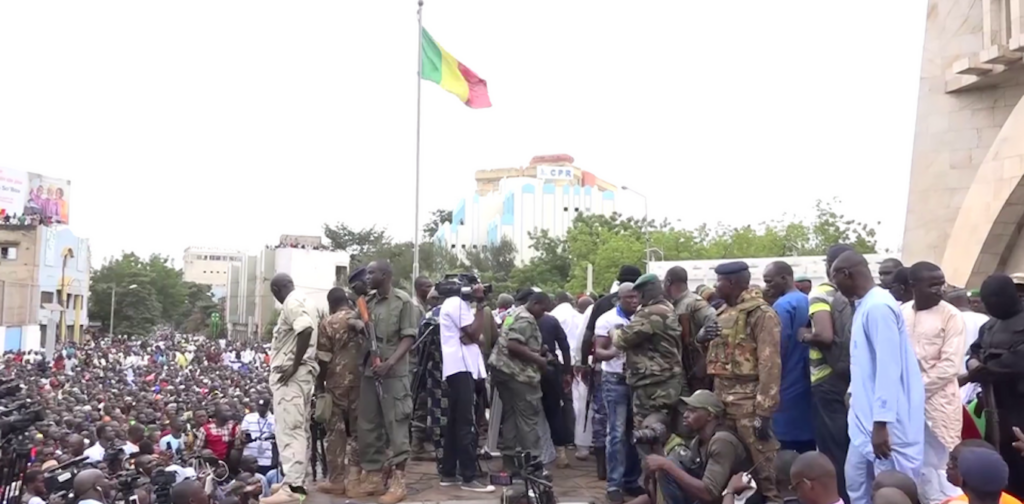
In Mali, this mechanism appeared most intensely in early 2022. Driven by a “rally-round-the-flag” effect – where the population unites behind leaders facing an external or perceived threat – the Malian regime saw its authority strengthened. Now backed by a civilian component in the second version of the transition following the May 2021 putsch, the military enjoyed massive popular support.
Tens of thousands of protesters gathered at Boulevard de l’Indépendance on 14 January 2022 to denounce the economic and diplomatic sanctions imposed by ECOWAS. They chanted hostility toward Paris and the regional body, accusing them of meddling in the country’s affairs. They also demanded a Mali returned to its own citizens, free from external influences.
In Burundi, it is Belgium that draws the anger of supporters of the National Council for the Defence of Democracy – Forces for the Defence of Democracy (CNDD-FDD), the ruling party. Blamed as historically responsible for ethnic divisions in the country, the former colonial power is also accused of complicity with Rwanda in an attempt to destabilise the regime. The Burundian government, led by the CNDD-FDD, portrays Brussels as the instigator of EU economic sanctions – a narrative that allows both regimes to divert international criticism into a story of resistance against the former coloniser.
Choosing a regional adversary
At the regional level, each regime also picks an adversary. In Mali, Algeria is accused of hosting opposition figures such as Imam Mahmoud Dicko and of colluding with terrorist groups active in the country. The Malian junta announced on 25 January 2024 the “immediate end” of the Algiers peace agreement. Mali also closed its airspace to Algeria after Algiers took a similar step in April 2025. In Burundi, it is Paul Kagame’s Rwanda, a Tutsi-led regime, that fills this role.
Described as a “bad neighbour” by President Ndayishimiye, Kigali is accused of sheltering the putschists involved in the 2015 coup attempt. Rwandan authorities are also presented by Burundi as supporters of rebel movements such as RED-Tabara, sometimes linked to other armed groups in the region. This defensive posture led to the closure of land borders with Rwanda in January 2024 as well as active military intervention in eastern DR Congo between August 2022 and December 2025 to support the Armed Forces of the Democratic Republic of the Congo (FARDC), alongside the Wazalendo militias (meaning “patriots” in Kiswahili) and the Democratic Forces for the Liberation of Rwanda (FDLR), against the March 23 Movement (M23) backed by Kigali.
These are all symbolic resources mobilised to maintain a permanent sense of siege – a necessary condition for the political survival of regimes that use external threat as their main fuel.
The security contradiction
A contradiction emerges, however, between the two countries from a security standpoint. In Mali, the threat appears more immediate through the attacks of 25 April 2026 carried out by the FLA and JNIM. These attacks help strengthen the credibility of the regime’s security discourse.
This divergence in the nature of the threat leads to distinct legitimising logics.
The head of the Malian junta, Assimi Goïta, has freed himself from electoral constraints. In July 2025, the National Transitional Council granted him a renewable five-year mandate without elections and without term limits, completing a drift that began with the repeated postponements of the promised March 2024 vote. The junta no longer needs to legitimise a ballot; it becomes the sole bulwark capable of defeating JNIM and the FLA – even though Mali’s economy, while resilient, remains exposed to recurrent power cuts and the gradual withdrawal of development and humanitarian aid.
In Burundi, the CNDD-FDD has invested the incumbent president as its candidate for the 2027 presidential election. The vote, even if tightly controlled, remains a mandatory step.
The security record touted by Gitega therefore does not replace an election; rather, it aims to prepare for one, in a context where the security register allows economic shortcomings – such as fuel and foreign currency shortages affecting the country since 2015 – to be pushed to the background.
Considered among the poorest nations in the world – Burundi ranked last in 2023 – does the use of deflecting responsibility through the constant construction of an enemy also mask internal dynamics of predation that structure authoritarian regimes, as per the analytical framework of French political scientist Jean-François Bayart?
What the Mali-Burundi comparison ultimately reveals is less the uniqueness of each trajectory than the robustness of a common logic among regimes that have turned their enemies not into a burden, but into their foundation.
You may also like
Gabon and Guinea-Bissau: a model for smooth political transitions
Paul biya’s record absence from Cameroon sparks debate
Cameroon’s leadership vacuum under Paul Biya sparks national and regional concerns
Le grand invité Afrique – Exploitation de l’or au Cameroun et en RDC: «Les opérateurs nationaux et étrangers doivent rendre des comptes»
Burkina Faso’s junta under Ibrahim Traoré shifts towards Soviet and North Korean model