Behind the curtains of Africa’s security crises, a silent exchange unfolds: protection in exchange for gold. This transaction, often conducted away from public scrutiny, is redefining power dynamics across the Sahel and Central Africa, with the Russian presence at its core. At the heart of this evolution is not merely a military alliance but a complex web where security contracts, mining concessions, and economic incentives intertwine, raising critical questions about sovereignty and governance.
The Young Architect Behind Russia’s African Empire
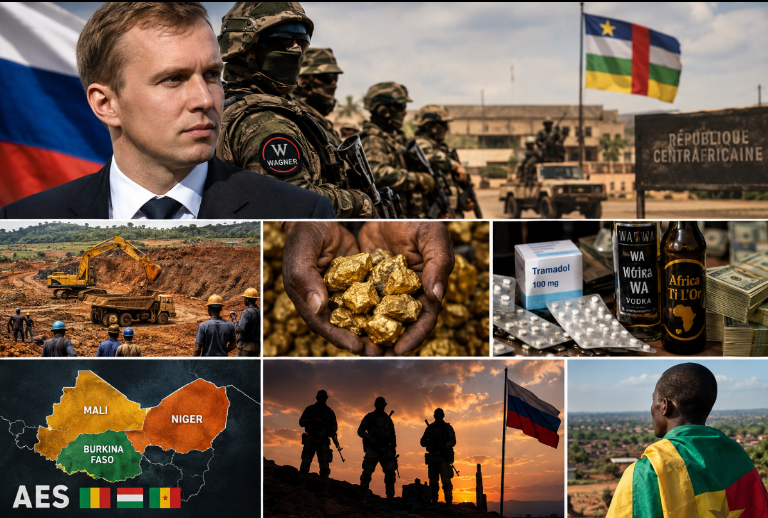
In the Central African Republic, where Wagner’s operations once thrived under Evgeny Prigojin’s leadership, his son Pavel has allegedly taken the reins, transforming the once informal network into a structured economic empire. Estimates suggest that the annual revenue generated by this empire now exceeds $400 million, a figure that underscores the scale of financial stakes involved. These revenues are not derived from a single sector but span multiple industries, blending military operations, mining ventures, and commercial enterprises into a cohesive yet opaque business model.
Pavel Prigojin, now 28, has not only preserved but expanded the family’s African footprint. According to reports, his network maintains approximately 500 fighters in the Central African Republic, where they continue to provide security services to President Faustin-Archange Touadéra’s regime. This presence is not limited to military support; it extends into the country’s lucrative mining sector, particularly gold, where the network’s main extraction operation reportedly generates around $250 million annually.
Key insight: The transformation of a military operation into an economic venture raises concerns about the transparency of resource exploitation and the actual benefits accruing to the host nation.
Central African Republic: A Blueprint for Leveraging Security into Economic Power
The Central African Republic serves as a case study in how security partnerships can morph into economic leverage. Wagner’s deployment in Bangui was initially framed as a military intervention to stabilize the country and protect its leadership. However, the organization’s activities quickly expanded into mining, logistics, and even the trade of controlled substances, such as tramadol. This diversification suggests a deliberate strategy to embed itself into the country’s economy, creating dependencies that extend far beyond security concerns.
The intertwining of security and economic interests introduces significant risks. For instance, the gold extracted under the network’s control is exported through opaque channels, raising questions about revenue transparency and whether these earnings are reinvested in public services or diverted to private interests. The lack of clear oversight mechanisms further complicates efforts to assess the true impact of these operations on the nation’s development.
The Central African Republic’s experience underscores a critical dilemma: When a security partner also becomes an economic actor within the country, how can the host nation ensure that national interests—not private gains—remain the priority?
Beyond Bangui: The Sahel’s Growing Unease
The dynamics observed in the Central African Republic are beginning to reverberate across the Sahel, where the Alliance of Sahel States (AES)—comprising Mali, Burkina Faso, and Niger—has increasingly turned to Moscow for military support. While the circumstances in each country differ, the potential for similar patterns of economic entanglement looms large. In Mali, for example, the presence of Russian forces has sparked debates about the human cost and effectiveness of the partnership, while in Burkina Faso and Niger, discussions are intensifying around the financial and strategic implications of such alliances.
The key issue is not the choice of partners but the conditions under which these partnerships are forged. Without robust transparency, independent oversight, and clear legal frameworks, there is a substantial risk that security agreements could inadvertently cede control over critical resources and strategic decisions to external actors. The Central African Republic’s example serves as both a cautionary tale and a potential model, depending on how each Sahel nation navigates its own path.
Russia’s Dual Strategy: Military Influence Meets Economic Ambitions
Since the collapse of the Wagner rebellion in June 2023 and the subsequent death of Evgeny Prigojin, Moscow has sought to consolidate its control over Russia’s African operations through the Africa Corps, a new military formation tied directly to the Russian Ministry of Defense. This restructuring aims to formalize and centralize the country’s African engagements, reducing the autonomy of semi-independent networks like Wagner.
Yet, the transition is far from seamless. Entities with vested economic interests in Africa, such as those linked to the Prigojin family, have retained considerable influence. In the Central African Republic, these networks continue to operate alongside official Russian structures, blending state-backed initiatives with private economic ventures. This duality poses a challenge for host nations: How can they distinguish between legitimate state-backed cooperation and operations driven by private agendas?
The underlying tension: Russia’s dual approach—balancing state control with the preservation of economic networks—creates a grey area that Sahel nations must carefully navigate to avoid becoming economic dependencies of Moscow’s broader geopolitical strategy.
What Sovereignty Looks Like in a Gold-Backed Security Deal
The Central African Republic’s experience forces a fundamental question: What does sovereignty mean when a nation’s security is contingent upon a partner that also controls significant economic assets within its borders? Answering this question requires more than military agreements; it demands transparent contracts, accountable governance, and public oversight of resource revenues. For the AES countries, the path forward must prioritize mechanisms that ensure security partnerships do not inadvertently trade away national assets or decision-making authority.
The gold-for-security model, if left unchecked, risks transforming sovereign nations into economic tributaries of external powers. To counter this, Sahel states must insist on:
- Independent audits of mining concessions and revenue flows to ensure transparency and accountability;
- Publicly accessible contracts that clearly define the roles, responsibilities, and limitations of foreign security partners;
- Mechanisms to reinvest natural resource revenues into local development, rather than private networks;
- Clear legal frameworks to delineate the boundaries between state-backed cooperation and private commercial ventures.
Without these safeguards, the line between security assistance and economic exploitation becomes dangerously blurred, leaving nations vulnerable to the unintended consequences of unchecked power imbalances.
Conclusion: A Warning or an Inevitable Trend?
The Central African Republic’s model is neither a certainty nor a foregone conclusion for the Sahel. However, it serves as a stark reminder of the potential pitfalls of security partnerships that neglect economic dimensions. For the AES countries, the choice is not merely between aligning with Russia or the West but about defining the terms of engagement that protect their sovereignty, resources, and futures.
The real battle is not just over who provides security but who ultimately benefits from the resources that lie beneath the ground—and whether those benefits trickle down to the people who need them most.