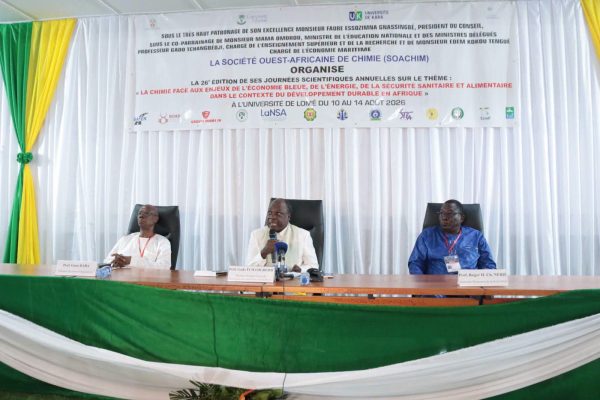
Lomé, 14 August 2026 — Four days of intense scientific exchanges concluded on Friday at the University of Lomé, marking the end of the 26th edition of the West African Chemistry Society (SOACHIM) Scientific Conference. Co-organised by the Universities of Lomé and Kara, the event brought together researchers, educators, academics, and students to tackle pressing challenges in chemistry and its real-world applications.
The closing ceremony was led by Professor Gado Tchagbedji, MinisterDelegate for Higher Education and Research. It provided a platform for organisers to highlight the success of an edition distinguished by robust scientific engagement and broad international participation.
Nearly 500 scientific presentations
A total of 493 scientific papers were delivered to an audience of 533 participants hailing from across SOACHIM’s eight member countries. Over four days, attendees presented findings, exchanged ideas, and explored key issues in chemistry through a dynamic programme featuring a keynote lecture, a roundtable discussion, and 15 thematic conferences.
The conference fostered meaningful dialogue across generations of scientists. For students and early-career researchers, the event offered a rare opportunity to showcase their work, receive expert feedback, and forge partnerships beyond their home institutions.
A universally acclaimed edition
Speeches during the closing ceremony and the adopted motions of satisfaction underscored the event’s high organisational standards and the depth of exchanges. Participants from SOACHIM’s member countries praised the 26th edition as a resounding success—a testament to the value of regional scientific forums in uniting universities, labs, and researchers across West Africa.
The true challenge now lies in translating these discussions into tangible collaborations, joint projects, and solutions tailored to the region’s evolving needs.
Bridging theory and practice in food safety
Following the closing ceremony, attendees visited the National Laboratory for Food Safety and Phytosanitary Control (LaNSA). The guided tour provided insights into the lab’s operations, offering a practical dimension to the conference by exposing scientists and students to critical infrastructure dedicated to West Africa’s food safety and phytosanitary standards.
The conclusion of this 26th edition signifies more than the end of four days of dialogue; it underscores the urgent need to strengthen links between academic research, scientific expertise, and the region’s pressing societal demands.
You may also like
Burkina Faso: what does Ibrahim Traoré’s four-year record truly mean for the displaced and the silenced?
Cameroon’s Vision 4 suspension: does silencing a broadcaster protect the Martinez Zogo trial or undermine press freedom?
Thali oil permit: can Prime Global Energies’ $15 million rescue finally unlock Cameroon’s stalled Njom-3 well?
Can West Africa’s peace hold without the Entente Council and UNOWAS pact?
Can Lomé’s quiet diplomacy finally deliver peace to eastern DRC?