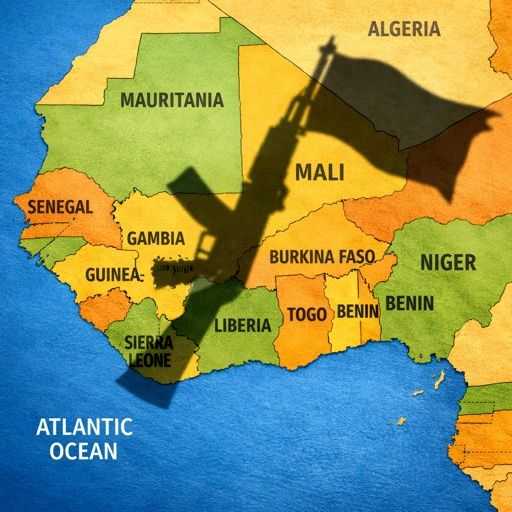
The Jama’at Nusrat al-Islam wal-Muslimin (JNIM), an affiliate of Al-Qaeda operating in West Africa, faces a critical strategic crossroads as it contemplates expanding beyond its traditional Sahel strongholds. Since its formation in 2017, this militant faction has solidified its influence across central Sahel regions, particularly in Mali, Niger, and Burkina Faso, where its various battalions challenge state authority for territorial control.
From Sahel heartlands to the Gulf of Guinea: a calculated shift?
While JNIM’s core operations have historically concentrated in the Sahel, recent years have seen a marked shift southward toward the Gulf of Guinea. This expansion targets northern regions of Bénin, Togo, and Côte d’Ivoire, where the group has claimed responsibility for several high-profile attacks since 2019. However, this geographic progression reveals puzzling inconsistencies: Ghana remains largely untouched, Côte d’Ivoire experienced attacks between 2020 and 2022 but has seen no recent armed actions, while Bénin has faced a sharp deterioration in security as recently as 2025.
International Crisis Group’s latest report examines this seemingly erratic expansion pattern, analyzing how JNIM leadership perceives and implements this territorial strategy. The findings suggest that expansion isn’t a straightforward calculation but rather a complex dilemma for the organization, with internal factions debating its merits. Failing to expand risks ceding influence to rival groups and disappointing followers, while rapid expansion could stretch the group’s resources too thin, potentially leading to internal fractures and operational inefficiencies.
Geopolitical currents shaping jihadist ambitions
The current West African geopolitical landscape adds another layer of complexity to this strategic conundrum. The emergence of the Alliance of Sahel States (AES)—with its withdrawal from ECOWAS and ongoing regional tensions—creates an environment where militant groups like JNIM may find new opportunities for growth. Understanding the internal decision-making processes of such organizations has become crucial for developing effective security policies in neighboring countries increasingly concerned about armed jihadist expansion.
This critical analysis will be the focus of an upcoming expert discussion featuring leading researchers who have extensively studied the JNIM’s operations, ideological motivations, and strategic evolution in the Sahel and beyond.
Key speakers
- Jean-Hervé Jézéquel – Director of the Sahel Project at International Crisis Group, specializing in political and security dynamics across the Sahel region. He holds a PhD from the École des Hautes Études en Sciences Sociales (EHESS), earned in 2002.
- Marte Beldé – Postdoctoral researcher at Sciences Po Bordeaux, contributing to the international Governing Jihad in Africa project. Her work examines the political economy and spatial expansion of jihadist movements in West Africa. She completed her PhD at the University of Ghent in 2025 with a thesis titled Contested Fringes: An Ethnographic Study of Salafi-Jihadi Expansion in Sikasso, Mali.
- Beatriz de León Cobo – Doctoral candidate at GEMASS – Sorbonne Université, focusing on radicalization processes. She serves as an Associate Fellow at the Royal United Services Institute (RUSI) in London and directs the Europe-Sahel Dialogue Forum at the University Francisco de Vitoria in Madrid.
Moderator:
Dan Sanaren – Researcher affiliated with CERI–Sciences Po and CNRS.