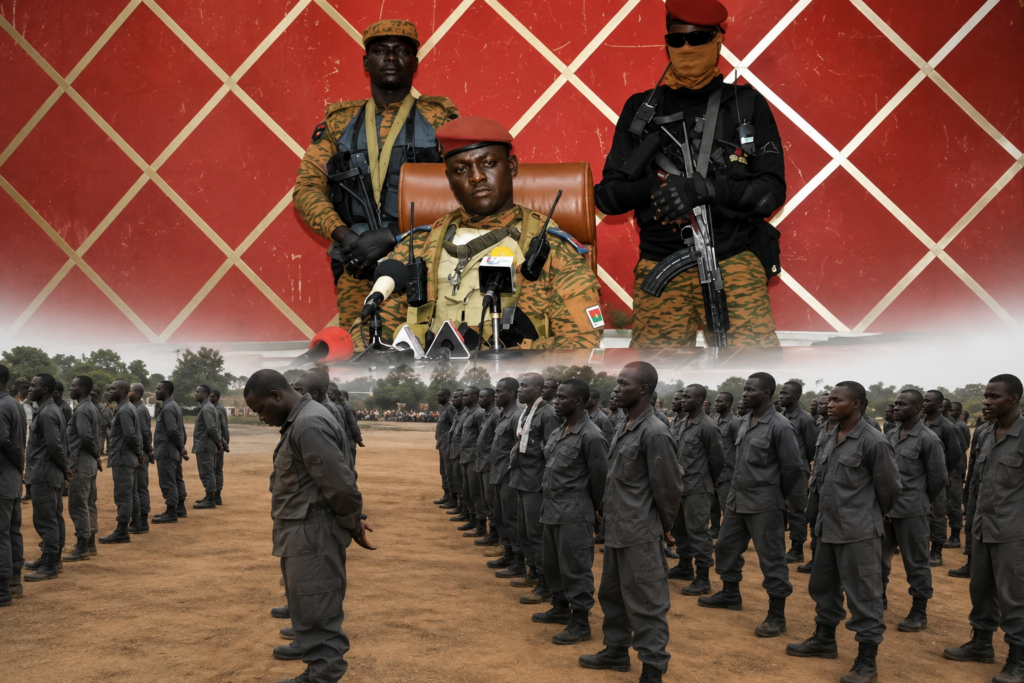
From repression tool to political weapon
History shows a persistent paradox in authoritarian regimes: tools designed to silence opponents inevitably turn against their creators. Burkina Faso’s current leadership under Captain Ibrahim Traoré exemplifies this pattern. Initially deployed against traditional critics, the regime’s tactics—arbitrary arrests, forced disappearances, smear campaigns, intimidation summons, media restrictions, and citizen conscriptions under the guise of war effort now ensnare former allies. Among those now facing consequences are Muslim community leaders, civil society figures, commentators, influencers, and opinion makers who once championed the transition.
Loyalty loses its protective shield
The erosion of safeguards stems from a deliberate centralization of power. As decision-making becomes concentrated and dissent is equated with national threat, the line between adversary and supporter blurs. Today, Burkina Faso’s political landscape operates on a single criterion: perpetual obedience rather than past allegiance. In such an environment, no individual regardless of prior loyalty can claim immunity from suspicion.
The illusion of safety through compliance
Captain Traoré’s legitimacy rests on a nationalist and security-focused narrative, amplified by a digital army of supporters. This rhetoric frames all criticism as foreign-backed destabilization or treason. Supporters once justified unproven arrests as security imperatives, dismissed disappearances of critics as overstated, and applauded media closures as acts of sovereignty. Yet this normalization of exception has eliminated nuance, replacing democratic debate with a binary choice: unconditional support or immediate labeling as an enemy.
The danger lies in this binary logic. A regime demanding absolute adherence eventually interprets even minor reservations as defiance. Yesterday’s allies become today’s suspects.
The cult of personality fuels systemic suspicion
Burkina Faso’s transition is increasingly centered on Ibrahim Traoré’s persona. Criticizing policies risks being perceived as undermining his personal authority. This cult of personality fosters a climate of perpetual suspicion. Persistent security failures, economic strains, and social tensions fuel a narrative of internal conspiracies rather than policy shortcomings.
Under such a system, the circle of suspects expands relentlessly. Opposition figures are first targeted, followed by independent journalists, human rights defenders, magistrates, academics, religious leaders, and eventually former allies whose influence is deemed excessive or misaligned.
Fear as a governing strategy
The regime’s reliance on high-profile arrests, public summons, social media smear campaigns, and administrative sanctions serves a dual purpose. While neutralizing specific individuals, these measures also broadcast a chilling message: no one is beyond reach. Each arrest serves as a warning, each unexplained disappearance fuels anxiety, and each summons reinforces the idea that coercive power can strike anyone deemed inconvenient.
This strategy cultivates self-censorship. Intellectuals hesitate to publish, journalists scale back investigations, religious leaders temper sermons, and citizens avoid public debate. A society governed by fear loses its capacity for innovation, error correction, and collective problem-solving.
Institutional erosion weakens democratic safeguards
The weakening of Burkina Faso’s institutional checks exacerbates the crisis. Judicial independence faces scrutiny when rulings appear politically motivated. Independent media endure suspensions that shrink pluralism. Civil society organizations operate under increasing constraints. Political parties function within severely limited frameworks. Without robust institutions to counterbalance executive power, citizens’ protections become precarious, and the rule of law yields to the whims of authority.
A historical pattern of self-destruction
Burkina Faso is not alone in this trajectory. Authoritarian systems built on concentrated power often follow a familiar arc. Revolutionaries purge former comrades. Military leaders grow suspicious of their own ranks. Political movements sideline founders. Ideologues face accusations of betrayal. This pattern reflects a fundamental truth: when loyalty to a leader replaces institutional loyalty, no level of devotion is ever sufficient. The pursuit of political purity inevitably leads to purges, exclusions, and unfounded accusations.
Fundamental rights are not conditional privileges
Public freedoms—fair trials, free expression, press freedom, presumption of innocence, protection from arbitrary detention or disappearance—are not rewards granted to the faithful. They are universal guarantees designed to protect every citizen from power abuses. Supporting the arbitrary arrest of an opponent sets a dangerous precedent. Once established, such arbitrariness can be applied to anyone without distinction.
Many of Ibrahim Traoré’s former supporters erred by believing proximity to power ensured lasting protection. In authoritarian systems, loyalty is not a contract but a precarious relationship, constantly reassessed based on shifting interests.
Security cannot justify unchecked power
Burkina Faso faces a real terrorist threat demanding a strong state response. However, effective counterterrorism depends not only on coercive measures but also on citizen trust in institutions. When fear of arbitrary state actions outweighs the sense of protection, that trust erodes. History demonstrates that sustainable victories over insurgencies require credible institutions. Security and the rule of law are not opposing goals; they are complementary. A state that combats terrorism while respecting legal norms strengthens its legitimacy. Conversely, permanent emergency measures risk transforming counterterrorism into a justification for total societal control.
The system’s ultimate betrayal
The predicament facing former regime supporters today reveals a broader truth: in a system weakened by institutional decay and governed by fear, no one enjoys lasting protection. Today’s allies may become tomorrow’s suspects. The most fervent defenders can be accused of insufficient loyalty. Communication channels may be replaced or sidelined. Religious figures may face reprimands for deviating from official narratives. The arsonist eventually gets burned.
Yet the true cost extends beyond individual fates. When a regime extends suspicion to its own supporters, it exposes a fundamental flaw: the problem is not the people but the system itself. True national protection does not derive from proximity to the leader or ideological alignment but from strong institutions, independent justice, free press, and laws applied equally to all. Only within such a framework can security challenges be met without sacrificing citizens’ freedoms.
You may also like
Benin’s rating leap to AA-: the moment regional capital started taking Cotonou seriously
Brigitte Tchede’s Cairo surge: Benin’s discus medal breakthrough that changes everything
Burkina Faso’s armored vehicles: the moment of truth arrives on the battlefield
Togo presses pause on press freedom as a reporter’s sidelining marks a decisive shift
Benin-Rwanda breakthrough: Wadagni’s Kigali mission redefines strategic partnership