Gabon’s parliament takes center stage in a new era of governance
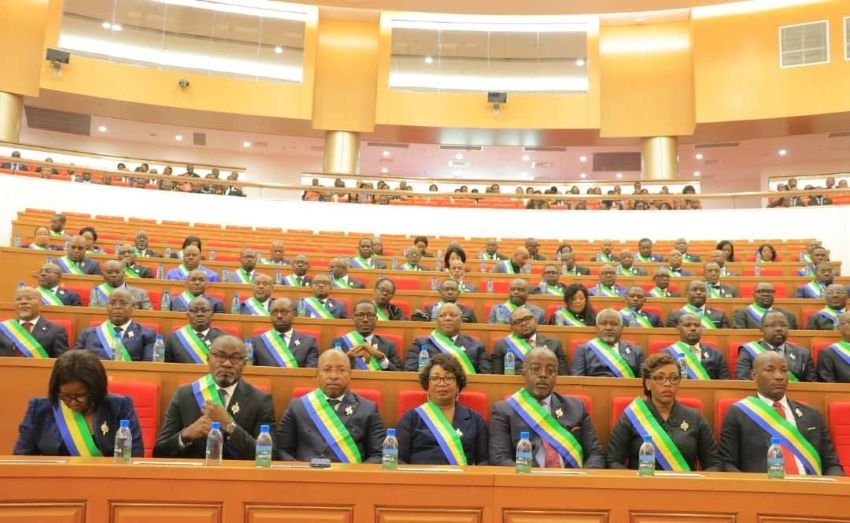
Libreville – June 15, 2026, marks a pivotal moment in Gabon’s political trajectory, potentially initiating a significant institutional transformation. For the first time since the Fifth Republic’s Constitution came into effect, President Brice Clotaire Oligui Nguema addressed the assembled Parliament in a joint session, a mandate now enshrined by Article 59 of the nation’s new fundamental law.
This unprecedented gathering signifies more than a mere institutional formality; it heralds the emergence of a redefined power structure. The explicit objective is to position the Gabonese Parliament as the central pillar of republican life and a crucial mechanism for governmental accountability.
At a time when numerous democracies globally strive to rebuild public trust between leaders and citizens, Gabon is pioneering a system poised to become a defining characteristic of its new political chapter. The historic Palais Léon Mba, home to the National Assembly, transcends its traditional role as merely a legislative chamber, evolving into a symbolic arena where the executive, national representatives, and, by extension, the sovereign people converge annually.
A profound institutional innovation
In previous political systems, presidential addresses to Parliament were reserved for exceptional circumstances. However, the Fifth Republic elevates this possibility into a constitutional imperative. Annually, the Head of State is now required to present his strategic vision, review his administration’s accomplishments, and outline future policy directions to the parliamentarians gathered in Congress.
While this evolution might appear procedural, its implications are profoundly political. It embeds a principle of regular accountability at the apex of the executive branch. The President’s legitimacy no longer solely derives from electoral mandate; he is now directly answerable to the national representation for the actions undertaken on behalf of the nation.
This provision differentiates the Gabonese model from many traditional presidential systems. It establishes a perpetual republican rendezvous, actively contributing to the institutionalization of a culture where government actions are publicly evaluated. Furthermore, the selection of Palais Léon Mba as the venue for this Congress holds considerable symbolic weight. For decades, the locus of power naturally gravitated around the executive. By appearing before Parliament, the President now physically moves towards the representative institution. This gesture is powerful, emphasizing that democratic legitimacy extends beyond the presidential election, residing instead in continuous dialogue with the people’s elected representatives.
Parliament: a new cornerstone of the Fifth Republic
The constitutional reforms stemming from the Inclusive National Dialogue have led to an unprecedented enhancement of the parliamentary role. Far from being a secondary institution, Parliament now stands as a primary guardian of the new institutional equilibrium within Gabon.
This significant shift is a direct outcome of a unique political environment. The political transition initiated in 2023 placed the imperative of rebuilding public trust at the forefront of national discussions. The new Constitution directly addresses this need by strengthening mechanisms for control, transparency, and responsibility.
The annual Congress perfectly aligns with this rationale. Even in the absence of direct voting or immediate debate, its impact is substantial. It creates a space for political visibility where both the majority and the opposition share a common institutional moment. In a political landscape often marked by tensions, this ceremony introduces a unifying republican ritual.
Through this framework, Parliament also serves as a mirror reflecting the Nation. The 215 deputies and senators gathered embody Gabon’s political, geographical, and social diversity. While the presidential address is directed to them, its true audience encompasses all Gabonese citizens.
Forging a new political culture
All robust democracies are built upon established rituals, which imbue political time with meaning and anchor institutions within the collective consciousness. The annual Congress could well become one of these foundational events for Gabon.
Beyond its ceremonial aspects, this meeting enshrines a philosophy of governance rooted in transparency and institutional dialogue. It actively contributes to the development of a political culture where authority is exercised not merely through decree, but also through clear explanation and demonstrable responsibility.
In an African continent where institutional reforms are often viewed with caution by investors, international partners, and multilateral organizations, this mechanism also projects a crucial signal of stability. It demonstrates a commitment to embedding public governance within a predictable and enduring framework.
Therefore, the true significance of the June 15 Congress extends far beyond the specific content of the presidential address. What truly enters history is not merely the words of a head of state, but the establishment of a republican tradition destined to shape national political life for years to come.
By designating Parliament as the common ground where the executive and national representation convene annually, the Fifth Republic is laying a fundamental cornerstone of its identity. Gabon is thus inaugurating a novel institutional balance where the strength of the state is measured less by the concentration of power and more by its capacity for accountability. This may well represent the most profound transformation undertaken since the dawn of the new Republic.