As Gabon strives to build a modern Fifth Republic, its media landscape is facing one of the most severe crises in its history. Print journalism is in sharp decline, online outlets are struggling, advertising revenue is drying up, and access to public information is becoming increasingly difficult. Many publications have vanished altogether. This isn’t just about the economic survival of media companies—it’s about the very quality of our democracy.
The most troubling silence in Gabon today isn’t political scandal or public outcry. It’s the quiet erosion of the media sector. While the nation focuses on major infrastructure projects, political deadlines, and ambitious economic plans, an essential pillar of democratic life is crumbling in plain sight—yet receiving little notice.
Without a strong, independent media, democracy risks becoming a monologue. When a government stops hearing beyond its own voice, it drifts dangerously far from reality. The stakes are high: a nation that lets its media fade away doesn’t just lose voices—it loses the very mechanism that keeps power accountable.
Print journalism: a fading institution
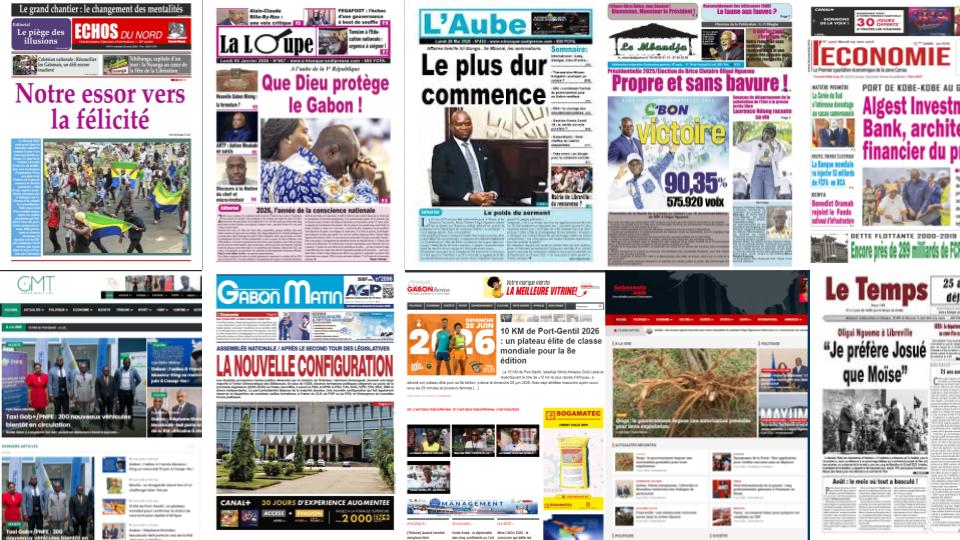
Once, newspaper kiosks were vibrant hubs of public debate. Titles like La Loupe, L’Aube, and Échos du Nord were staples in homes and cafés. They were read, discussed, and anticipated. These papers endured tough times, criticized by officials who called them adversarial or oppositional—but they still published, still sold, still shaped the national conversation.
Today, those same newspapers are nearly extinct. Not because they lacked audience, but because they lacked support. Their disappearance isn’t just a business failure—it’s a silencing of public discourse. Every closing title erases a perspective, a question, a watchdog voice.
The decline of Gabon Matin: more than a format change
Gabon Matin, once the government’s flagship daily, now survives as a shadow of itself. Once printed every day, then twice weekly, then weekly during transition periods—it now exists almost entirely online. Officially, this is framed as a technological upgrade. But can anyone believe it’s that simple?
The truth is far more stark: Gabon Matin is struggling like everyone else. Even titles historically backed by the state are gasping for air. The economic pressures are universal. The result? A once-dominant voice has been reduced to a whisper.
Where are the promised reforms?
For years, officials have pledged support for media restructuring—funding, restructuring plans, survival strategies. Promises have been made. Hopes raised. But on the ground, editors are still fighting to keep their doors open. Where are the results? Where is the tangible change?
The best measure of public policy isn’t in speeches or press releases. It’s in outcomes. And the outcomes today are alarming. The gap between rhetoric and reality is widening—and the media sector is paying the price.
Digital media: growth without substance
Gabon’s online media landscape is expanding—but substance is scarce. Sure, new websites appear daily. But how many have real newsrooms? How many publish clear ownership and editorial leadership? How many operate transparently? Very few.
A handful of outlets still uphold professional standards despite meager resources. But even they face an impossible equation: shrinking ad revenue, weak digital income, rising costs, and limited access to institutional advertising. Most are one crisis away from collapse.
Why a weak press weakens democracy
The crisis has moved beyond economics. It’s now a democratic emergency.
How can we speak of pluralism when media outlets vanish daily? How can diversity survive when companies close one after another? How can editorial excellence thrive when journalists live in constant financial uncertainty?
A financially fragile press becomes politically vulnerable. It bows to pressure. It compromises. It self-censors. And a democracy cannot function without a robust, independent, and fearless press.
The silent failure of media regulation
What happens when the regulator’s role outlasts the very media it was meant to oversee? When the framework exists but the actors disappear? When laws promise pluralism but independent voices fade into silence?
These aren’t hypotheticals. They are real risks. The media regulator of tomorrow may find itself overseeing an empty landscape. And an empty public sphere cannot sustain a healthy democracy.
Time to act: media survival is a national duty
The media crisis isn’t a journalists’ issue. It’s not an editor’s problem. It’s a national one.
A country that lets its media die slowly impoverishes its public debate. And an impoverished debate erodes democracy itself.
Gabon now faces a choice: watch its media sector wither, or implement real reforms. Not just funding, but structural change—transparency, fairness, pluralism, and long-term viability.
Because a democracy doesn’t just die when newspapers close. It begins to weaken the moment we stop defending them.