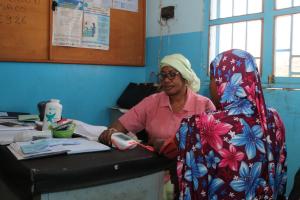
Empowering Malian Midwives to Transform Lives
Bamako – At just 19 years old, Kadidia faced a common dilemma in Mali: the fear of judgment when discussing contraception. « I was ashamed to talk about family planning, » she admits. « It’s still a taboo subject in many communities, and I didn’t want people in my neighborhood to talk about me. » Like Kadidia, countless young women across Mali navigate social, cultural, and structural barriers to access sexual and reproductive health services.
Despite progress, 2024 data reveals a sobering reality. Mali recorded 583 maternal deaths, including 89 among adolescents aged 15 to 19. Early and unwanted pregnancies remain a critical concern. While the numbers show improvement—4.8 million women of reproductive age in 2024 and 559,493 young women accessing modern contraception in 2024, up from 480,682 in 2023—the gap between need and access persists. Strengthening reproductive health services for young women isn’t just about healthcare; it’s about safeguarding their futures, reducing unintended pregnancies, preventing sexually transmitted infections (STIs), and fostering both physical and mental well-being.
Breaking Barriers Through Global Support
In response to these challenges, the World Health Organization (WHO), with significant donor backing, is collaborating with the Malian government to implement a bold initiative. This program focuses on expanding access to sexual and reproductive health rights by strengthening legal frameworks, enhancing healthcare provider skills, supplying essential medical equipment, and creating youth-friendly clinics. It also emphasizes data-driven policymaking through reliable health indicators and national health accounts.
Dr. N’Tji Keita, Head of the Maternal and Child Health Department at the National Office for Reproductive Health, highlights the program’s impact: « Our strategic plan prioritizes youth and adolescent rights. We’ve trained judges on WHO guidelines, established a national health observatory, and reinforced maternal death surveillance systems. »
The WHO doesn’t just provide technical support—it acts as a catalyst for coordination and supervision. Key achievements include Mali’s first national bulletin on sexual and reproductive health indicators and the 2022 National Health Accounts, tools that empower data-driven decision-making.
Bringing Care Closer to Communities
Dr. Sylla Ousmane, WHO Sexual and Reproductive Health Program Manager in Mali, explains the initiative’s community-focused approach: « We’ve launched a Mother-Child-Adolescent clinic in Sikasso offering integrated family planning and gender-based violence support. Mobile teams are also deployed in humanitarian zones like Macina to reach vulnerable populations. » These efforts ensure that life-saving services are accessible where they’re needed most.
Midwives at the Heart of Change
At the core of this transformation are trained midwives, whose continuous education has significantly elevated the quality of care for young women. Aïssata, a midwife at the Kebila community health center, shares her experience: « I’ve received advanced training in prenatal care, family planning, STI/HIV/AIDS management, and medical prescriptions. This has not only improved my practice but also allowed me to serve young women without judgment. »
Assetou, a mentor midwife in Yanfolila, echoes this sentiment: « These trainings have revolutionized my approach—prioritizing listening, availability, and consent. Between 2019 and 2025, the number of adolescents accessing reproductive health services in my center more than doubled, from 2,330 to 5,121. »
Beyond statistics, these changes are visible in shifting attitudes. School awareness campaigns, radio programs on sexual health, and provider training in empathy and consent have encouraged young women to seek care without fear. Kadidia’s story reflects this shift: « The healthcare worker put me at ease, listened without judgment, and gave me excellent advice. I can confidently say these services are changing lives. To other young women, I say: don’t be afraid to seek help—it’s here for you. »
The journey toward improved reproductive health for Mali’s youth is ongoing, but with empowered midwives, supportive policies, and community engagement, progress is undeniable. Every trained midwife, every accessible clinic, and every open conversation brings Mali closer to a future where no young woman’s health is compromised by fear or silence.