

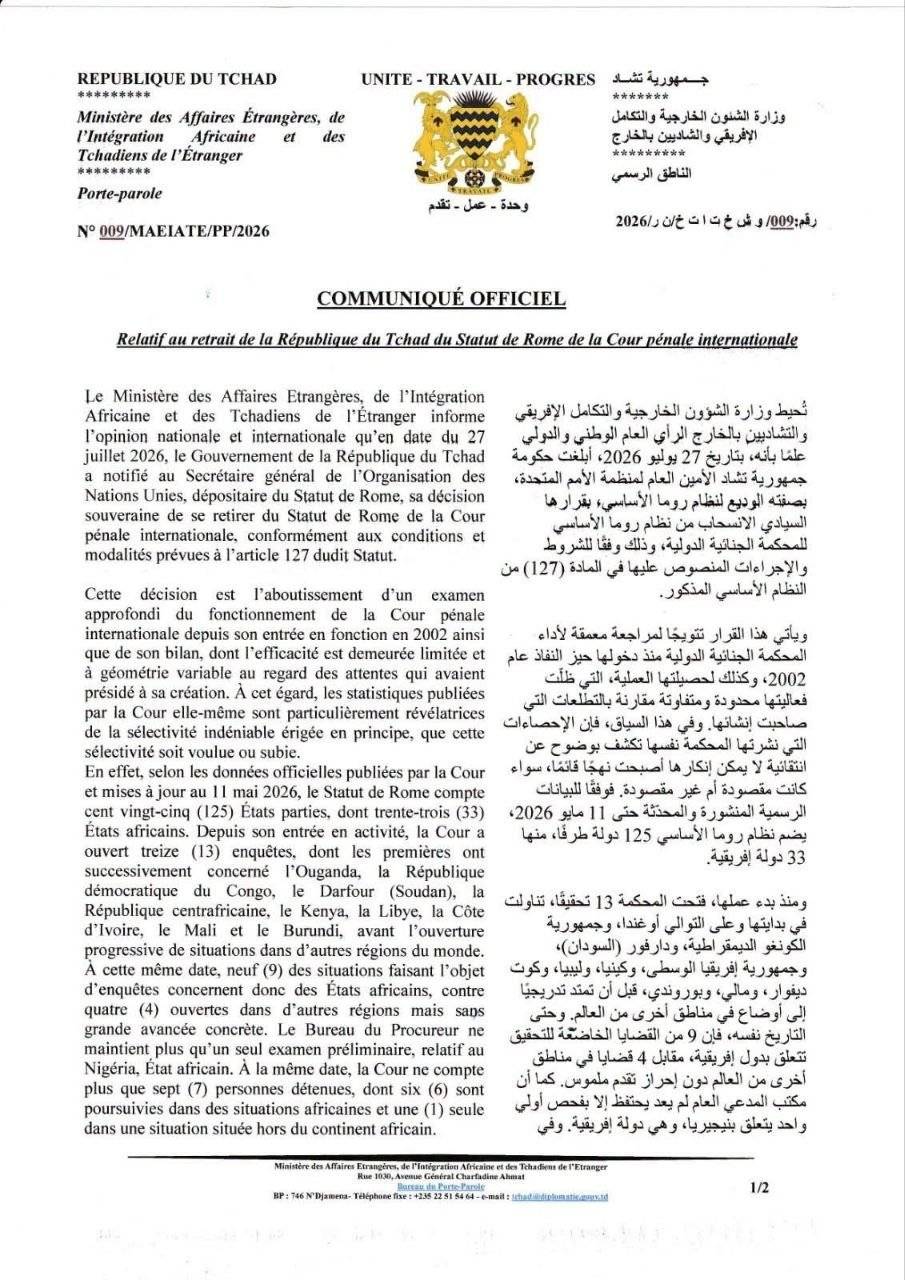
The government of Chad has formally initiated proceedings to exit the International Criminal Court (ICC), as confirmed by a letter delivered to the United Nations headquarters in New York. This decision, announced on July 27, reflects a broader dissatisfaction with what N’Djamena describes as the court’s political manipulation, particularly its disproportionate targeting of African and Global South nations. The move raises critical questions about the future of human rights protection and the judicial landscape within Chad.
a historic diplomatic shift
The withdrawal marks a definitive break with The Hague. By notifying the withdrawal from the Rome Statute—the foundational treaty of the ICC—the Chadian authorities have triggered a year-long transition period before the exit becomes legally binding. In their justification, officials argue that the ICC suffers from inherent inefficiencies and an unjust geographical imbalance in its prosecutions. The government contends that the court disproportionately focuses on leaders and actors from the Global South while overlooking similar crimes in other regions, effectively turning the ICC into a tool of Western geopolitical influence.

impact on chadian citizens and justice mechanisms
The withdrawal is more than a symbolic diplomatic gesture; it carries profound implications for the Chadian people. The ICC operates on the principle of complementarity, intervening only when national courts are unable or unwilling to prosecute grave crimes. By exiting the Rome Statute, Chad removes the last layer of international judicial oversight for victims of mass atrocities or widespread abuses.
the challenge of local judicial independence
Without the ICC’s oversight, victims of state-sponsored violence or armed group abuses must now rely solely on Chad’s domestic justice system. Civil society groups have expressed deep concerns that this shift could weaken the protection of human rights and increase impunity. The effectiveness of local courts in delivering fair and impartial justice will be put to the test, particularly in cases involving powerful political or military figures.
risks for victims and human rights defenders
Human rights organizations warn that the absence of an international judicial recourse may complicate the documentation of abuses and the protection of witnesses. The ICC has historically served as a deterrent against large-scale violence; its withdrawal could embolden perpetrators and leave victims without recourse. The Chadian government’s decision to leave the court may also hinder efforts to gather evidence and hold accountable those responsible for atrocities.
regional and international repercussions
The move places Chad at the center of a growing divide between African nations and international judicial institutions. While some governments in West Africa and the Sahel share N’Djamena’s frustrations with the ICC, others remain cautious about breaking ties with the court. The decision reflects a broader trend of asserting national sovereignty over foreign legal influence, but it comes with diplomatic risks.
potential consequences for aid and investment
Chad’s withdrawal could strain its relationships with Western partners and international donors, many of which tie financial assistance to compliance with human rights and rule of law standards. Additionally, the absence of an independent judicial recourse may deter foreign investors who prioritize legal certainty and stability. While the African Union has previously criticized the ICC, member states remain divided on how to address the court’s perceived biases, making Chad’s unilateral move a bold and potentially isolating choice.
the road ahead: sovereignty or justice at risk?
Government officials argue that the withdrawal is necessary to strengthen national institutions and affirm Chad’s judicial sovereignty. They assert that the country’s courts are fully capable of handling domestic cases and ensuring republican order. However, achieving this goal will require substantial reforms, including greater financial and logistical support for the judiciary, stronger guarantees for judicial independence, and robust mechanisms to protect witnesses and victims.
The one-year transition period, as outlined in Article 127 of the Rome Statute, will be a critical window for assessing Chad’s commitment to justice. During this time, the ICC retains theoretical jurisdiction over crimes committed before the withdrawal notification, but cooperation from Chad may wane, further complicating accountability efforts.
a pivotal moment for african justice
The formal announcement of Chad’s withdrawal on July 27 underscores the complex relationship between African nations and global governance institutions. While the criticism of the ICC’s perceived double standards resonates with many observers, the practical consequences of this decision remain a subject of concern. By closing the door to The Hague, Chad is staking its future on the promise of national sovereignty. The success or failure of this gamble will not be measured in international courtrooms or diplomatic salons but in the everyday lives of its citizens. Will Chad’s courts provide the justice and protection that victims deserve? The government’s next steps will be closely watched.
You may also like
-
Niger’s three-year isolation leaves citizens trapped in crisis
-
Mali’s contrasting security picture: Bamako’s relief meets central’s turmoil
-
Gazoduc Nigeria-Maroc : Rabat sollicite la Banque mondiale et l’US Exim Bank pour mobiliser 26 milliards de dollars
-
Tchad se retire de la Cour pénale internationale
-
Riz et maïs au Bénin : Comment le projet « Food Systems » veut métamorphoser l’agriculture nationale