
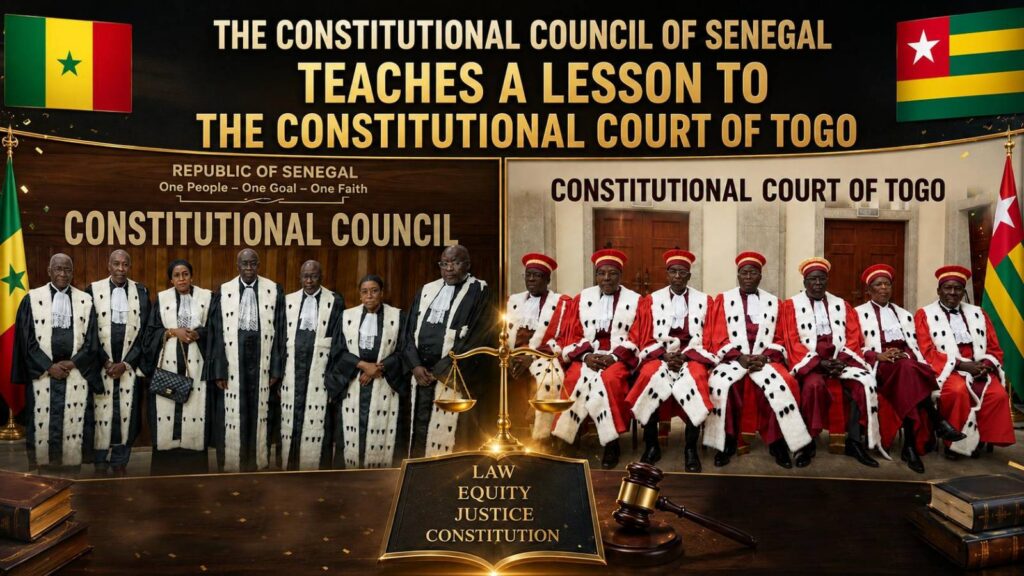
Two visions of the rule of law take shape in West Africa
In the evolving landscape of constitutional governance in West Africa, Dakar and Lomé present starkly different interpretations of the rule of law. Recent constitutional decisions in both capitals underscore a fundamental divide: one prioritizes judicial independence, while the other appears to align with executive preferences.
Senegal’s constitutional guardians stand firm
The Council of the Constitution in Senegal has once again affirmed its role as an impartial arbiter, rejecting a proposed constitutional amendment backed by the government and parliamentary majority. This decision underscores a critical principle: electoral victory does not grant unlimited authority. In a functioning democracy, political legitimacy is constrained by constitutional boundaries.
Togo’s constitutional court faces scrutiny
Across the border, Togo’s Constitutional Court has approved sweeping changes to the country’s foundational law, despite widespread political and legal opposition. Critics argue that the reform process lacked inclusivity, transforming the Constitution from a social contract into a tool of political negotiation. When constitutional amendments are perceived as serving immediate power interests rather than fostering national consensus, their legitimacy erodes—often irreparably.
Judicial independence as a bulwark against instability
Senegal’s judicial restraint in upholding constitutional limits highlights how a strong, independent judiciary can prevent political crises. By blocking a government-backed reform, the Council of the Constitution not only preserved legal principles but also reinforced institutional stability. Such judicial courage sends a clear message: democratic rules apply equally, regardless of political influence.
This independence fosters public trust. When courts can challenge executive decisions without fear of retribution, citizens perceive the system as fair and predictable—a key factor for political stability, investor confidence, and international credibility. Conversely, a constitutional court seen as rubber-stamping government actions risks losing moral authority, pushing citizens toward regional or international forums for justice.
Constitutional reforms must transcend political expediency
The manner in which a constitution is amended shapes a nation’s democratic future. In mature democracies, such reforms are preceded by broad consultations, rigorous debate, and efforts to build consensus. A constitution is not merely a present-day document; it sets the rules for future leadership transitions.
When amendments are driven by short-term political gains, they create dangerous precedents. Each new government may be tempted to reshape institutions to its advantage, fueling instability and concentrating power. The political fallout is equally damaging: a contested constitution becomes a perpetual source of conflict, undermining institutions and reducing them to political tools.
Lessons in constitutional governance
Togo’s authorities have sought inspiration from foreign models, studying parliamentary systems abroad. While comparative analysis is valuable, it cannot replace the lessons drawn from African experiences shaped by similar political, social, and historical realities.
The continent offers numerous examples of how constitutional principles, when respected, strengthen democracy. Senegal’s Council of the Constitution serves as a case in point: its credibility stems not from rhetoric but from its willingness to challenge power, even when doing so conflicts with the ruling majority.
This distinction is far from trivial. It influences governance quality, citizen trust, international standing, and economic attractiveness. Investors and development partners closely scrutinize the stability of institutions and the predictability of the legal framework. A nation where rules are consistently upheld commands greater confidence than one where institutions appear to bend to political winds.
Ultimately, the difference between Dakar and Lomé lies not in their constitutional texts but in how their institutions interpret them. In Senegal, the Constitution serves as a check on power. In Togo, critics argue, it risks becoming an instrument of political adaptation. A resilient democracy is not measured by the number of constitutional amendments it adopts but by its ability to protect citizens from the excesses of all branches of government.
You may also like
-
Price cap on eggs in Burkina Faso threatens poultry farmers
-
Senegal’s constitutional council blocks revised constitution law
-
The human toll of Russia’s exclusive alliance in the Sahel
-
Benin’s army strikes hard against terrorists in kouandé
-
Niger: Ousmane Sonko’s Signature Falsification Case Postponed to July 23, Khardiata Tandian Remains in Detention