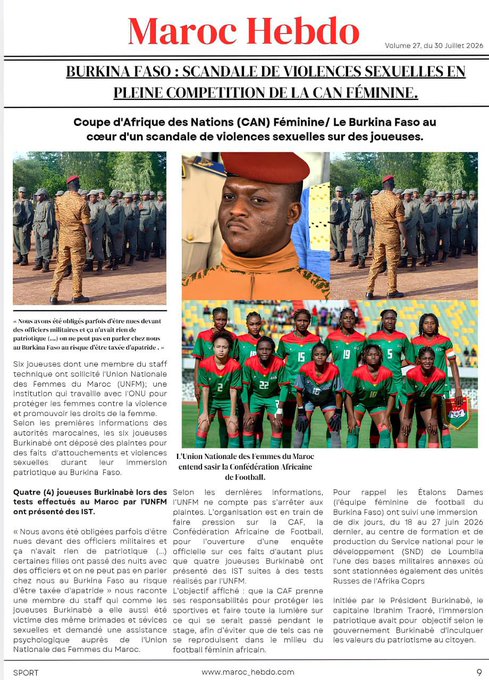
Amid a national agenda framed around patriotism, military discipline, and societal rebuilding, Captain Ibrahim Traoré’s administration in Burkina Faso is steadily extending military influence across the nation. The emergence of serious allegations of sexual abuse, reportedly involving several members of the national women’s football team during a training camp held at a military facility, compels a fundamental inquiry: what are the boundaries for a government when checks and balances erode and impunity becomes the norm?
A project touted as patriotic, allegations of extreme gravity
The initiative was conceived to embody the regime’s new doctrine: prioritizing the development of citizens over athletes. Consequently, the female national team players were dispatched to a military camp for a ‘patriotic immersion program.’ This was presented as an opportunity to instill discipline, national commitment, and values of sacrifice ahead of an upcoming continental competition.
However, this public relations endeavor now risks backfiring on its architects.
A formal complaint lodged in Morocco with the Union Nationale des Femmes du Maroc (UNFM) details claims from six players and a technical staff member, asserting they endured violence and sexual abuse perpetrated by military officers during their time at the camp. Should an independent investigation corroborate these accounts, they would represent exceptionally severe human rights violations, exposing the dangers of a system where military authority largely operates beyond civilian oversight.
The progressive militarization of all societal spheres
Beyond the specific accusations, this incident highlights a more profound societal shift underway in Burkina Faso.
Since assuming power, Ibrahim Traoré has systematically expanded the military’s influence far beyond traditional national defense matters. The armed forces are now engaged in diverse sectors, including civic education, youth programs, culture, political communication, and even sport.
This strategy reflects a deliberate intent to position the military as the primary vehicle for national construction. Yet, when civilian structures are supplanted by military ones in areas outside their core competence, the customary mechanisms of protection, oversight, and accountability can significantly weaken.
This concentration of power fuels growing alarm among human rights organizations, which have consistently warned for months about the diminishing scope for democratic control.
Impunity as a consequence of absent counter-powers
Every democracy relies on a delicate balance among its institutions.
When the judiciary, independent media, civil society organizations, and political parties experience a reduction in their operational space, their capacity to expose potential abuses also becomes significantly more fragile.
In such an environment, victims may hesitate to file complaints, fearing professional, social, or security-related reprisals.
The current allegations starkly illustrate this challenge: available information indicates that the complainants only initiated formal proceedings after departing Burkinabe territory.
This singular fact raises serious questions about the level of trust placed in national mechanisms designed to protect victims.
A climate fostering silence
Several factors likely contribute to the current difficulty for critical voices to be heard:
- Criticism of military authorities is frequently equated with a lack of patriotism or implicit support for armed groups.
- Journalists, activists, and civil society actors report an environment where dissent can lead to intimidation or coercive measures.
- Restrictions imposed on various media outlets diminish opportunities for independent investigation and limit the circulation of alternative information.
- The paramount importance given to security imperatives tends to relegate issues concerning human rights and victim protection to a secondary status.
Under these circumstances, the silence observed within parts of society cannot be automatically interpreted as an endorsement of the authorities. It may also reflect a profound fear of the repercussions of public commentary.
An issue transcending sports
This matter extends beyond women’s football.
It fundamentally questions the role of military institutions within a society at war and the necessary boundaries governing their involvement in civilian life.
It also scrutinizes the state’s capacity to guarantee the safety of its own citizens when they participate in programs organized under its direct authority.
Ultimately, it serves as a stark reminder that the fight against terrorism, however legitimate, cannot justify the sustained erosion of judicial guarantees, public freedoms, and accountability mechanisms.
Recourse to international bodies: a concerning signal
The fact that formal steps were initiated with a foreign organization rather than within Burkina Faso itself sends a powerful message.
Regardless of the outcomes of forthcoming investigations, this situation reveals a crisis of confidence in national protection and justice mechanisms.
For the victims, seeking support beyond national borders appears to be an attempt to secure assurances of being heard and treated impartially.
This internationalization of the case could intensify pressure on Burkinabe authorities to ensure an independent, transparent, and credible investigation is conducted to establish accountability, protect victims, and, where appropriate, sanction those responsible.
Conclusion
The allegations surrounding the patriotic immersion camp serve as a critical reminder that no political project, however ambitious, can be sustainably built by circumventing the rule of law.
Patriotism cannot be invoked to justify the dismantling of oversight mechanisms, nor to obstruct the pursuit of truth when grave human rights violations are alleged.
Should these facts be substantiated, this incident would mark a significant turning point in the assessment of Burkinabe governance, illustrating the profound risks associated with an excessive concentration of power and the weakening of institutions tasked with safeguarding citizens.
You may also like
Niger’s defense money: inside the 1.8 billion FCFA monthly question over the CFPD
Mali balances Russia ties with renewed US security talks
Mali drone war: 731 civilians killed in 199 strikes, investigation reveals
Nigeria police vow secure and neutral presidential election
Benin’s DGI sets September 21 as launch date for online tax services in Parakou