Behind the rhetoric of national ownership
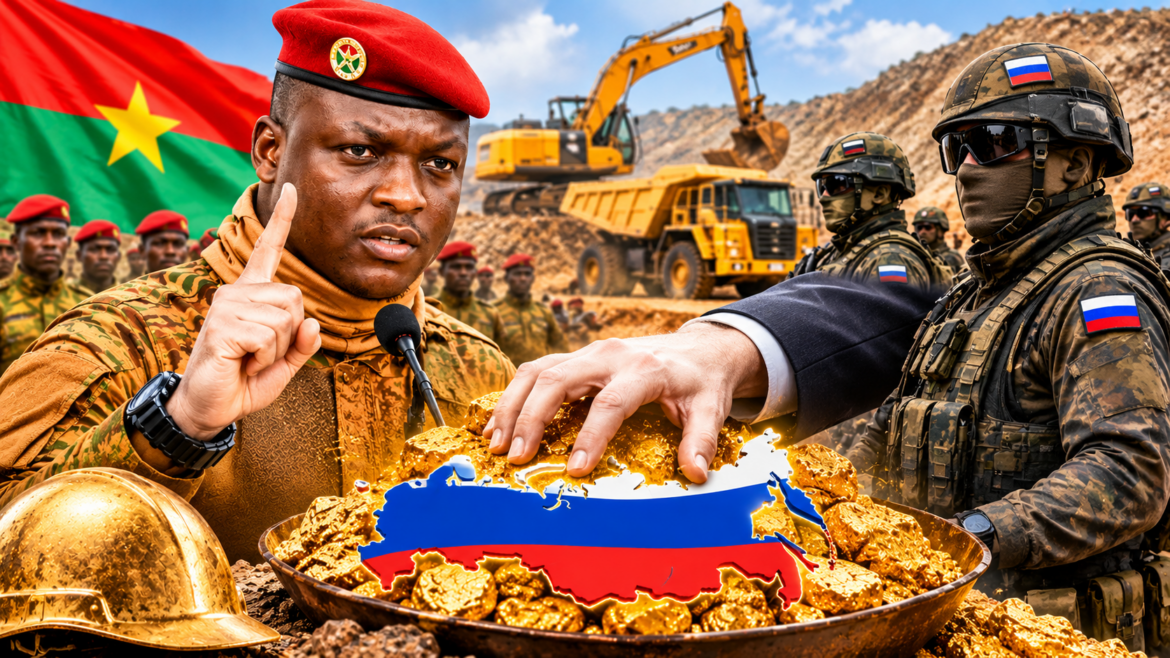
Since his ascent to power, Burkina Faso’s transitional leader Ibrahim Traoré has positioned the nation’s natural resources as a cornerstone of economic sovereignty. Nowhere is this declaration more pronounced than in the gold sector, where the government has repeatedly framed its extraction, processing, and profits as exclusively Burkinabè a claim echoed in policy speeches and state communications. Yet beneath this sovereign rhetoric lies a complex and increasingly visible dynamic: the growing footprint of Russian security firms in the operational and protective layers of the gold mining industry.
While the state touts its gold as 100% Burkinabè, the involvement of foreign private entities particularly those from Russia raises a critical question: who truly holds the power over these strategic resources? The answer is not merely academic. It determines whether sovereignty is an achieved reality or a political aspiration.
Security as a lever of influence
The role of Russian security companies in Burkina Faso’s mining zones extends beyond standard protective services. These actors are increasingly involved in critical security functions: guarding extraction sites, overseeing transport corridors, and safeguarding high-value mineral flows. In doing so, they occupy a tier of influence that directly intersects with national economic decision-making.
Such a presence is not neutral. Security firms are not passive service providers; they operate within defined operational boundaries, often with contractual discretion in personnel deployment, threat response, and even access control. When foreign entities gain influence over these functions within a sovereign state’s most lucrative industry, the implications for national control are immediate and deeply structural.
The paradox of sovereignty in practice
Sovereignty, as Ibrahim Traoré has articulated it, is not merely a legal or symbolic declaration. It is the capacity to make independent decisions about resource exploitation, to control access to wealth, and to ensure that economic gains serve public welfare. Yet when foreign firms design the security architecture around gold extraction including the rules governing who enters sites, how ore is monitored, and who benefits from transport contracts the government’s autonomy becomes contingent upon agreements it does not fully control.
This paradox is visible even without the transfer of ownership. The presence of Russian security teams in multiple mining hubs does not imply direct foreign control of production. But it introduces a layer of external decision-making that complicates Burkina Faso’s claim to full autonomy. The real issue is not who holds the mines, but who sets the terms of their protection—and, by extension, who shapes the flow of value from them.
Who profits from the protection of Burkinabè gold?
Behind the curtain of nationalistic rhetoric lies a quieter reality: the beneficiaries of security contracts are often shielded from public scrutiny. The financial arrangements, performance metrics, and even the personnel records of these firms remain largely opaque. This lack of transparency creates fertile ground for conflicting interests and undermines the state’s ability to verify that contracts align with national priorities.
A sovereign nation cannot cede control over its most vital economic lifelines especially when those lifelines generate billions in revenue. If Russian security firms are integral to the protection of gold, then the Burkinabè people deserve clarity: Who pays? To whom? And what national oversight exists to ensure these agreements serve the public interest not foreign entities or private intermediaries?
From principle to proof: what sovereignty looks like on the ground
The test of sovereign control is not rhetorical. It is operational. It is measured in contracts that are public, auditable, and aligned with national law. It is seen in the independence of regulatory bodies, the presence of national personnel in key roles, and the transparency of financial flows from mining to state coffers.
Right now, Burkina Faso is caught between two realities: a declared commitment to full economic sovereignty and the practical reality of entrusting a slice of its most critical infrastructure to foreign security firms. This gap between word and deed is not just a technicality it is the central tension shaping the country’s economic future.
If Traoré’s vision of 100% Burkinabè gold is to be more than a slogan, it must be backed by mechanisms of true control: complete contractual transparency, national oversight of security operations, and a clear public accounting of all revenues generated by mining activities. Anything less risks turning sovereignty into a performance a carefully staged narrative aired on national television, rather than a lived reality across the mines of the Sahel.
By Pierre Tchuente — Journalist