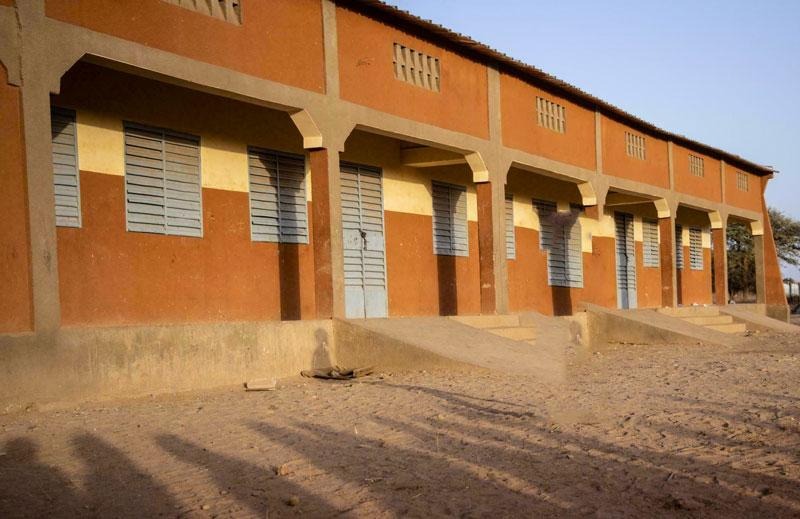
Bamako — The start of the 2026-2027 school year in Mali arrived with little fanfare on October 1st. Promoted as a landmark moment by the military-led transition government, it was declared the ‘Year of Education and Culture’ by interim president General Assimi Goïta. Yet as officials delivered their speeches in the capital, the nation’s education system was collapsing under the weight of escalating violence. More than 2,400 schools are not reopening. Over 730,000 children are now being denied education—not by accident, but by design.
The unspoken calculus behind Mali’s shuttered classrooms
This staggering number represents more than just absent teachers or damaged buildings. It reflects a deliberate strategy by armed groups to dismantle the state’s institutions and a failure by the Malian authorities to adapt. Over 20% of the country’s schools now sit empty, their fates tied to the broader collapse of state control.
In the remote northern region of Kidal, 84% of schools remain closed. In Ménaka, a stronghold of the Islamic State in the Greater Sahara (ISGS), more than half of all schools are non-functional. In Gao, Mopti, Bandiagara, and parts of Ségou and Koulikoro, schools are deliberately targeted—either burned, looted, or repurposed as shelters for the displaced. The pattern is clear: where the state withdraws, violence moves in, and education disappears.
From military promise to systemic vulnerability
The Malian government’s response to this crisis has only deepened the problem. After severing ties with France and expelling UN peacekeepers, Bamako pivoted toward Russian military support. The arrival of the Africa Corps (formerly Wagner) was meant to reverse the tide of insurgency. Instead, it coincided with a dramatic escalation in attacks. Military setbacks—most notably the humiliating defeat at Tinzaouatène in summer 2024—exposed profound weaknesses in the junta’s security model.
Rather than restoring security, the heavy-handed military approach has provoked even greater retaliation. Armed groups, including the Support Group for Islam and Muslims (GSIM, affiliated with Al-Qaeda), have intensified operations beyond their traditional strongholds. In September 2024, coordinated assaults on the Faladié gendarmerie school and Bamako’s military airport demonstrated that the insurgency had breached the capital’s defenses, undermining the junta’s core claim to national authority.
A fractured nation: mapping the collapse of state sovereignty
The geography of school closures mirrors the fragmentation of Mali’s sovereignty. In the vast north—Kidal, Ménaka, and Taoudénit—the state survives only in isolated, fortified towns. ISGS now governs large swaths of Ménaka, imposing taxes and enforcing its interpretation of Islamic law. Meanwhile, the GSIM and smaller armed factions control border regions with Algeria and Mauritania. In central Mali (Mopti, Ségou, San), rural areas are effectively controlled by insurgents, who enforce school closures and execute teachers who defy their decrees. In the south and west—once considered safe zones—blind cells of the GSIM are disrupting fuel and food supplies, choking off economic lifelines to the capital.
The human cost: a generation abandoned by the state
For a government that has staked its legitimacy on national resilience, the silence from Bamako speaks volumes. Despite the grand rhetoric of ‘refounding’ Mali, education—a fundamental right—has become a casualty of war. Every closed school is not just a building left vacant; it is a classroom surrendered to radical ideologies, a community surrendered to fear, and a child surrendered to ignorance.
The junta’s ‘Year of Education’ now rings hollow across the country. For hundreds of thousands of Malian children, October 1st did not mark a beginning—it marked another year without learning. Their classrooms remain dark. And until the violence stops and the state regains control, they may stay that way indefinitely.