The recent detention of two French nationals in northern Togo has cast a harsh light on the country’s governance failures. Incarcerated after only days in the custody of intelligence services, their fate appears to have been sealed by an explicit directive from Faure Gnassingbé, who personally instructed his Justice Minister, Pacôme Adjourouvi, to ‘resist any interference.’
Beyond the diplomatic fallout, this incident exposes a far deeper crisis: the erosion of Togo’s governance structure. The question now resonates across the nation who truly holds power, and by what authority?
The dismantling of Togo’s constitutional framework
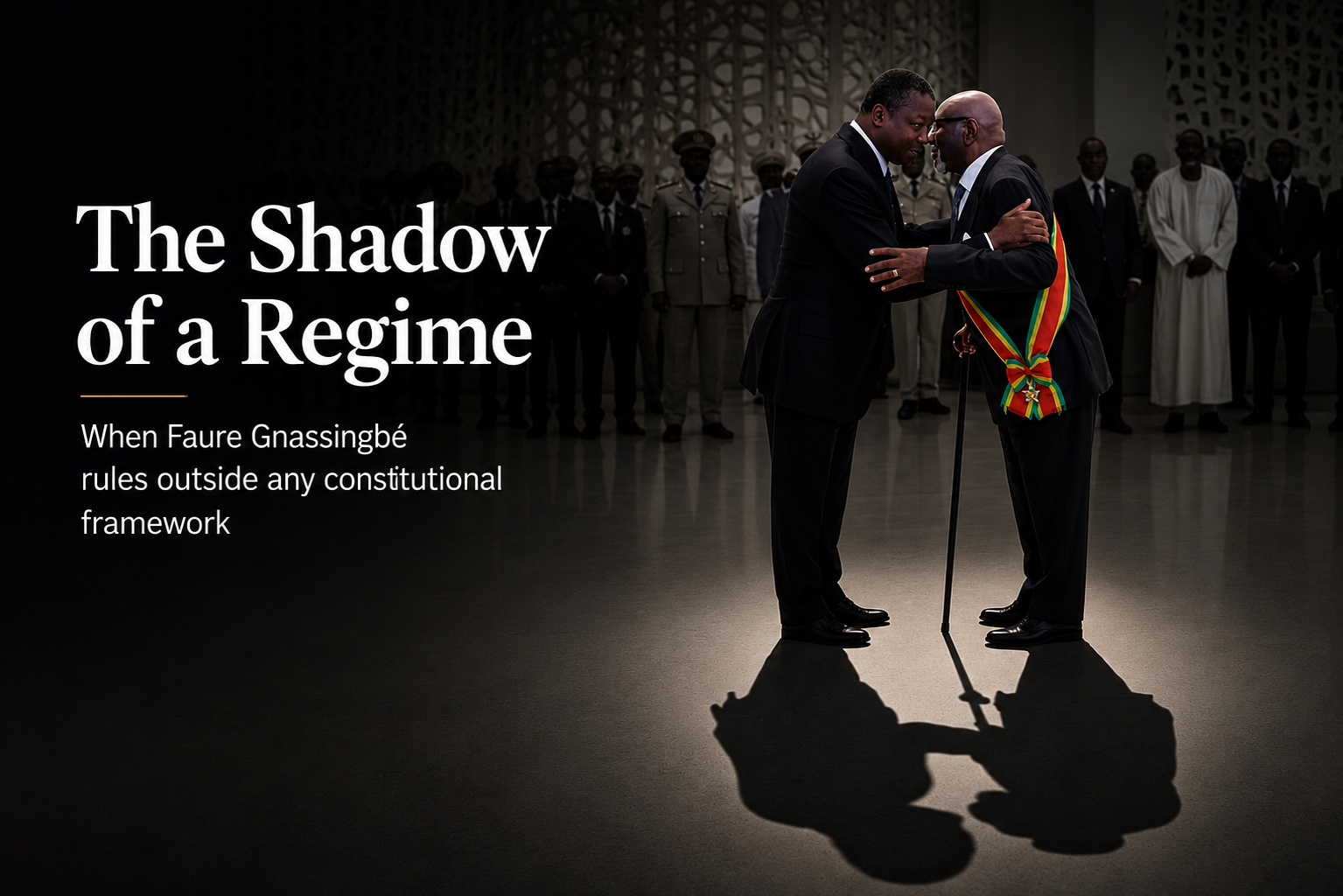
Faure Gnassingbé’s tenure has crossed a perilous threshold. Through a constitutional overhaul and the installation of a symbolic president while reserving the title of Council President for himself his administration has engineered an unprecedented departure from democratic norms. This is not merely a political reshuffle; it is the deliberate dismantling of institutional checks and balances in favor of unchecked executive dominance.
The 2024 reform, rubber-stamped by the National Assembly dominated by the ruling Union for the Republic (UNIR), redefined Togo’s system from a presidential to a parliamentary model. Jean-Lucien Savi de Tové, now the ceremonial President, holds no influence over state policy, military command, international representation, or judicial appointments. These powers now vest in the office of ‘Council President’ a position Faure Gnassingbé assumed on May 3, 2025.
Crucially, this role carries no term limits, making it a vehicle for perpetual rule. In a legislature where UNIR controls 108 of 113 seats a bloc secured after the 2024 elections, widely boycotted by the opposition the outcome was predetermined. This is no democratic transition, but the institutionalization of dynastic control under a renamed office.
Justice under political command
The detention of French journalists Sébastien Perez Pezzani and Gaël Mocaër arrested while filming for a France Télévisions production is not an isolated incident. It reflects a pattern: intelligence services and the judiciary operate at the behest of the executive. The alleged instruction to ‘resist any interference’ reveals a chain of command that erodes judicial independence. When the head of state dictates courtroom decisions, the separation of powers becomes a facade.
This phenomenon is evident across multiple spheres: the handling of June 2025 protests, the prosecution of dissenting voices, and the selective application of laws. Law is no longer a pillar of justice, but a tactical instrument of governance deployed or suspended according to political expediency.
A legitimacy built on silence and coercion
Who governs Togo? The answer lies not in the Constitution, but in the consolidation of power. Faure Gnassingbé, who inherited the presidency in 2005 and has spent two decades reinforcing it, has now engineered a constitutional framework to perpetuate his rule indefinitely. There was no public referendum on this fundamental shift. Legislative elections were held amid boycotts and widespread contention, while the Senate one-third of whose members are appointed by the Council President further entrenches executive control.
This is not reform. It is the consolidation of personal authority under a veneer of institutional process. Titles change, procedures accumulate, but the locus of decision-making remains unchanged: Faure Gnassingbé, as Council President, head of the ruling party, commander-in-chief, and ultimate arbiter of state affairs.
The ticking clock of instability
When the rule of law is replaced by arbitrary decree, when institutions become hollowed-out shells, when courts obey political directives, the social contract frays. Togo is no longer debating a constitutional amendment it is confronting a regime that has chosen to govern outside the bounds of a stable, predictable republic.
The question is no longer ‘who leads?’ It has become: how long can a system sustained by coercion and silence endure before internal contradictions or popular pressure force its collapse?