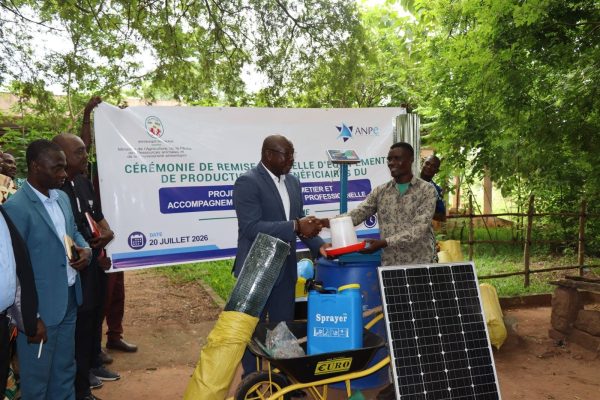
Kpomé, August 3, 2026 — Tackling youth unemployment in Togo requires more than just skills—it demands tangible action. In Kpomé, within the Maritime region, fifty young people have taken a decisive step toward self-employment by receiving full equipment packages to launch agricultural and livestock ventures immediately after completing a three-month professional training program.
The initiative, presided over by Dotsè Medjina, Secretary General of the Maritime Regional Governorship, marks a shift in approach: from theoretical learning to immediate, practical empowerment. Participants were trained in high-potential agropastoral sectors, preparing them for careers in market gardening, poultry farming, small ruminant rearing, and pig production.
From training to action: equipment kits delivered on the spot
A major hurdle in youth employment programs is the gap between training and actual business startup. Many young graduates possess skills but lack the capital to begin operations. In Kpomé, this gap has been closed.
The graduates did not leave empty-handed. They received a comprehensive starter kit including:
- Motorized tillers and pumps
- Sprayers and high-quality seeds
- Fertilizers and electronic scales
- Fencing wire rolls and irrigation systems
- Water storage solutions and wheelbarrows
- Construction materials for farm infrastructure
This immediate access to equipment enables the new entrepreneurs to begin production without delay, eliminating the need for additional financing and accelerating their path to financial independence.
Agropastoral sector as a driving force for rural job creation
The program targets sectors identified as key drivers of rural economic growth. By equipping young people with sector-specific tools and knowledge, authorities aim not only to boost individual livelihoods but also to strengthen local food production and stimulate rural economies.
Each beneficiary is now positioned to become a self-sustaining producer, contributing to the country’s broader goal of food sovereignty while reducing reliance on imported agricultural products.
Responsibility and long-term vision: the core of the initiative
During the handover ceremony, Dotsè Medjina emphasized the importance of responsible use of the equipment. He urged the young entrepreneurs to manage their resources with discipline, ensuring both profitability and the sustainability of their ventures.
He called on them to embrace their role not just as farmers or livestock keepers, but as active contributors to the economic development of their communities and the nation.
Part of a national strategy for food sovereignty
This initiative is part of the “Vocational Training and Professional Integration Support” program, launched in 2025 by the National Employment Agency (ANPE) in partnership with the Ministry of Agriculture, Fisheries, Animal Resources, and Food Sovereignty.
The program redefines employment policy by prioritizing the creation of income-generating activities over traditional job placement. By focusing on agropastoral entrepreneurship, Togo is investing in a generation of young producers capable of turning skills into viable businesses and securing the country’s food future.
You may also like
As donor fatigue spreads, can Benin’s €544,042 UNAIDS pledge keep the HIV response on track?
Who pays the price when Burkina Faso’s public payroll contracts? Households weigh the cost of 1,917 fewer agents
Libya pushes for direct Tripoli-Yaoundé flights as Cameroon sets up working groups
JNIM seizes three Burkinabè positions in a single day as Traoré’s security record faces hard questions
Chad condemns Ennedi-East airstrikes at un general assembly, warns of retaliation