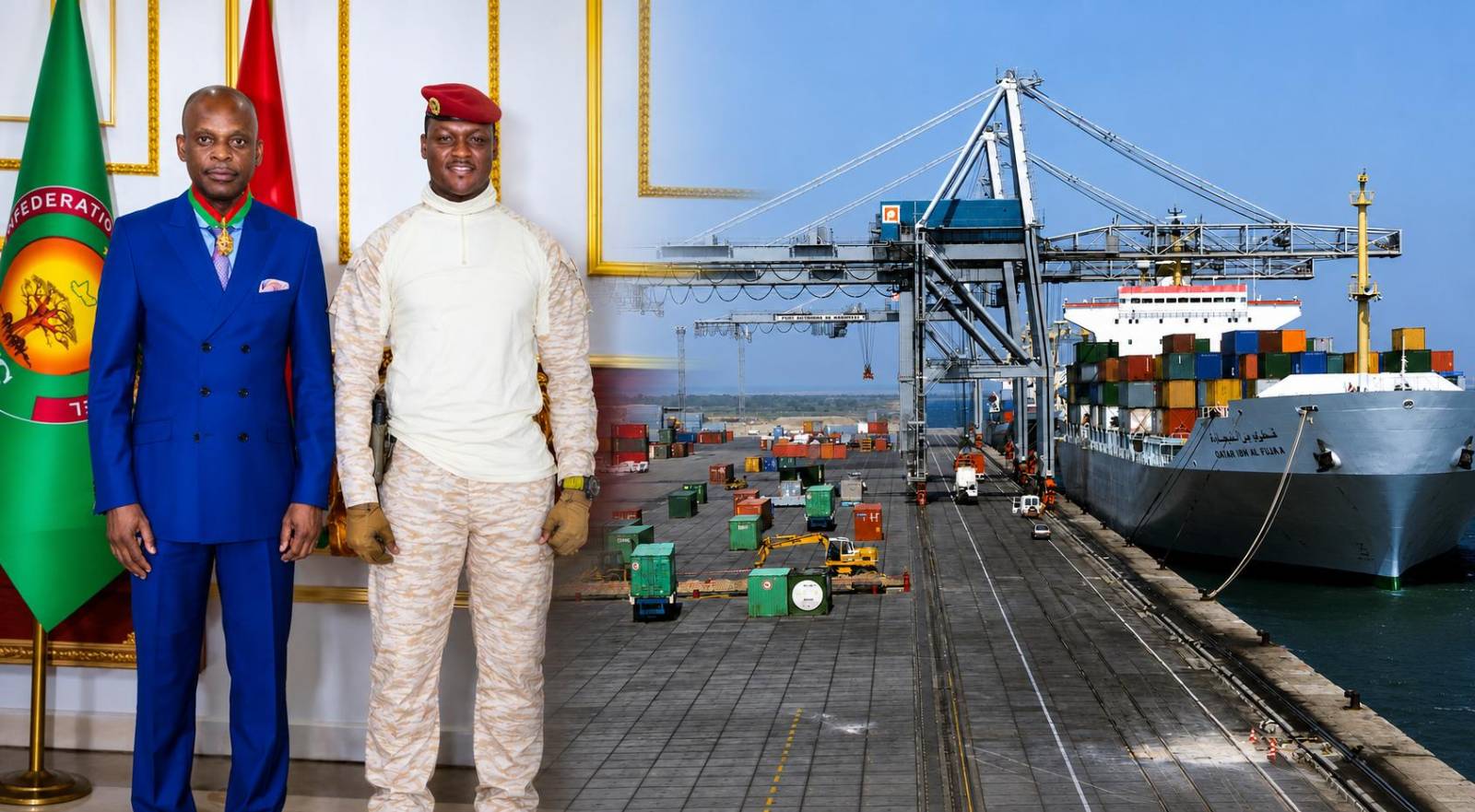
The Burkinabé government has recently bestowed upon Togo’s Foreign Minister the highest national honor, the Commander of the Order of the Stallion. While official channels hail this gesture as a testament to Lomé’s commitment to a ‘diplomacy of openness, solidarity, and proximity,’ the political landscape reveals a far more nuanced, and less flattering, narrative.
Diplomacy driven by interests rather than principles
The symbolic weight of this distinction raises a critical question: Does this award truly recognize diplomatic excellence, or does it merely reflect a convergence of interests between two governments facing shared political and economic challenges? In international relations, honors of this nature often serve to solidify alliances, yet they can also function as subtle political signals to regional partners.
Behind the scenes, many view this accolade as the culmination of a geopolitical charade. It is worth noting that this diplomatic thaw follows a contentious episode that left a lasting impression on observers. The Togolese regime, led by Faure Gnassingbé, had briefly offered asylum to Burkina Faso’s former president, Roch Marc Christian Kaboré. However, this act of solidarity proved short-lived, as Lomé swiftly abandoned Kaboré in favor of securing lucrative economic agreements with Ouagadougou’s new leadership.
The primacy of economic pragmatism and mutual dependence
For Lomé, regional solidarity appears to extend only as far as its economic interests allow. By relinquishing Kaboré, the Togolese government prioritized strategic trade deals with Burkina Faso, with the Port of Lomé (PAL) serving as the cornerstone of this arrangement. The primary objective? To ensure the seamless transit of Burkinabé goods through Togolese territory, thereby guaranteeing a steady flow of commercial activity.
This strategy is underpinned by a stark economic interdependence. As a landlocked nation, Burkina Faso relies heavily on maritime corridors for its trade. The Port of Lomé, a vital hub for imports and exports, thus becomes a linchpin for both nations—Ouagadougou’s survival depends on it, while Lomé reaps substantial revenue from regional transit. This mutual reliance explains the dramatic rapprochement between the two capitals, where economic pragmatism trumps ideological alignment.
By exchanging the fate of a political exile for assurances of logistical flows, Lomé has laid bare the transactional nature of its so-called ‘proximity diplomacy,’ revealing it to be little more than a vehicle for financial opportunism.
A transactional diplomacy under scrutiny
The timing of this honor coincides with lingering concerns over governance, political rights, and public freedoms across the region. To some analysts, this distinction underscores a strategic alignment rather than a celebration of democratic values or principled cooperation.
This episode reflects a broader trend sweeping through West Africa: a shift toward transactional diplomacy, where economic and security considerations increasingly overshadow traditional commitments to political ideals. Alliances are now forged in response to commercial incentives, logistical needs, and security imperatives, leaving ethical and ideological principles in the background.
The gap between official rhetoric and political reality
Government officials present this honor as proof of an exemplary bilateral relationship. Yet, this institutional narrative clashes sharply with reality and fails to address the underlying motives behind this rapprochement. When diplomatic decisions are so closely tied to economic interests, the discourse on African solidarity risks losing its credibility in the eyes of an increasingly skeptical public.
Ultimately, this distinction exemplifies a relationship governed by political realism, where state interests prevail over ideological considerations. Nations prioritize strategic gains, commercial exchanges, and political stability, even if it means drawing criticism for the disparity between their words and deeds.
Beneath the veneer of diplomatic smiles and medals adorning the lapels of officials lies a stark pragmatism. Far from symbolizing selfless brotherhood, this honor appears to reward a commercial partnership secured at the expense of ethical principles and asylum rights. It is this very discrepancy that fuels contemporary debates on the true nature of relations between Lomé and Ouagadougou.