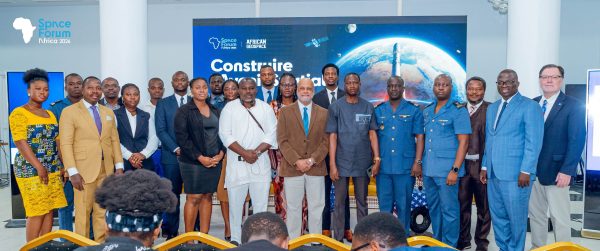
In Lomé, the Space Forum Africa 2026 shifted perspectives. From July 28 to 30, policymakers, researchers, investors, and innovators gathered to explore a concept gaining momentum in African development agendas: space technologies are no longer limited to Earth observation. They now play a pivotal role in boosting productivity, disaster preparedness, communications, and market expansion.
For decades, Africa’s space ambitions were framed by distant goals—launching satellites, funding scientific programs, and training talent. Yet in Lomé, the conversation evolved. The focus shifted from whether Africa could conquer space to how space could conquer Africa’s most pressing challenges.
The event, supported by the U.S. Embassy in Lomé, brought together key players in the space sector to address a single challenge: turning space science and technology into tangible solutions for the continent’s needs.
From satellites to fields: transforming orbital data into ground-level decisions
One of the forum’s most significant takeaways was the shift in scale. Space is no longer just about scientific research or technological prestige. Satellite data now supports critical ground-level activities—agriculture, climate monitoring, communications, and disaster prevention. The real challenge lies not in orbit but in how these orbital assets are leveraged on Earth.
For African economies grappling with climate change, information gaps, and forecasting limitations, space technologies offer an additional tool for smarter decision-making. As these data streams become more accessible, they unlock opportunities for local tech startups to develop high-value solutions tailored to African needs.
Jim Adams and the NASA legacy shaping Africa’s space future
The forum featured a keynote by Jim Adams, a NASA veteran with over four decades of experience in space exploration, satellite technologies, and innovation. His expertise highlighted how space capabilities are already transforming sectors like agriculture, climate resilience, communications, and disaster management.
But beyond applications, Adams posed a critical economic question: Who will develop tomorrow’s technologies, and who will capture their value? His insights underscored the need for African innovators to move beyond mere users of foreign technology and become creators of homegrown solutions.
Strengthening ties: bridging African startups and U.S. space enterprises
The growth of Africa’s space economy depends not just on infrastructure or technical skills but on fostering connections between innovation ecosystems. The forum emphasized the potential of partnerships between African institutions, local entrepreneurs, and U.S. space tech companies.
This collaboration extends beyond scientific cooperation. It’s about commercial diplomacy, investment, knowledge transfer, and market creation. For African entrepreneurs, the goal is clear: avoid being passive consumers of imported technologies. For international partners, the opportunity lies in discovering new talent, unmet needs, and untapped markets across the continent.
Space as an invisible backbone for economic and climate resilience
The forum redefined Africa’s relationship with space. A satellite can optimize crop yields. Climate data can predict disasters. Communication tech can connect remote regions. Orbital insights can guide emergency responses. Space is no longer a distant frontier—it’s an invisible infrastructure with measurable impacts on the ground.
The Space Forum Africa 2026 made one thing clear: the future of Africa’s space sector lies not in awe-inspiring launches but in practical, transformative applications that drive economic and social progress.
Washington and Lomé: expanding the circle of peaceful space innovation
The U.S. Embassy’s involvement in Lomé reflects a broader commitment to peaceful and responsible space exploration. As the U.S. celebrates 250 years of innovation, its engagement in Africa signals a strategic focus on collaboration over competition.
The next chapter of Africa’s space story may not be defined by rocket launches but by transforming satellite data into viable businesses, research into marketable solutions, and partnerships into sustainable growth. In Lomé, the sky was not just observed—it was presented as a new frontier for development.
You may also like
Northern Niger’s unanswered question: can Tiani’s government deliver water and power where it matters most?
Can Air Sénégal survive the Interpol smuggling probe? The stakes for crew, passengers and the airline’s future
As donor fatigue spreads, can Benin’s €544,042 UNAIDS pledge keep the HIV response on track?
Who pays the price when Burkina Faso’s public payroll contracts? Households weigh the cost of 1,917 fewer agents
Libya pushes for direct Tripoli-Yaoundé flights as Cameroon sets up working groups