
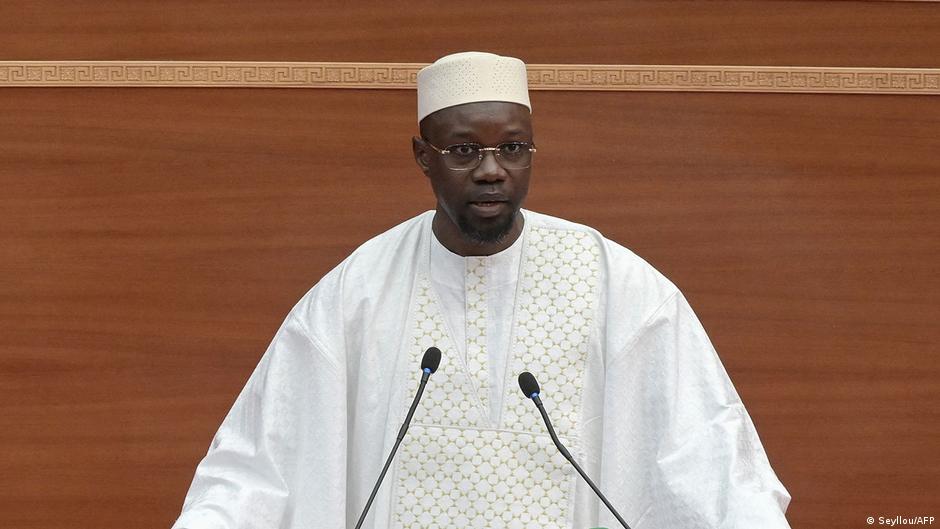
Dakar — A political earthquake is shaking Senegal’s National Assembly today, as lawmakers prepare to debate two explosive issues: the possible reinstatement of Ousmane Sonko as a deputy and the election of a new speaker to replace the recently resigned El Hadj Malick Ndiaye.
Sonko, a polarizing opposition figure, had suspended his parliamentary mandate when he was appointed Prime Minister by President Bassirou Diomaye Faye. His return to the Assembly would not only restore his seat but could also propel him to the position of Assembly President — making him the second-highest-ranking official in the country.
But the move faces fierce resistance. The opposition coalition, led by figures like Aïssata Tall Sall, has condemned the reinstatement as unconstitutional, calling it a constitutional coup. They argue that Sonko’s return could destabilize the government and trigger a no-confidence motion against the new Prime Minister, Ahmadou Al Aminou Mohamed Lô, a former central bank executive and minister.
a fractured alliance and rising tensions
Sonko’s political alliance with President Faye, once a symbol of unity during their election campaign, now lies in tatters. Supporters who once chanted “Diomaye est Sonko – Sonko est Diomaye” now feel betrayed by the president’s decision to dismiss him as Prime Minister. One disillusioned activist, Nourdine Diallo, reflected on the broken bond: “We campaigned on the belief that they were brothers — not just in words, but in action. We told Senegal that Faye and Sonko were one. Now, that promise has been broken.”
institutional showdown in the assembly
The Assembly session, set for today, will not only decide on Sonko’s parliamentary return but also elect a new speaker. The resignation of El Hadj Malick Ndiaye, a staunch Sonko ally, has intensified the power struggle. The opposition group Takuu Walu has rejected his resignation letter, calling it invalid and in violation of parliamentary rules.
Political analyst Malao Kanté warns that Sonko’s potential rise to the Assembly Presidency could trigger a constitutional crisis, destabilizing governance and locking the state into a cycle of deadlock. “He may represent a new face of the opposition, but this opposition now holds the parliamentary majority. That’s dangerous. A no-confidence motion against the Prime Minister is almost certain — and the country risks paralysis.”
opposition cries foul over unconstitutional move
The opposition is not backing down. Adama Fall, a senior figure in the Pastef-Les Patriotes party, has called on the nation to rise above personal rivalries. Referencing historical African power struggles, Fall insists this generation will not repeat past mistakes: “We’ve seen leaders like Compaoré, Sankara, Lumumba — even conflicts between Mamadou Dia and Senghor. But we are a different generation. The cycle must end — and it will, in the right way.”
Meanwhile, multiple party officials have resigned in solidarity with Sonko, signaling deep fractures within Pastef. The political fallout has reached a fever pitch, with both sides accusing each other of undermining democracy.
President Faye, who appointed a new Prime Minister in a late-night move, has urged national unity, calling the moment a turning point for Senegal. But with Sonko’s return looming and the Assembly on the brink of a historic vote, the country braces for what could be a defining moment in its political future.
You may also like
Gabon’s economic management hindered by unreliable public data
Niger: General Tiani faces growing unease within special forces after Russian involvement
Mali : 17 morts dans les rangs des dozos, le JNIM accentue sa pression
Sahel : le pari des juntes tourne-t-il à l’échec sécuritaire ?
MALI : Le JNIM diffuse les images de l’attaque de la base de San et contredit la version des FAMa