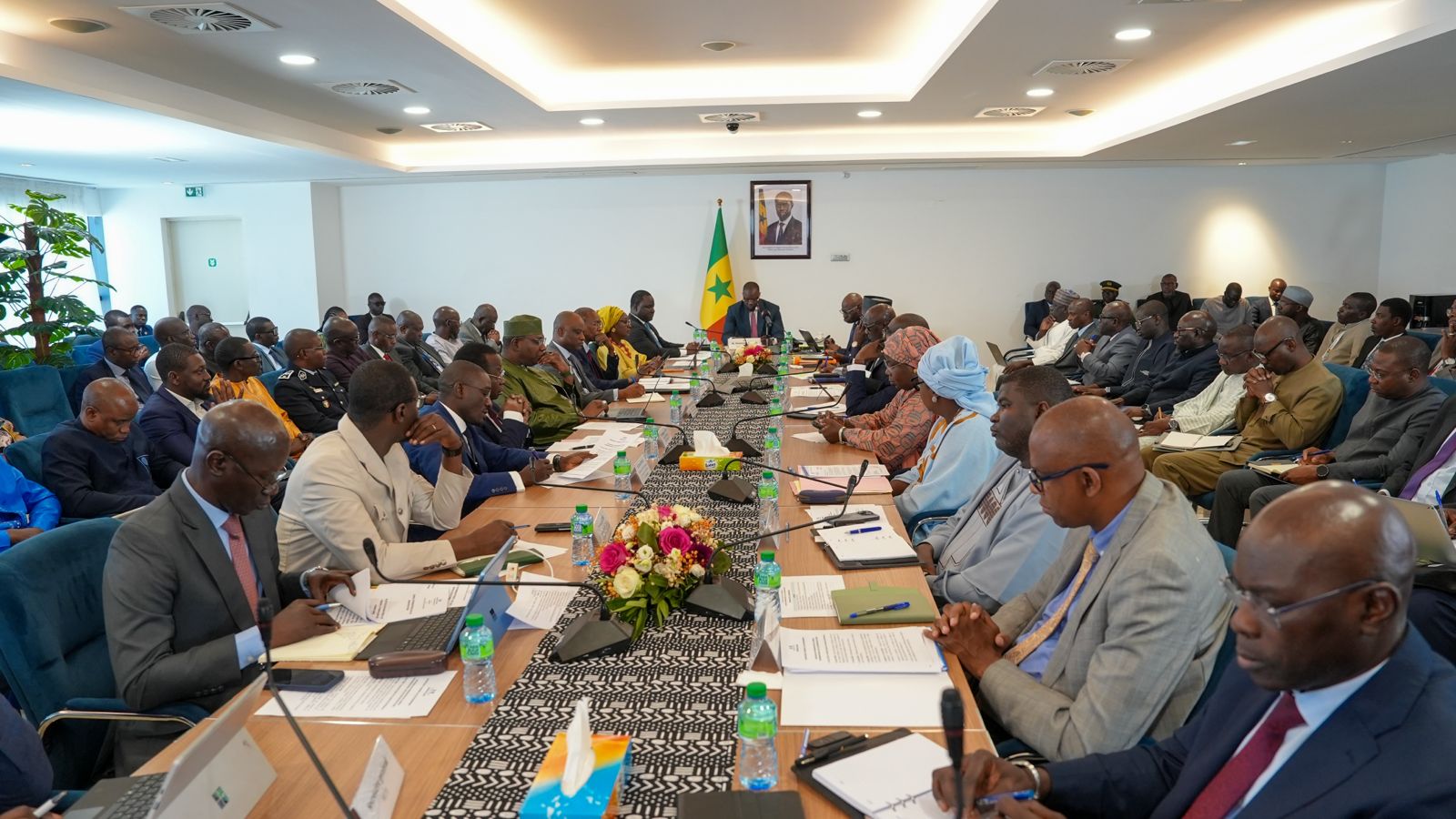
The Prime Minister of Senegal, Ousmane Sonko, convened an inter-ministerial council this week to address the country’s critical infrastructure challenges. Held at the Administrative Building in Dakar, the meeting revealed a staggering 245 public projects and assets mired in financial, legal, and technical bottlenecks, with total investments exceeding several trillion CFA francs.
Stalled projects and underutilized assets
Among the most pressing concerns are 30 completed but inactive infrastructures, 25 of which remain entirely paralyzed. This frozen investment amounts to a staggering 279 billion CFA francs, with 15 of these projects flagged as high-priority due to their economic and strategic significance. The government also identified 23 operational assets—worth an estimated 1,065 billion CFA francs—that could be repurposed or better exploited. Additionally, 94 ongoing projects, 62 of which have come to a halt, represent an investment of 5,227 billion CFA francs, with an additional 973 billion CFA francs needed to complete them.
The audit further uncovered 97 state-owned properties, primarily located in Dakar, valued at 132 billion CFA francs. These assets, though legally owned by the government, often fail to generate economic value due to bureaucratic inertia, funding gaps, or misaligned operational models.
A coordinated push for solutions
In response, Prime Minister Sonko ordered the immediate establishment of a high-level task force under the leadership of the Secretary-General of the Government. This committee, which held its first meeting this week, will conduct weekly reviews and deliver a comprehensive action plan by June 30, 2026. Its mandate includes accelerating the completion of stalled projects, defining sustainable operational and management frameworks, and identifying viable strategies to recycle and monetize underperforming public assets.
The government’s diagnostic report highlights financial constraints as the primary obstacle. Of the stalled projects, 42 face chronic funding shortages, delayed payments, or insufficient investment allocations. Other roadblocks include technical hurdles, unresolved legal disputes, and the absence of clear operational blueprints.
Sonko emphasized the paradox of completed infrastructures lying dormant for years, often due to poor inter-institutional coordination, incomplete handover procedures, or misalignment with actual public needs. He stressed the urgency of breaking these cycles to restore confidence in public investment and improve service delivery.
Key projects targeted for intervention
The government has singled out several emblematic projects for urgent intervention, including:
- Port and maritime infrastructures in Foundiougne, Soumbédioune, and Ndangane
- Youth and Citizenship Centers across multiple regions
- Naatangué ANIDA village farms
- Agro-poles in Mpal, Adéane, Dioulacoulon, and Mbellacadiao
Major stalled initiatives also include the Université du Sine-Saloum, 45 Open Digital Spaces (ENO), regional airports in Saint-Louis, Matam, and Kolda, the Ndayane Container Terminal, the Le Joola Memorial, and the Aristide Le Dantec Hospital.
To maximize the return on public investments, the government is prioritizing public-private partnerships (PPPs) for managing national stadiums, parks, natural reserves, and certain state-owned real estate assets, including diplomatic representations abroad.
Toward a more efficient public asset ecosystem
By systematically auditing, reallocating, and optimizing infrastructure and assets, the Senegalese government aims to enhance the efficiency of public spending, reduce idle capital, and improve the socioeconomic impact of state-funded projects. This initiative signals a broader commitment to structural reforms in public asset management and economic revitalization.