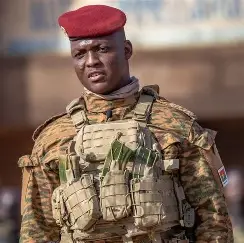
The recent declarations of Captain Ibrahim Traoré in Burkina Faso have intensified discussions regarding the legitimacy of his leadership and the political direction of the country since the September 2022 coup d’état. Far from ambiguous, his statements reflect an unapologetic acknowledgment of his ascent to power through extra-constitutional means, presenting this rupture as a new political paradigm.
From coups to contested legitimacy
Ibrahim Traoré did not ascend to the presidency through universal suffrage but through a military takeover that ousted Lieutenant-Colonel Paul-Henri Sandaogo Damiba, who himself had seized power in a previous coup against President Roch Marc Christian Kaboré. This succession of military interventions underscores a fundamental departure from the democratic principles that traditionally underpin presidential legitimacy.
The crux of the issue extends beyond the circumstances of his rise. What is particularly troubling is the narrative framing this power transition as inherently legitimate. By publicly embracing this breach of constitutional order, Traoré, according to critics, normalizes the notion that force could serve as an acceptable pathway to power, provided it garners fleeting public support.
Such reasoning carries grave implications. If political legitimacy no longer derives from institutions, elections, or the rule of law but from the ability of an armed faction to impose itself, future grievances could similarly justify further military interventions. This cycle fosters chronic instability, where the authority of firearms increasingly overshadows that of ballots.
A governance deficit masked by rhetoric
Proponents of the regime often cite restored sovereignty, severed foreign dependencies, and a resurgence of national pride as evidence of success. While these themes resonate with the population, they cannot substitute for tangible governance outcomes. History demonstrates that patriotic slogans, no matter how compelling, cannot replace economic progress, security, or institutional functionality.
Observers note a troubling imbalance: political communication has assumed an outsized role in governance. Patriotic symbols saturate public discourse, social media amplifies staged displays of support, and speeches proliferate. Meanwhile, critical questions persist regarding the tangible progress on the core challenges that precipitated the coup: counterterrorism operations, territorial recovery, and socioeconomic improvement for the populace.
Security and stability: the unmet expectations
The most urgent metric by which Traoré’s leadership is judged remains security. Despite announced reforms and military restructuring, lethal attacks, mass displacements, and a burgeoning humanitarian crisis continue to plague Burkina Faso. In numerous regions, civilians remain hostage to armed groups, while access to healthcare, education, and public services remains severely constrained.
The economic landscape offers little respite. Persistent insecurity hampers agricultural output, domestic trade, and foreign investment. Citizens yearn for tangible improvements: stable employment, higher purchasing power, reliable essential services, and an environment conducive to rebuilding lives. Yet these aspirations have yet to materialize in meaningful ways since 2022.
The peril of unchecked authority
Critics also highlight the consolidation of power under Traoré’s leadership. Dissenting voices—journalists, civil society actors, and opposition figures—face an increasingly restrictive climate where criticism of the regime is frequently equated with disloyalty to the nation. This conflation of patriotism with unquestioning support represents a dangerous deviation from democratic norms. In a functioning democracy, devotion to one’s country does not necessitate blind approval of its leaders.
The adage ‘Jupiter renders mad those he wishes to destroy’ encapsulates a timeless truth. It does not indict Traoré personally but serves as a cautionary reflection on the corrupting influence of power. Throughout history, leaders have often believed their popularity, strength, or historical mission placed them above accountability. This conviction frequently leads to the suppression of dissent, the marginalization of opponents, and the conflation of personal ambition with national destiny.
This risk is precisely what analysts emphasize: the more a leader centralizes power and portrays authority as absolute, the greater the likelihood of losing touch with the realities faced by ordinary citizens. Applause at rallies, orchestrated media campaigns, and manufactured displays of loyalty cannot replace objective assessments of ground-level progress.
The true measure of leadership
Ultimately, the legitimacy of a head of state is not forged in the barrel of a gun, nor in patriotic declarations, nor in defiant rhetoric. It is built upon institutional integrity, the protection of citizens, the safeguarding of fundamental freedoms, sustainable socioeconomic development, and the recognition that power is a means—not an end. It is against these benchmarks that Ibrahim Traoré’s tenure will be measured. Until concrete solutions emerge for the security, economic, and social crises afflicting Burkina Faso, questions surrounding his legitimacy and the durability of his rule will continue to shape the nation’s political discourse.