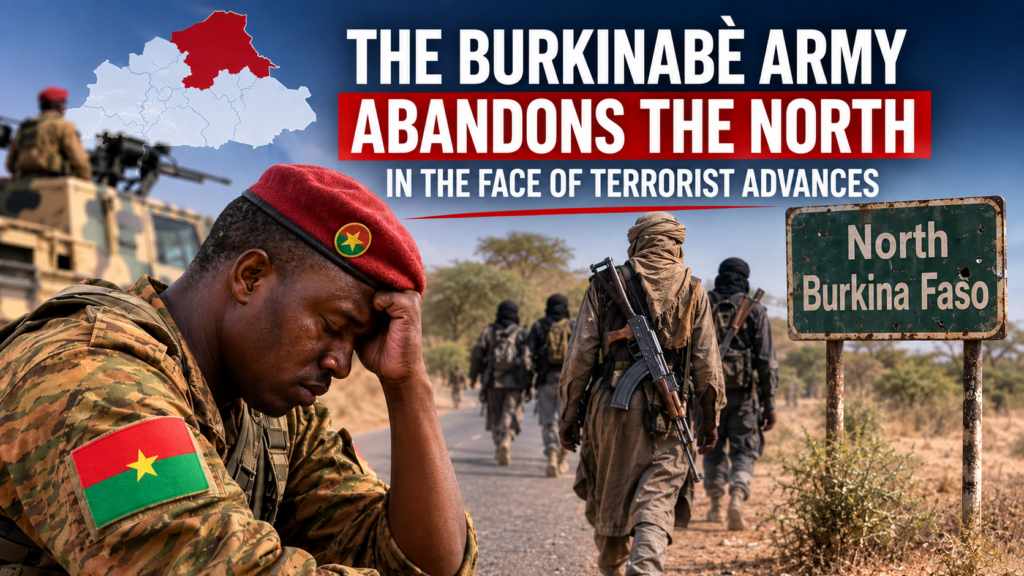
Military operations struggle to secure northern Burkina Faso
Despite repeated announcements of large-scale military operations and offensive maneuvers by national authorities, the security landscape in northern Burkina Faso remains precarious. Armed groups continue to adapt their tactics, avoiding direct confrontations in favor of sustained harassment and pressure on local communities. The result is a fluid conflict where temporary gains do not guarantee lasting control.
An elusive adversary reshapes the battlefield
One of the greatest challenges facing the Burkinabè armed forces is the mobility and adaptability of their opponents. These armed factions operate in small, decentralized units that dissolve and reappear across vast rural areas, exploiting gaps in security coverage. Unlike traditional warfare focused on holding territory, this approach turns the conflict into a shifting campaign of ambushes, raids, and intimidation.
Even after a military operation retakes a village or destroys a camp, the absence of continuous surveillance often allows insurgents to regroup elsewhere. The destruction of a single position rarely translates into the permanent elimination of the threat.
Roads remain prime targets for armed groups
The security of transportation routes serves as a critical barometer of stability. In northern regions, highways, rural roads, and supply lines are frequently disrupted by attacks, improvised explosive devices, and roadblocks. These incidents ripple through the economy and society: markets slow down, food prices rise, and entire communities become isolated from urban centers.
Cities may appear secure within their perimeters, but their vulnerability persists if surrounding roads and supply networks remain unsafe. The presence of troops alone cannot ensure long-term safety without control of the broader landscape.
Sustaining control after military gains proves difficult
The real test of success is not the initial recapture of territory, but the ability to hold it. Frequently, after security forces withdraw from a region, administrative, judicial, and police structures fail to re-establish themselves quickly enough. This creates power vacuums that armed groups exploit to rebuild their influence.
A successful military campaign must be followed by stabilization efforts: restoring public services, reopening schools and health centers, enabling farmers to return to their fields, and re-establishing local governance. Without these measures, even the most impressive offensive may only yield short-lived results.
Civilian populations bear the brunt of prolonged insecurity
Behind the statistics of operations and combatant losses lies the harsh reality faced by civilians. Forced displacements, disrupted farming seasons, closed markets, and shuttered public services deepen economic and social fragility. These conditions create a dangerous cycle: vulnerable communities become more susceptible to coercion, while the state’s weakened presence allows insurgents to expand their influence.
Displacement camps swell, and livelihoods vanish. Without basic security and services, families face impossible choices between risking travel to markets or going hungry.
Why military announcements don’t tell the full story
Official communications often emphasize the number of operations conducted or fighters neutralized. While such figures may bolster morale and public perception, they do not reflect the true state of security. Real indicators include the resumption of free movement, the reopening of roads, the return of public services, and the restoration of economic activity.
A series of tactical victories can coexist with a strategic stalemate. The true measure of progress lies not in how many battles are won, but in whether civilians can live and work without fear.
Beyond force: the need for a holistic approach
The crisis in northern Burkina Faso has evolved beyond a purely military challenge. While force remains essential in countering armed groups, it cannot resolve the underlying issues fueling the conflict. A sustainable solution requires a multi-pronged strategy: enhanced intelligence, secured transportation corridors, robust protection of civilians, the return of administrative structures, access to social services, support for displaced populations, and support for local economic recovery.
Equally important is preventing the security response from deepening communal divisions. In a conflict where misinformation and mistrust spread rapidly, the restoration of trust between communities and state institutions is itself a security imperative.
Premature declarations of victory risk prolonging the crisis
Declaring success after a military operation can be misleading. Armed groups may lose fighters or temporarily retreat, yet retain the capacity to disperse, regroup, and adapt. Tactical setbacks often become strategic pauses, allowing insurgents to exploit weaknesses in state presence.The key question is not how many positions have been retaken, but whether the state can maintain control and restore normal life in those areas. Until stabilization efforts match military advances, victories will remain temporary, and the conflict will endure in a different form.
The path to lasting peace requires more than firepower
The ultimate goal is not merely to push armed groups out, but to make their return impossible. This demands restoring security, reasserting public authority, and revitalizing the living conditions of local populations. Only then can the cycle of displacement, violence, and instability be broken.
You may also like
Can Washington force third-country deportations? Ivory Coast’s refusal raises the stakes
Will Benin’s AEO exporters finally crack the Chinese market?
Northern Niger’s unanswered question: can Tiani’s government deliver water and power where it matters most?
Can Air Sénégal survive the Interpol smuggling probe? The stakes for crew, passengers and the airline’s future
Senegal’s December 2, 2026: will Diomaye Faye dissolve parliament or play the long game?