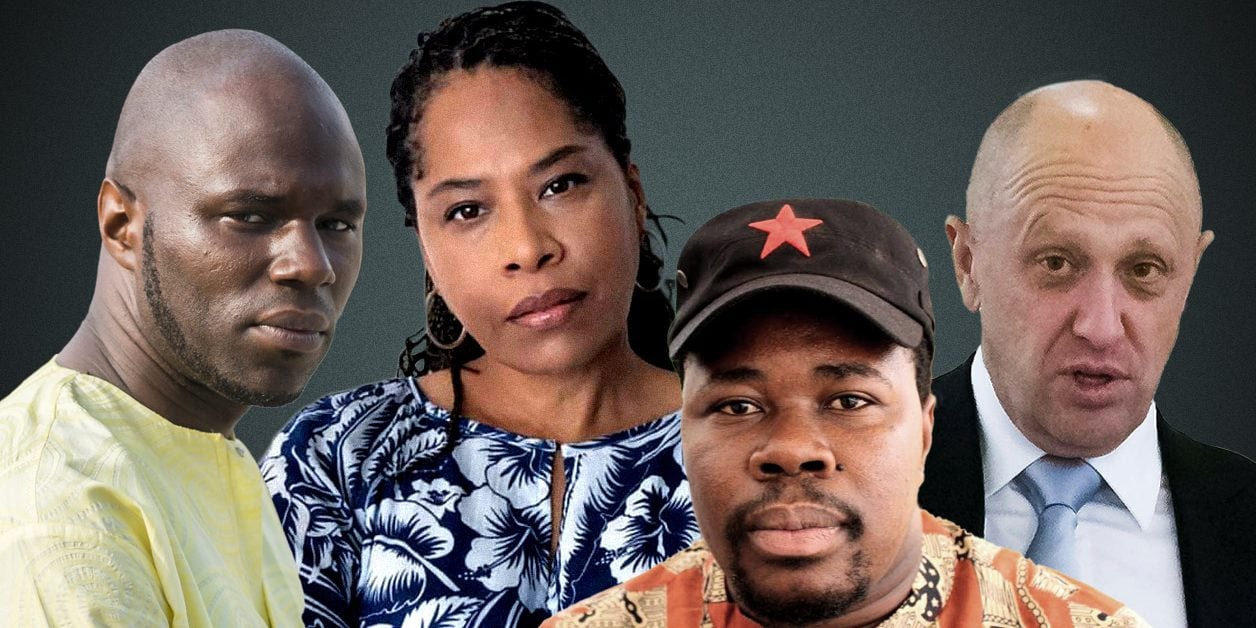
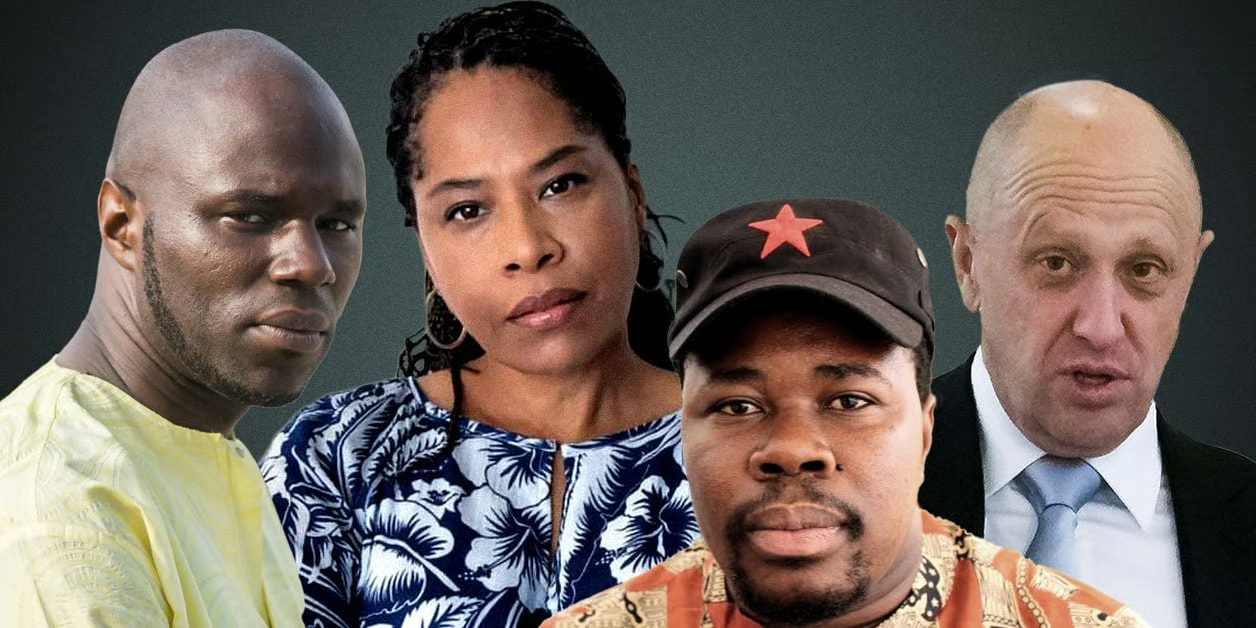
The Russian government’s influence in Africa has grown significantly in recent years, leveraging both media and political networks to spread its narratives. At the heart of this strategy is oligarch Evgueni Prigojine, a close ally of Vladimir Poutine and financier of the Wagner Group, whose operations extend across the continent.
To execute his plans, Prigojine relies on intermediary organizations such as the Afric (Association pour la recherche libre et la coopération internationale), led by Mozambican academic José Matemulane in Maputo and presided over by Ioulia Afanasieva, a Prigojine associate. This network facilitates pro-Kremlin messaging through partnerships with panafricanist media outlets like Radio Révolution panafricaine and Afrique Média TV, headquartered in Cameroon and owned by the Justin B. Tagouh-led Afrique Média press group.
Justin B. Tagouh has visited Sotchi twice and claims to have met Vladimir Poutine. Meanwhile, Banda Kani, president of Cameroon’s Nouveau mouvement populaire party, frequently appears on Afrique Média TV advocating pro-Moscow positions, including dismissing Ukraine’s Volodymyr Zelensky as a “criminal oligarch.” The station also hosts Kemi Seba, the Franco-Béninese militant known for his anti-French rhetoric.
Kemi Seba: from Moscow to the Sahel
Kemi Seba, founder of the Urgence Panafricaniste NGO, has cultivated ties with Russian nationalist ideologue Aleksandr Douguine, a key figure in anti-Western and anti-liberal circles within Putin’s inner circle. Seba met with Vladimir Poutine in 2017 and again in March 2022, where he also engaged with Mikhaïl Bogdanov, Russia’s Deputy Foreign Minister for Africa and the Middle East, during a lecture at the Moscow State Institute of International Relations.
In October 2020, Seba disclosed on Vox Africa that Evgueni Prigojine had invited him to Russia, Sudan, and Libya. Though Seba distanced himself from Prigojine after the oligarch proposed violent actions against Western symbols—even at the risk of collateral damage in Africa—he continues to amplify pro-Kremlin narratives on social media.
Nathalie Yamb: the “Lady of Sotchi”
Nathalie Yamb, a Cameroonian-Swiss activist and self-proclaimed “Lady of Sotchi” after attending the 2019 Russia-Africa Summit, is one of Africa’s most vocal critics of France. Her expulsion from Côte d’Ivoire in December 2019 followed her anti-French activism. According to the Free Russia Foundation, Yamb participated in a 2020 Berlin conference organized by the Afric and the Fondation pour la protection des valeurs nationales, a Prigojine-linked entity led by Russian “journalist” Alexander Malkevitch.
Since Russia’s invasion of Ukraine, Yamb has openly supported Moscow’s military actions. She is also affiliated with Côte d’Ivoire’s Lider party, whose Twitter account amplifies pro-Kremlin propaganda. Though party founder Mamadou Koulibaly has retired from politics, he visited Bamako in mid-March to back Mali’s junta—a move he framed as supporting “youth fighting for sovereignty.”
Mali: the Kremlin’s stronghold
In Mali, Adama Diarra (aka “Ben le cerveau”), spokesman for the pro-Russian movement Yerewolo – Debout sur les remparts, has emerged as a central figure. In September 2021, he confirmed rumors of negotiations between the Malian state and Wagner Group. As a member of the National Transitional Council, Diarra has since organized multiple pro-Moscow rallies, claiming that 50 Russian military experts have been deployed in Mali for over a month to assess the situation.
The Central African Republic: Radio-Kremlin on air
Russia’s influence extends to the Central African Republic (CAR), where Fred Krock runs the popular Lengo Songo radio station. Funded by Lobaye Invest—a Wagner-linked mining company initially managed by Evgueni Khodotov, a Prigojine loyalist—Lengo Songo amplifies voices of pro-Russian figures in Bangui, including former ambassador Vladimir Titorenko, presidential advisor Valeri Zakharov, sociologist Maksim Shugaley, and Aleksandr Ivanov, head of the Community of Officers for International Security (Cosi).
The station is a platform for civil society actors like Blaise Didacien Kossimatchi (a member of the pro-Touadéra “Galaxie nationale” platform) and Harouna Douamba, president of the Aimons notre Afrique association—both funded by Lobaye Invest and active in organizing pro-Russia demonstrations.
South Africa’s social media sphere also reflects this trend, with the Twitter account of Duduzile Zuma-Sambudla—daughter of former president Jacob Zuma—popularizing the #istandwithrussia hashtag, which has been shared hundreds of thousands of times. Most associated content denounces NATO and Western “imperialism.”