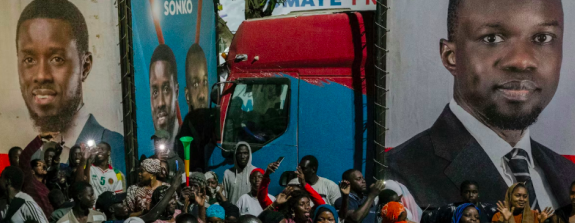
Since the dismissal of Ousmane Sonko from the Prime Minister’s office and the subsequent reshuffle of the executive branch, Senegal has entered a fresh political chapter. For the first time since 2024, when Bassirou Diomaye Faye assumed the presidency, the ruling party Pastef-Les Patriotes faces an unprecedented internal crisis.
Diverging paths within the party
The political landscape is now divided between two key figures: President Bassirou Diomaye Faye, whose authority stems from constitutional legitimacy, and Ousmane Sonko, whose influence remains rooted in his charismatic connection with the party’s base. This division has triggered a wave of departures among high-ranking officials who have chosen to align with the President rather than follow the party’s designated leader.
Several ministers, presidential advisors, directors-general, and even members of the National Political Bureau have abandoned the party line to support the Head of State. This exodus highlights a fundamental tension between two forms of legitimacy: the legal-rational authority derived from institutional power, and the charismatic authority built on personal devotion to a leader.
While the President draws strength from his constitutional mandate, Ousmane Sonko continues to command loyalty from thousands of militants who view him not just as a party leader, but as a political savior. This messianic perception has fueled accusations of excessive personalization within Pastef, with critics arguing that the party’s structure suffers from weak internal democracy and an over-concentration of power around Sonko’s figure.
Institutional capital vs. electoral base
The dissidents, who justify their departure by claiming to uphold the original “Project” of Pastef, argue that the President now embodies the movement’s true vision. However, this argument faces a critical challenge: most of those leaving are administrative officials whose political visibility was built through their association with Pastef—and specifically with Ousmane Sonko. Few possess an independent local political base or territorial anchorage comparable to established figures in Senegalese politics.
For the broader public, these dissidents remain political entities without clear identification—leaders whose influence is largely contingent on Sonko’s continued leadership. Their political capital is primarily institutional rather than electoral, meaning their departure does not necessarily weaken the party’s grassroots structure.
Pastef’s organizational resilience was on full display during recent events. The June 6 party congress, which reaffirmed Ousmane Sonko’s leadership with unanimous support, and his June 7 popular investiture at Dakar Arena—both held without the participation of dissidents—dominated national political discourse. Similarly, the July 4 launch of membership card sales sparked massive mobilization, demonstrating the party’s enduring capacity to mobilize supporters beyond its institutional elite.
The party’s ability to attract over sixty smaller political movements and parties ahead of the congress further underscores its organizational strength. This fusion reflects a mobilization capacity that extends far beyond the circle of institutional officials, largely due to the charismatic legitimacy Sonko maintains among the rank-and-file.
Can the dissidence reshape Senegal’s political future?
Despite these challenges, the risk of fragmentation cannot be ignored. The emergence of a rival presidential party could attract lawmakers seeking to preserve their access to state resources—a common pattern in African political systems. The coexistence of two centers of legitimacy—one institutional, centered on the President, and the other partisan, centered on Sonko—risks perpetuating tensions within the political sphere.
Yet, available evidence suggests the crisis primarily affects elites rather than the party’s grassroots. No mass departures have been observed at the local level, and Pastef’s identity—rooted in militant activism, economic patriotism, and popular mobilization—continues to define its loyal base.
The current crisis reveals less an existential threat to Pastef than a confrontation between two competing sources of legitimacy. The party’s future hinges on whether these forms of legitimacy can be translated into durable electoral strength. The central question remains: does Ousmane Sonko’s charismatic bond with the electorate retain its potency? Can he continue to deliver victories at the municipal, legislative, and presidential levels? The answer will shape not only the future of Pastef but also the broader evolution of Senegal’s political landscape in the coming years.