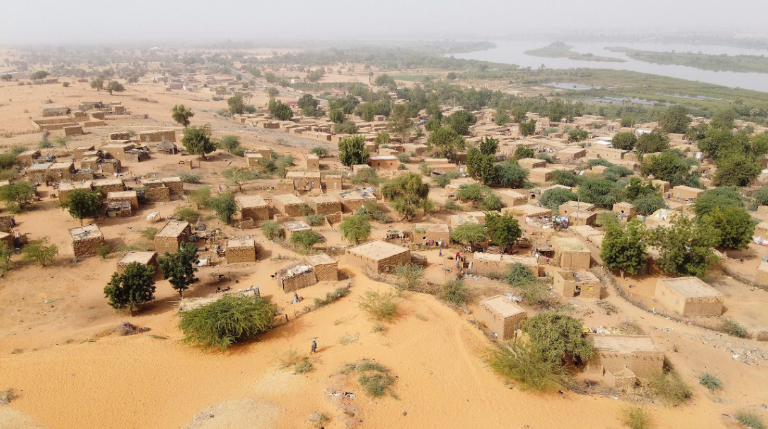
The recent ambush near Téra in Niger’s Tillabéri region, which left at least 37 civilians dead, is more than a tragic incident—it is a stark reminder of the deep-rooted vulnerabilities facing rural communities in the Sahel. This attack, targeting a convoy headed to market under the protection of local militias, reveals not just the escalating boldness of the Islamic State in the Sahel (EIS), but also the systemic gaps in civilian security that leave even escorted movements exposed to deadly violence.
Behind the attack: why even escorted convoys are no safe haven
The victims, hailing from Tillim, were part of a motorcade traveling to a local market when the assault occurred on a Thursday afternoon. Despite being accompanied by Domol Leydi militiamen—local self-defense groups deployed to counter armed incursions—this tragic outcome underscores a harsh reality: the tools communities are forced to rely on for protection are often insufficient against the coordinated attacks of a well-armed militant group such as EIS.
The Domol Leydi, formed as a grassroots response to the absence of consistent state security presence, play a crucial role in patrolling rural routes and village perimeters. Yet, their resources, training, and firepower pale in comparison to those of the jihadist network. The attack near Téra is not an isolated failure; it reflects a broader pattern where even fortified movement corridors become lethal traps when militant groups choose to strike with intent to terrorize and disrupt daily life.
The insurgency’s expanding shadow: ten days of targeted violence in western Niger
The ambush near Téra is not an anomaly but part of a disturbing trend in western Niger. Over the span of ten days, multiple attacks attributed to EIS have rocked the area, marking a deliberate campaign aimed at destabilizing civilian life and economic activity. The repetition of such violence is not random—it is strategic. By striking convoys, burning fields, and targeting livestock, insurgents aim to erode economic resilience, push communities into survival mode, and deepen distrust in state and local institutions.
These attacks occur against the backdrop of Tillabéri’s geographic vulnerability. As a nexus at the intersection of Niger, Mali, and Burkina Faso—the infamous “tri-border zone”—the region remains a hotbed for jihadist mobilization. The Islamic State in the Sahel, alongside other groups such as the Group for the Support of Islam and Muslims (JNIM), has capitalized on porous borders, weak governance, and the disillusionment of rural youth to expand its influence.
When routine becomes a gamble: the cost of everyday survival
For residents of Tillabéri, the march to the weekly market is not just a social custom—it’s an economic lifeline. Farmers bring goods to sell, traders restock supplies, and families connect after long weeks in isolation. Yet, this essential movement now carries mortal risk. The mental and social toll is immense: parents weigh the danger of sending children to school, farmers avoid distant fields, and elders advise against traveling after dusk.
The psychological impact is just as devastating as the human loss. Markets grow less vibrant, agricultural cycles shorten, and communities fragment under the weight of fear. The attack near Téra has now etched another scar into the collective memory, one that will linger long after the bodies are buried and the headlines fade.
The Domol Leydi dilemma: community defense in the crossfire
Domol Leydi militias represent one of the few tangible defenses available to rural Nigeriens. Formed organically in response to state shortcomings, these self-defense units are a testament to community resilience. Yet, their effectiveness is contingent on more than goodwill. Without regular military training, reliable communication equipment, or backup from national defense forces, their role is inherently limited—and vulnerable to exploitation by better-armed adversaries.
The failure to prevent the Téra attack despite their presence raises critical questions: Is civilian protection merely a stopgap measure? Can communities ever be truly secure when public safety infrastructure remains thin and sporadic? The answer lies not in relying solely on local militias, but in building integrated security systems that include intelligence, rapid response teams, and safe passage protocols for civilians.
Tillabéri’s silent crisis: human cost beyond the headlines
The 37 lives lost near Téra were not just numbers in a report—they were fathers, mothers, sons, and daughters whose journeys ended in bloodshed. Their deaths are not just a statistic; they are a wake-up call. They expose how insurgency doesn’t just kill—it dismantles livelihoods, displaces families, and hollows out the social fabric of entire villages.
The humanitarian ripple effect extends far beyond the attack site. Disrupted markets mean food shortages. Displaced herders lose livestock and income. Children abandoned by fleeing families face trauma and interrupted schooling. The attack near Téra is a microcosm of a larger existential crisis: in the Sahel, the war isn’t only fought between armies—it’s waged on the bodies of civilians, on the paths they once walked freely, and in the markets they once trusted to be safe.
What comes next for Niger’s embattled west?
For Tillabéri and its people, the immediate future is fraught with dread. Community leaders now face an impossible choice: continue life as usual under threat, or retreat into isolation and economic stagnation. The state’s response must go beyond rhetoric and short-term operations. It requires sustained investment in rural security, community trust-building, and economic alternatives that reduce dependence on dangerous transit routes.
Civilian protection cannot be an afterthought. The attack near Téra was preventable in principle—had coordination between local militias, village councils, and national forces been stronger. But prevention demands more than good intentions. It requires vision, investment, and an acknowledgment that in Tillabéri, every unarmed civilian movement is a potential target—and every life lost is a community diminished.