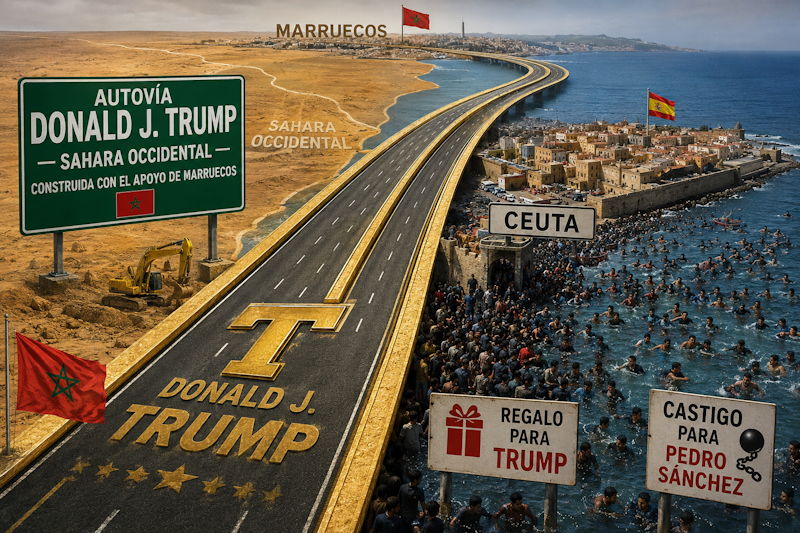
In a bold diplomatic maneuver, Morocco is leveraging both symbolic gestures and strategic pressure to advance its claim over the Western Sahara. With a newly renamed highway honoring Donald Trump and a sudden surge of migrants at the Spanish enclave of Ceuta, Rabat is sending unmistakable signals to Washington and Madrid.
As the Trump administration returns to the White House, Morocco has intensified efforts to secure definitive U.S. backing for its sovereignty over Western Sahara—a territory it has administered since Spain’s withdrawal in 1975. The move comes amid escalating tensions with Spain, particularly over the enclave of Ceuta, which Morocco does not recognize as Spanish territory.
Trump Highway: a symbolic tribute with far-reaching impact
In a striking display of gratitude, King Mohammed VI has named the Tiznit-Dakhla highway—one of Africa’s longest road infrastructures—after Donald J. Trump. The decision, announced through the official MAP news agency, reflects Morocco’s appreciation for the former U.S. president’s 2020 recognition of Moroccan sovereignty over Western Sahara.
The 1,055-kilometer route, which connects southern Morocco to Dakhla via Laâyoune in the heart of Western Sahara, is described by the king as a vital link uniting the country from north to south and connecting Europe to Africa. Trump responded swiftly on Truth Social, calling the honor “tremendous” and expressing eagerness to visit the highway soon.
Ceuta crisis: migration as a diplomatic weapon
While the Trump Highway garners international attention, Morocco’s real leverage lies elsewhere. At the end of July, nearly 60,000 migrants breached the border into Ceuta within hours, triggering a humanitarian and diplomatic emergency. Spanish authorities reported at least 57 deaths, including drownings and trampling incidents, while Morocco officially acknowledged 11 fatalities.
Ceuta, one of the European Union’s two land borders with Africa, sits at the heart of strained Hispano-Moroccan relations. Morocco has long contested Spain’s claim to the enclave, labeling it an “occupied territory.” The timing of the crisis—just days after Spanish Prime Minister Pedro Sánchez visited Algeria to restore ties—was no coincidence.
A familiar playbook with new stakes
This is not the first time Morocco has used migration as a bargaining chip. In May 2021, a similar rush of 8,000 migrants forced Spain to reconsider its stance on Western Sahara, leading Madrid to support Morocco’s autonomy plan after treating Polisario Front leader Brahim Ghali for medical care.
Analysts warn that Rabat’s strategy has evolved. “Morocco seeks more than just autonomy for Western Sahara—it wants formal recognition of its sovereignty,” notes Carlos Ruiz Miguel, director of the Western Sahara Studies Center at the University of Santiago de Compostela. The current crisis suggests a more assertive approach, especially following Spain’s outreach to Algeria, a regional rival.
Washington’s role in the equation
The United States has emerged as Morocco’s strongest ally in the Western Sahara dispute. Secretary of State Marco Rubio recently reiterated U.S. recognition of Moroccan sovereignty, while Trump called Morocco’s autonomy proposal “the only basis for a just and lasting solution.” The White House has also criticized Spain’s migration policies, with a spokesperson warning that Madrid risks “undermining its own stability.”
Europe’s divided response
The Ceuta crisis has sent shockwaves across the European Union. Italy temporarily suspended Schengen agreements with Spain, joined by Finland and Denmark. Belgian politician Georges-Louis Bouchez even called for a partial suspension of Spain from the Schengen Zone.
“Morocco has demonstrated its willingness to use migration as a retaliatory tool against Spain, which remains vulnerable due to its North African enclaves,” explains Paul Melly, a researcher at Chatham House. The episode underscores a shifting geopolitical landscape in which Morocco holds significant leverage.
A clear message to Madrid and beyond
Rabat’s strategy is unmistakable: it is not the Trump Highway that passes through Ceuta, but a message of equal clarity. By combining symbolic overtures to Washington with targeted migration pressure on Madrid, Morocco is weaving a diplomatic web designed to strengthen its position on Western Sahara. European and Spanish negotiators are now acutely aware of the stakes—and Morocco’s willingness to play hardball.
You may also like
As donor fatigue spreads, can Benin’s €544,042 UNAIDS pledge keep the HIV response on track?
Who pays the price when Burkina Faso’s public payroll contracts? Households weigh the cost of 1,917 fewer agents
Libya pushes for direct Tripoli-Yaoundé flights as Cameroon sets up working groups
JNIM seizes three Burkinabè positions in a single day as Traoré’s security record faces hard questions
Chad condemns Ennedi-East airstrikes at un general assembly, warns of retaliation