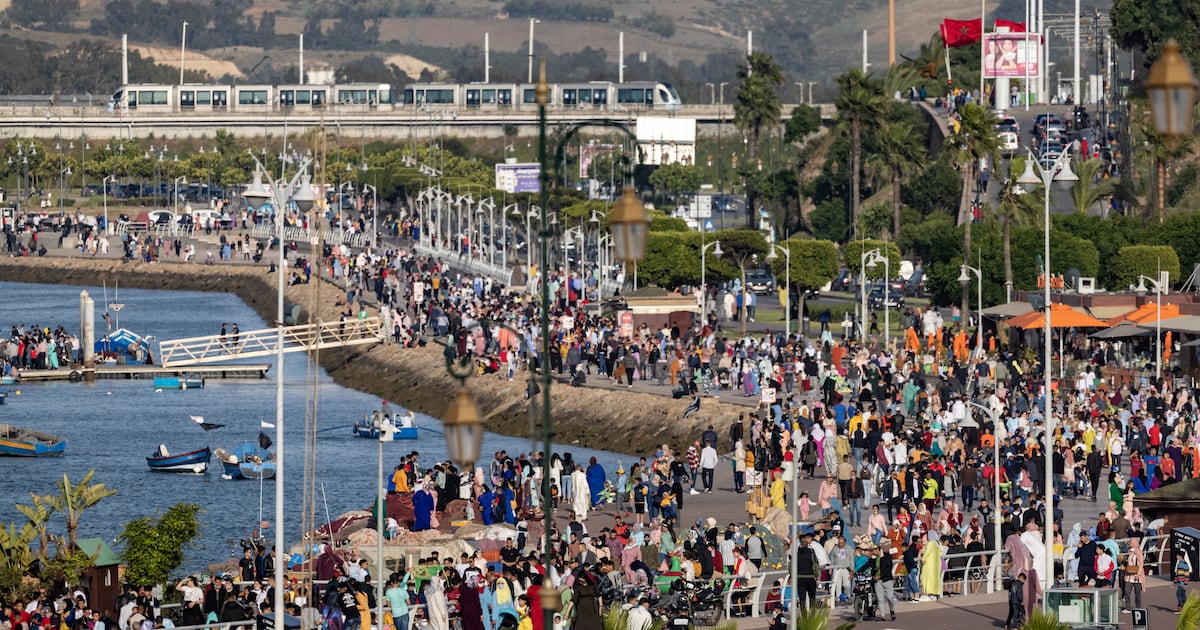
The High Planning Commission has unveiled its latest population projections for Morocco, spanning 2024 to 2060. These projections model various trajectories based on fertility rates, mortality trends, and migration flows, offering a glimpse into the kingdom’s future demographic landscape.
a slowdown in population growth
Under the central scenario, Morocco’s population is expected to rise from 36.8 million in 2024 to 43.3 million by 2060, marking a 17.8% increase over 36 years. This translates to an average annual addition of 182,000 inhabitants. However, the annual growth rate, currently at 0.7% in 2024, is projected to gradually decline, approaching zero by 2060. This signals a shift toward near-stagnation in demographic growth, following decades of steady expansion.
urban dominance and rural decline
Urban areas are set to absorb the vast majority of this growth, with the urban population swelling from its current level to nearly 32.5 million by 2060—representing about three-quarters of the total population. Conversely, rural populations will shrink to approximately 10.8 million. This shift, the Commission warns, will intensify pressures related to urbanization, demanding urgent public policy responses in housing, infrastructure, and social services to prevent territorial imbalances.
At the same time, the institution emphasizes the need to bolster rural development. Improving living conditions, retaining young populations, and leveraging local resources are critical to maintaining social and territorial balance in the decades ahead.
declining youth populations: implications for education
The projected decline in fertility will lead to a marked reduction in the number of young people. The preschool-age cohort (4–5 years) is expected to shrink by 23.8%, from 1.25 million to 960,000. Similarly, the primary school-age group (6–11 years) will decrease by 27%, falling from 4.16 million to 3.04 million. The middle school cohort (12–14 years) is projected to decline by 22.9%, and the secondary school group (15–17 years) by 11.4%.
These trends present an opportunity for educational policy reform. With fewer children entering the system, resources previously allocated to expanding classroom capacity can be redirected toward enhancing teaching quality, improving curricula, and strengthening pedagogical support.
working-age population: growth unevenly distributed
The population aged 15 to 59—considered the working-age bracket—will continue to grow, rising from 22.08 million in 2024 to nearly 24.96 million by 2060, an increase of 13.1%. This translates to an average annual gain of about 80,190 people. However, this growth is far from uniform: in urban areas, driven by rural-to-urban migration, the working-age population is expected to expand by 34.4%, from 14.2 million to 19.1 million. In rural zones, it will decline sharply by 25.4%, from 7.9 million to 5.9 million.
The Commission cautions that this urban-centered surge will place significant pressure on labor markets in cities, where the incoming workforce from rural areas must be absorbed. Meanwhile, the 18–24 age group—the primary cohort entering the job market—will see a slight national decline of 3.1%, though this masks contrasting trends: an 11.3% increase in cities and a 28.3% drop in rural areas.
The 50–59 age group will experience a substantial rise of 44.9% nationally, driven by a 76.6% increase in urban areas, while rural regions will see a 17.4% decline. This demographic window—where the working-age population grows faster than dependent cohorts—offers a strategic opportunity. However, it is temporary. As the number of retirees grows, the structural advantages of a younger workforce will diminish, underscoring the need to maximize productivity and skill utilization before the aging wave fully arrives.
aging population: a demographic revolution
Perhaps the most transformative change lies in the rapid aging of Morocco’s population. The number of people aged 60 and over is set to more than double, rising from 5 million in 2024 to 10.9 million in 2060. This cohort will represent 25.2% of the total population, up from just 13.6% today. Such a shift—nearly tripling in relative size over 36 years—has no precedent in recent Moroccan history. Urban areas will experience the most dramatic increase, with the elderly population multiplying 2.5 times, from 3.18 million to 8.06 million, compared to a 1.6-fold rise in rural areas, from 1.81 million to 2.83 million.
The 70+ age group will see even more pronounced growth, tripling in size from 2.06 million to 6.3 million. Urban octogenarians will surge by 256%, from 1.25 million to 4.44 million, while rural numbers will nearly double, from 810,000 to 1.86 million. This acceleration stems from the fertility decline that began in 1975—the onset of Morocco’s demographic transition—as well as sustained reductions in mortality and, to a lesser extent, migration patterns.
The aging trend will significantly raise the dependency ratio—the number of dependents (both young and elderly) per working-age adult. This shift will strain pension systems, increase demand for geriatric healthcare, and challenge intergenerational family structures, especially as urbanization weakens traditional support networks. The Commission stresses that population aging is not a temporary fluctuation but a permanent structural trend, regardless of future fertility or migration scenarios.
policy priorities for a changing nation
To navigate this transformation, Morocco must act now. Policymakers face a dual challenge: adapting education systems to smaller cohorts, managing labor markets amid urban migration flows, and preparing for the surge in elderly care needs. The Commission calls for integrated strategies in education, employment, territorial planning, and social protection to ensure a smooth transition into a future where growth slows but aging accelerates.