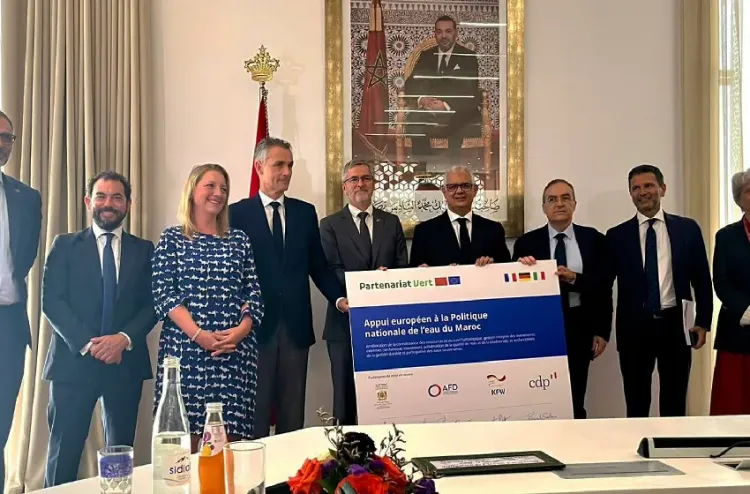
Morocco and the European Union have launched a landmark water partnership, earmarking 3.7 billion Moroccan dirhams (348 million euros) to bolster the country’s National Water Plan. The initiative, unveiled in Rabat, combines European Union grants with concessional loans from three European financial institutions under the Team Europe approach, according to an official announcement.
Funding structure and key contributors
The program draws on a 514.4 million Moroccan dirham (48 million euro) EU grant, augmented by three concessional loans totaling approximately 3.2 billion Moroccan dirhams (300 million euros). These funds are mobilized through the JEFIC network, with the German development bank KfW, Italy’s Cassa Depositi e Prestiti (CDP), and France’s Agence Française de Développement (AFD) leading the financing effort. The collaboration was jointly announced by Morocco’s Ministry of Equipment and Water, the EU delegation, and the ambassadors of Germany, Italy, and France, who serve as co-leads in this financing mechanism.
Strategic objectives under climate pressures
The initiative focuses on three core priorities: deepening understanding of water resources amid climate change, strengthening resilience against extreme weather events such as droughts and floods, safeguarding groundwater reserves, and enhancing institutional capacities within the water sector. As Nizar Baraka, Morocco’s Minister of Equipment and Water, emphasized, the program will reinforce the country’s revised water strategy, which has been reshaped in response to persistent drought conditions.
Diplomatic backing and thematic focus
French Ambassador Philippe Lalliot highlighted the pivotal role of AFD in driving this initiative. EU Ambassador to Morocco Dimiter Tzantchev framed the program within the broader Morocco-EU Green Partnership and the Mediterranean Pact, both designed to strengthen joint action on shared climate challenges. German Ambassador Robert Dölger underscored KfW’s targeted support for climate adaptation and groundwater protection. Meanwhile, Italian Ambassador Pasquale Salzano linked Italy’s contribution to advancing gender equality, identifying it as a key enabler for the program’s success.
Together, these efforts are set to reinforce both the National Water Plan and the National Program for Drinking Water Supply and Irrigation (PNAEPI) covering 2020–2027, ensuring long-term sustainability and resilience in Morocco’s water management.