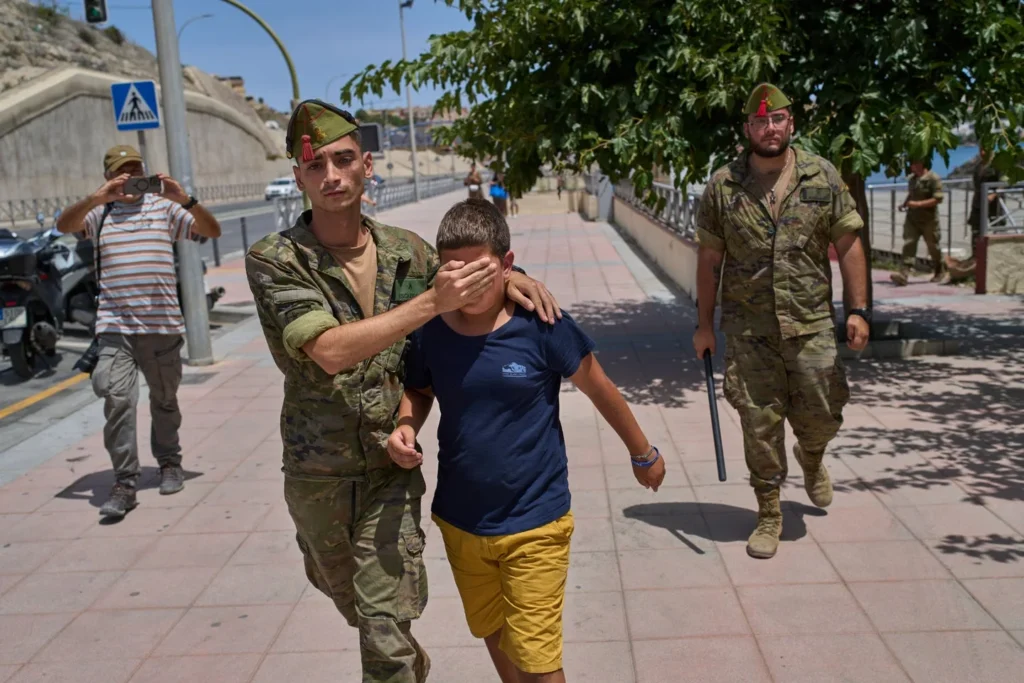
Morocco urges spain to facilitate return of unaccompanied minors
The Moroccan Minister of Justice, Abdellatif Ouahbi, has formally requested the swift repatriation of Moroccan minors currently in Spain, including those who arrived in Ceuta during the recent migration surge. This appeal follows direct instructions from the Moroccan monarch to relevant ministries, emphasizing the need for streamlined identification and return procedures for these vulnerable youth.
While the exact number of affected minors remains unclear, Spanish authorities reported 1,527 unaccompanied minors in Ceuta following the crisis, as of August 12th. Notably, this figure includes individuals who were already present in the enclave prior to the late July migration wave.
A bilateral agreement governs repatriation efforts
Contrary to common misconceptions, Spain does not outright prohibit the return of Moroccan minors. Since 2007, Madrid and Rabat have maintained a bilateral agreement focused on preventing irregular migration among unaccompanied minors, ensuring their protection, and facilitating their coordinated return. The agreement outlines cooperation between the two nations to trace the families of these children and, when feasible, arrange their return to Morocco or transfer them to Moroccan authorities.
However, the agreement does not permit mass or automatic repatriations. Spanish law mandates an individual assessment for each minor to determine whether their return aligns with their best interests. This process involves gathering family background details, consulting Moroccan authorities, and allowing the child to present their own perspective. The public prosecutor’s office also plays a critical role in these evaluations.
The requirement for case-by-case reviews explains why minors could not be treated identically to adults during the initial pushback operations. Their irregular entry into Spain does not negate their status as minors under Spanish protection laws.
2021 Ceuta crisis casts long shadow over current repatriation plans
The cautious approach to repatriation is deeply influenced by the events of August 2021, when hundreds of minors were returned to Morocco during a coordinated operation following a mass migration influx into Ceuta. The Spanish judiciary later ruled this process unlawful in January 2024, citing failures to comply with legal safeguards—particularly the absence of thorough individual assessments for each minor.
This legal precedent now poses significant challenges to any future collective repatriation efforts. Despite Morocco’s demands for the return of its citizens and Spain’s interest in alleviating Ceuta’s overcrowding, Spanish authorities must rigorously ensure that every repatriation complies with national and international legal standards.
Alternative measures: distributing minors across spain
In the interim, Spain is implementing emergency measures to address Ceuta’s overstretched resources. The government has activated protocols to relocate some unaccompanied minors to other autonomous communities. Importantly, this relocation strategy operates independently of potential repatriation efforts to Morocco—both processes are distinct and run concurrently.
Political tensions are already simmering in Spain over this issue. The central government advocates for the distribution of minors across regions to ease pressure on Ceuta, while the opposition Partido Popular insists that repatriation to Morocco should take precedence. Juan José Imbroda, President of Melilla, has also publicly endorsed the immediate application of the 2007 agreement with Morocco.
The core challenge ahead lies in determining whether bilateral cooperation can expedite family tracing and fulfill the necessary conditions for repatriation. The 2021 legal fallout serves as a stark reminder that hastily executed collective operations risk renewed judicial challenges. Success will depend on balancing legal compliance with the urgent humanitarian needs of these minors.
You may also like
As donor fatigue spreads, can Benin’s €544,042 UNAIDS pledge keep the HIV response on track?
Who pays the price when Burkina Faso’s public payroll contracts? Households weigh the cost of 1,917 fewer agents
Libya pushes for direct Tripoli-Yaoundé flights as Cameroon sets up working groups
JNIM seizes three Burkinabè positions in a single day as Traoré’s security record faces hard questions
Chad condemns Ennedi-East airstrikes at un general assembly, warns of retaliation