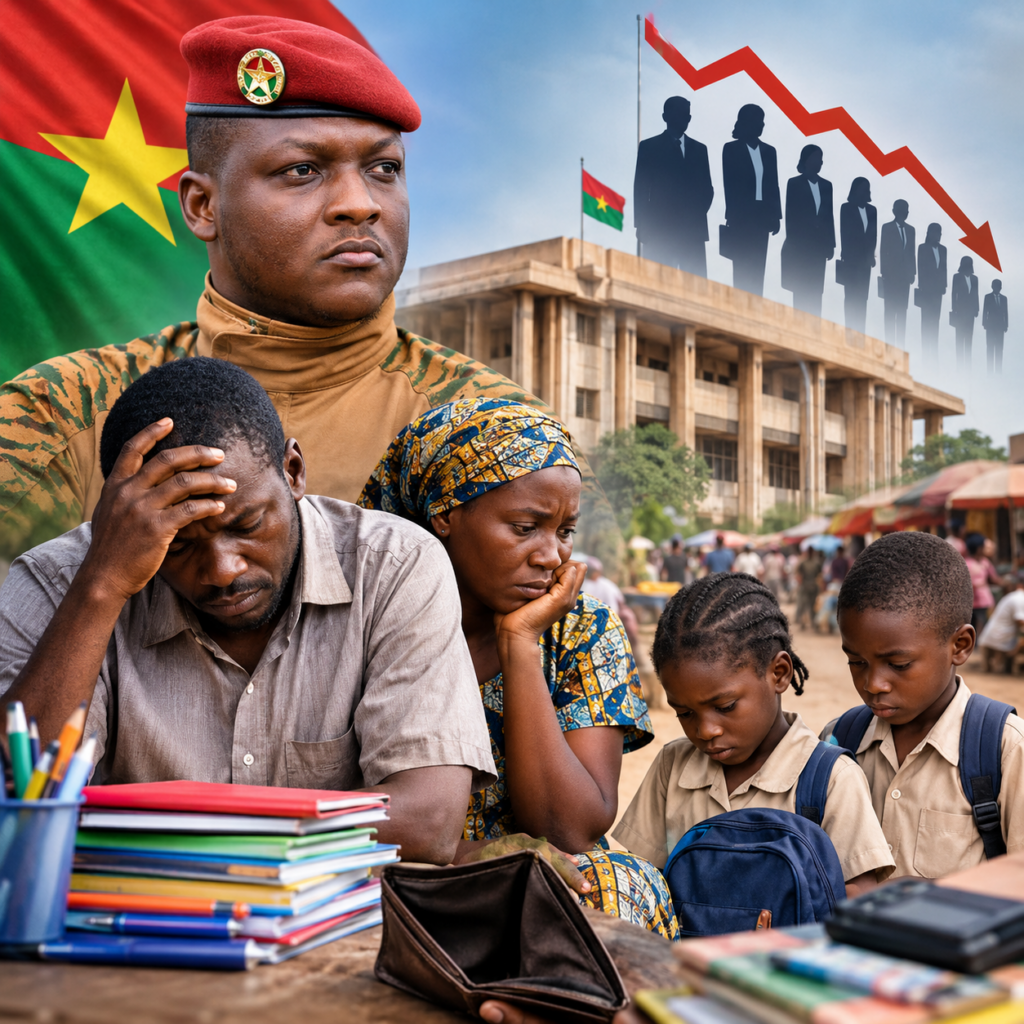
As Burkina Faso opens a new school year, an uncomfortable question settles over thousands of homes: when the state’s own workforce contracts, who absorbs the shock? For many families, the answer is not written in administrative reports but in school fees, food budgets and rent that still fall due.
This year, the start of classes coincides with a social reality that weighs heavily on a large number of households. The figures trace a clear trajectory: the number of salaried agents on the state’s Public Service payroll moved from 204,310 in 2021 to 202,393 in 2025, a net decline of 1,917 agents spread across four years.
The arithmetic of a four-year contraction
Broken down, the workforce recorded in 2025 comprises the following categories:
- 140,438 men;
- 61,955 women.
Reduced to a curve on a page, the shift looks modest. Read against the country’s social fabric, it takes on a different weight altogether.
Behind every post, a family ledger
What the aggregate numbers obscure is that a public employee is never merely a line in an administrative register. That person may be the primary breadwinner of a household, the one who covers tuition, housing, food and the small daily expenses that keep a family standing.
It is precisely here that the contraction acquires a social dimension. At the very moment when Burkinabè families confront the costs of the school year, any reduction in regular income can translate quickly into painful trade-offs: fees, supplies, meals or medical care, with one priority necessarily sacrificed for another.
A school year that converts a trend into a household dilemma
The timing sharpens the stakes. For some parents, the immediate concern is no longer simply preparing a child for a new academic year, but finding the means to finance it at all. A payroll that shrinks by nearly two thousand agents over four years produces, at the household level, a series of private decisions that no official communiqué will record.
Sovereignty rhetoric and the unanswered question of daily survival
Since Ibrahim Traoré assumed power, the official discourse has consistently foregrounded sovereignty, national mobilisation and the transformation of Burkina Faso. Yet beneath the grand declarations and economic announcements, the central question remains a domestic one: how many families today genuinely hold a stable income sufficient to meet their obligations?
That question does not disappear because it is inconvenient. It sits at the kitchen table of every household balancing a budget that no longer stretches far enough.
What the data cannot yet establish
Intellectual honesty requires a qualification. A decline in Public Service staffing does not, on its own, justify the claim that every agent concerned has been pushed into unemployment, nor does it allow each departure to be attributed mechanically to a personal decision by Ibrahim Traoré. The precise causes of this evolution still need to be documented: retirements, recruitment, non-renewal of contracts, administrative restructuring, or other workforce management measures.
None of that, however, removes the social debate from the table.
Classrooms, markets and homes: the wider ripple
When a household loses its main source of income, the consequences do not stop at the gates of an administration. They travel into classrooms, markets and living rooms. Every public position eliminated or left unfilled can generate an economic effect far broader than its own scope, particularly when it represented the principal revenue of a family.
Multiply that single case by hundreds, and the result is a quiet redistribution of hardship across neighbourhoods that rarely appear in fiscal summaries.
The test now facing the authorities
The real challenge for Burkina Faso’s leadership is therefore to demonstrate that the choices made in managing the state do not translate into further fragility for its households. That demonstration cannot rest on rhetoric alone; it requires visible evidence that families are being shielded rather than exposed.
Because behind the statistics of the Public Service there are people who live, consume, send their children to school and strive to preserve their future. The question posed at the start of this school year is ultimately the one that matters most: who pays the price when the payroll contracts, and whether those households can bear it.
You may also like
Senegal’s December 2, 2026: will Diomaye Faye dissolve parliament or play the long game?
Senegal’s 2026 budget revision: can Dakar still rescue its growth and investment agenda?
Senegal’s 2026 revised budget: a trap vote for Pastef or a necessary evil?
As donor fatigue spreads, can Benin’s €544,042 UNAIDS pledge keep the HIV response on track?
Burkina Faso’s armored vehicles: can Faso Armored’s 300-unit claim survive the scrutiny?