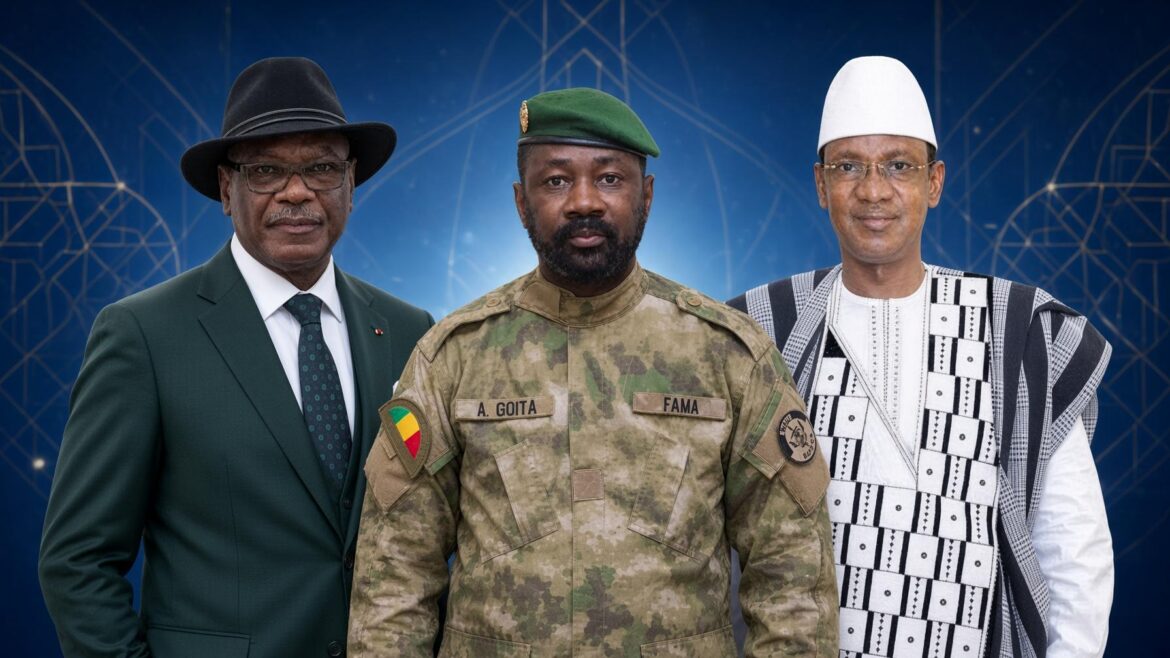
The once-dominant figures of Mali’s political scene have vanished from the public eye. For decades, they shaped governments, dominated televised debates, and filled convention halls, but since the ascent of General Assimi Goïta and the military junta, the old political elite is no longer just sidelined—it has been systematically dismantled.
What began as a purge of dissenters has evolved into a calculated erasure of an entire political generation. Through a mix of legal pressure, physical displacement, and psychological silencing, the junta has dismantled the very institutions that defined Mali’s democratic experiment. The question now isn’t just about who has disappeared, but why this strategy persists and what it reveals about power under authoritarian rule.
The three-pronged strategy: how the junta dismantled Mali’s political establishment
The collapse of Mali’s traditional political class wasn’t accidental—it was engineered. The junta’s approach followed a clear, three-part blueprint designed to neutralize, isolate, and eliminate any challenge to its authority:
1. Legal weaponization: prosecutions as tools of control
The justice system, once a battleground for political rivalry, has been repurposed into an instrument of repression. Prominent party leaders, former ministers, and even long-time allies of the regime have been arrested under vague charges such as “undermining state security,” “subversive remarks,” or “financial misconduct.” The prolonged detentions serve a dual purpose: they remove rivals from the scene and send a chilling warning to anyone who might resist.
One of the most telling cases is that of former Prime Minister Choguel Maïga, once a key architect of junta-aligned narratives. Despite his initial alignment with General Goïta’s vision, Maïga now faces open-ended detention, proving that loyalty offers no protection when power consolidates. His fate underscores a harsh reality: under the junta, the law is not a judge—it is a weapon.
2. Forced exile: the slow fade of dissenting voices
For those who escaped imprisonment, exile became the next best option—not by choice, but by necessity. Facing arrest warrants or daily harassment, dozens of politicians, civil society leaders, and activists fled to neighboring countries such as Côte d’Ivoire, Senegal, or farther afield to France. Cut off from their base, these exiled figures struggle to maintain influence as the junta tightens control over national discourse from Bamako.
While some continue to speak out from abroad, their impact has dwindled. State-aligned media dominates the narrative, and platforms for dissent—whether press conferences or public debates—have been systematically dismantled. The junta’s ban on political activities and dissolution of opposition-leaning associations have further weakened any organized resistance.
3. Self-censorship: the quiet survival of those left behind
For the few who remain in Mali, the message is unambiguous: silence is survival. Political parties are suspended. Civic organizations are dissolved. Any public criticism is swiftly labeled as support for “destabilizing forces,” a phrase often used to justify further crackdowns. The result is a political landscape emptied of debate, where former strongmen now speak in hushed tones—or not at all.
The fear is not just institutional; it is visceral. The junta’s supporters patrol public spaces, monitor online activity, and report perceived threats. The old political class, once accustomed to unfettered access to power, now navigates a minefield of uncertainty.
From scapegoat to system: how the junta turned public frustration into absolute control
The dismantling of Mali’s political elite wasn’t driven solely by repression—it was enabled by public fatigue. After 30 years of multiparty democracy marked by corruption scandals, weak governance, and a spiraling security crisis, many Malians welcomed the junta’s early promises of reform. By blaming the “traditional political class” for the nation’s failures, the junta positioned itself as the sole legitimate force capable of salvation.
Yet what began as a populist narrative quickly hardened into permanent institutional lockdown. Delayed elections, bypassed democratic processes, and the creation of tailor-made transitional bodies have stripped political parties of their former influence. Once the kingmakers of Malian politics, they now watch as their legacy is dismantled—and their future erased.
The paradox of power: stability without opposition
The junta’s campaign against the old guard has succeeded in creating an eerie calm. Without visible dissent, the streets of Bamako appear stable. But beneath the surface lies a dangerous vacuum: no structured opposition means no real debate on national priorities—only the unchecked authority of a military leadership focused narrowly on security.
By eliminating former rivals through imprisonment, exile, or silence, the junta has assured short-term stability. But in doing so, it has also eliminated the possibility of renewal. A political system without new leaders or fresh ideas risks becoming a relic—a hollow structure incapable of addressing complex challenges like terrorism, economic stagnation, or social unrest.
The irony is stark: in silencing the voices of the past, the junta may have unwittingly doomed its own future. A country cannot thrive without a functioning political ecosystem—and right now, that ecosystem is dormant.
What’s next for Mali’s political future?
Two paths lie ahead. One leads to continued authoritarianism, where power remains concentrated in the hands of a few and dissent is permanently suppressed. The other requires the junta to recognize that political reform isn’t a threat—it is the foundation for long-term stability.
Yet for that to happen, the cycle must be broken. The junta must allow the return of political pluralism, restore suspended parties, and end arbitrary detentions. Only then can Mali begin to heal—not from the wounds of the past, but from the silence of the present.
Until then, the old political elite will remain ghosts—present in name only, their influence evaporated, their legacy erased. And Mali, caught between fear and hope, waits to see what rises from the ashes.