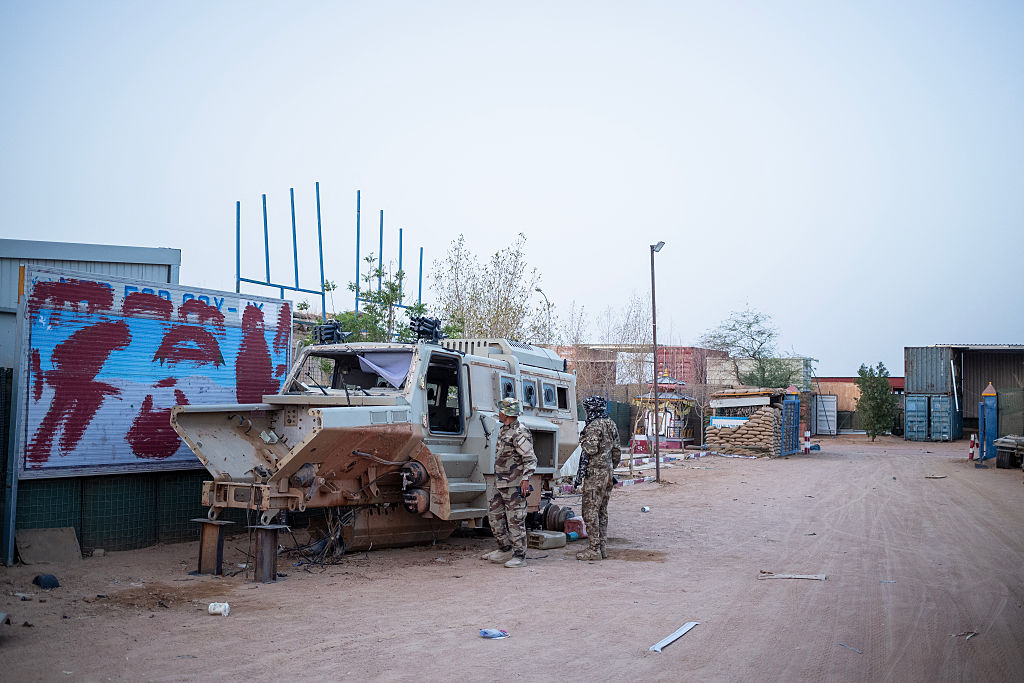
Russia’s Africa Corps is repositioning its personnel from Mali’s northern territories, focusing on safeguarding the capital and the governing junta. This strategic move includes offering aerial support and crucial intelligence to Malian soldiers operating in the field.
Analysts observe a distinct shift towards a more auxiliary function for the Africa Corps. Benedict Manzin, a leading Middle East and Africa analyst, noted their efforts to avoid further casualties. He explained their strategy involves minimizing personnel exposure while maximizing operational impact.
The Africa Corps took over from the infamous Wagner Group mercenaries around mid-2024. This transition followed a significant loss of Wagner fighters in an ambush orchestrated by the Azawad Liberation Front (FLA) near Tin Zaouatine, close to the Algerian border, where they clashed with Malian forces.
As a unit under the Russian Ministry of Defense, the Africa Corps maintains a presence of approximately 2,000 individuals within Mali, many of whom are former Wagner mercenaries. This contingent represents a notable reduction compared to the previous Wagner force and is roughly half the size of the French Operation Barkhane counter-terrorism mission, which the Malian junta expelled in 2022.
The fall of Kidal in northern Mali to the FLA and the Group for the Support of Islam and Muslims (GSIM) in late April appears to have been a pivotal factor in the Africa Corps’ decision to consolidate its presence around its primary base in Bamako.
In response, the Africa Corps executed retaliatory airstrikes against Kidal, which resulted in significant infrastructure damage and prompted residents to flee. These aerial operations were conducted to bolster the Malian Armed Forces (FAMa), now the primary ground force in the nation’s northern regions.
“Their reliance on air assets is evident,” observed Benedict Manzin. This has notably involved the recent deployment of Russian-made cluster munitions against communities in the Kidal region, a clear violation of Mali’s commitments under the international convention prohibiting their use.
“The Africa Corps operates with fewer expendable resources,” Manzin explained, adding that they are unwilling to disperse them across small northern communities where they could be vulnerable to attrition.
An examination of the Africa Corps’ recent social media communications reveals a clear shift in focus towards central and southern Mali, with the majority of their operations now concentrated near Bamako.
Following their withdrawal from Kidal, the Africa Corps significantly escalated its propaganda efforts, disseminating over 500 posts across Telegram and other platforms in the weeks subsequent to the setback.
Beyond aerial assaults, the Africa Corps has also sought to circumvent economic blockades imposed by the GSIM in Mali. Africa Corps personnel and air support have begun escorting truck convoys entering the landlocked nation from Côte d’Ivoire, Guinea, and Senegal, providing protection against GSIM attacks.
Despite the Africa Corps’ efforts to minimize its battlefield presence, the GSIM is deploying drones to target Russian personnel at their bases.
Recent GSIM videos shared on social media depict drone footage showing Russian fighters killed and Russian aircraft damaged by bombs dropped from drones over their base in Sévaré.
In turn, the Africa Corps has initiated its own armed drone strikes against GSIM positions in recent weeks, including targeting a GSIM fuel depot in the Timbuktu region.
Mali has allocated nearly a billion dollars for the services of the Wagner Group and subsequently the Africa Corps since late 2021. Throughout this period, the Malian government and its Russian partners have seen their control over the North diminish, while the GSIM has expanded its influence across the Sahel. This expansion is attributed, in part, to the brutal tactics employed by both Russian forces and the FAMa against civilians in the northern regions.
“The Malian state’s current strategy is proving ineffective,” Benedict Manzin concluded, warning that “in the long term, the stability of the state itself is at risk. Regrettably, the outcome is an increase in GSIM’s power, as communities are driven into their embrace.”
You may also like
Can OL Lyonnes still top the group after Chelsea stalemate?
Can Togo’s mediation still deliver peace in eastern DRC after Tshisekedi’s latest letter to Gnassingbé?
Mali: did the JNIM ambush on Africa Corps near Niono expose a fatal gap in Russia’s Sahel strategy?
Will Mali’s 73.6 million dollar funding gap decide the fate of millions by 2027?
Guinea-Bissau’s December 2026 vote: can Embaló return legally, and can the result ever be trusted?