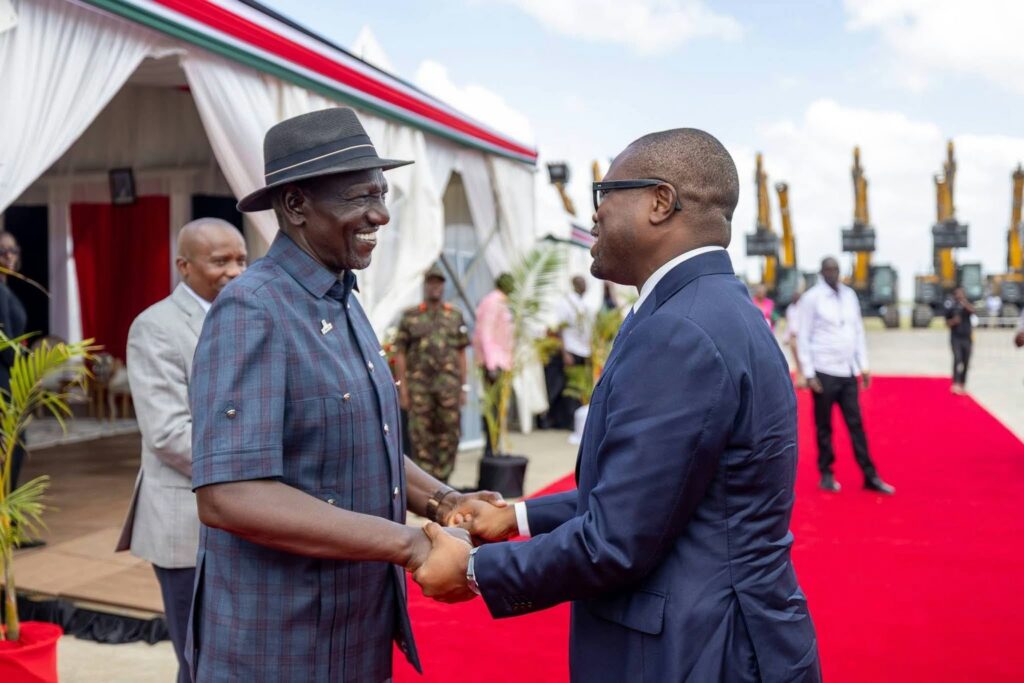
Lamu, Kenya — 30 September 2026. Benin’s President Romuald Wadagni took a decisive step this Wednesday by joining the groundbreaking ceremony for East Africa’s future refinery at Lamu, on Kenya’s northern coast, a flagship project driven by the group of Nigerian billionaire Aliko Dangote.
A turning point for African energy cooperation
This high-level gathering marked a major shift, bringing together several African leaders: Ugandan President Yoweri Museveni, Togolese President Jean-Lucien Savi de Tové, Ethiopian Prime Minister Abiy Ahmed Ali and Kenyan President William Ruto. Wadagni’s presence placed Benin at the centre of a meeting focused on one of the most significant industrial projects announced for East Africa, an event that drew political leaders around an infrastructure set to reshape crude oil processing capacity in the region.
A $16 billion investment in refining capacity
The future refinery in Lamu represents an investment estimated at $16 billion, or roughly 8,960 billion CFA francs. Once complete, the facility is expected to process 700,000 barrels of crude oil per day. That capacity would rank it among the largest industrial complexes on the African continent and make it, according to project data, East Africa’s biggest industrial undertaking in terms of refining capacity.
Beyond the figures, the project comes as several African nations push to strengthen local processing of raw materials and cut their reliance on imported refined petroleum products.
A ceremony with a strong continental dimension
Wadagni’s participation alongside several heads of state and government underscored the continental scope given to this initiative. The simultaneous presence of leaders from West and East Africa reflected a shared ambition to turn the Lamu site into a project that transcends Kenya’s borders.
For Benin, the president’s attendance was an opportunity to observe the prospects offered by major African industrial investments and the new dynamics of economic cooperation between states. The Lamu project fits into an Africa where energy infrastructure plays a growing role in development strategies, economic sovereignty and regional integration.
Industry at the heart of African ambitions
With its announced eventual capacity of 700,000 barrels per day, the future Lamu refinery is designed as an exceptional infrastructure. Its construction is expected to mobilise substantial capital and create an industrial ecosystem around energy, transport and logistics.
The ceremony of 30 September 2026 thus stands as a major milestone for the leaders present. For Romuald Wadagni, it offered a chance to take part, alongside several African officials, in a sequence dedicated to one of the major industrial projects currently announced on the continent.
In Lamu, attention is fixed on the future: an Africa seeking to expand its industrial capacity and process more of its resources on its own soil.
You may also like
Burkina Faso’s decisive shift: inside four years of Traoré’s military rule and its human toll
What Air Sénégal’s Dakar-Paris crew suspension means for passengers, prices and the airline’s future
Can anyone justify Moussa Kaka’s arrest in Niger? Alioune Tine says absolutely nothing does
Can OL Lyonnes still top the group after Chelsea stalemate?
Can Togo’s mediation still deliver peace in eastern DRC after Tshisekedi’s latest letter to Gnassingbé?