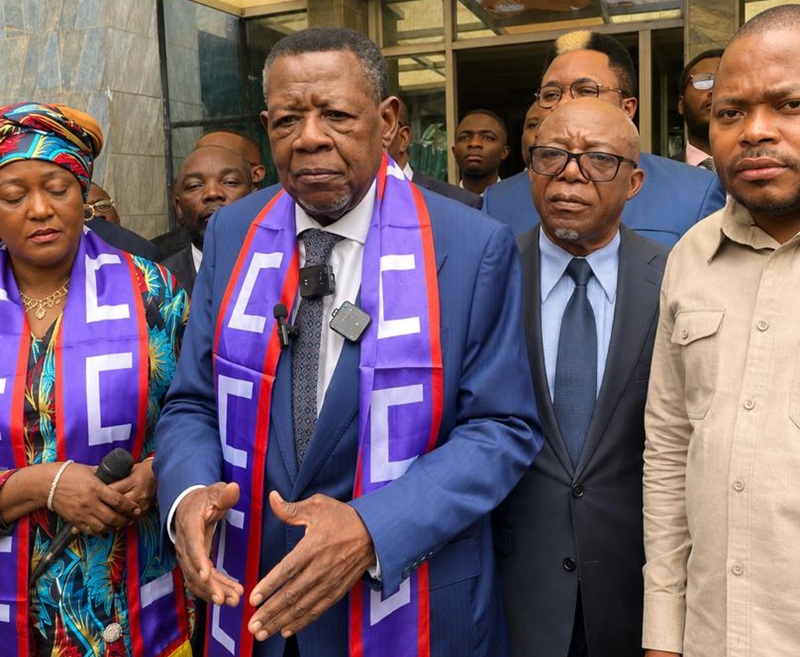
Lambert Mende rules out Félix Tshisekedi’s departure before Rwanda ends aggression
During a political gathering of the Convention des Congolais Unis (CCU) on August 3, 2026, Lambert Mende Omalanga delivered a sharp analysis of the security and humanitarian crisis gripping the Democratic Republic of the Congo. The CCU leader urged Congolese citizens to set aside their differences and unite against what he described as an existential threat to the nation.
« What will tomorrow bring? » This question framed Mende’s address to CCU activists, framing it as a call to action rather than mere rhetoric.
Kigali’s role in eastern DRC’s instability
Mende accused Rwanda of playing a central role in perpetuating instability in eastern DRC. He alleged that multiple armed groups operating in the region are proxies for Kigali, pointing to their alleged alignment with Rwandan strategic interests. The CCU leader also referenced repeated justifications from Rwandan President Paul Kagame, including the presence of the FDLR and protection of the Tutsi community in Kivu, arguing that these pretexts have evolved into territorial claims incompatible with Congo’s sovereignty.
Diplomatic pressure and FDLR disarmament
Despite the gravity of the situation, Mende struck an optimistic tone, highlighting diplomatic pressure on Rwanda—particularly U.S. sanctions—as a positive development for Congo. He also praised the ongoing voluntary disarmament of FDLR fighters, framing it as progress that weakens one of Kigali’s key justifications for its military presence in eastern Congo.
National dialogue: CCU’s red lines
On the prospect of an inclusive national dialogue, Mende acknowledged emerging consensus among political factions on its necessity. However, he stressed that the primary focus should remain countering Rwandan aggression and strengthening national cohesion. In his view, the dialogue must prioritize a unified strategy to prevent terrorism, « regardless of its origin. »
The CCU leader cautioned against including individuals convicted by Congolese or international courts for collaborating with the aggressor, as well as members of armed groups allied with Rwanda who have not formally distanced themselves from Kigali.
Constitutional reform and political stability
Mende also weighed in on the constitutional reform debate, distinguishing between the adoption of a referendum law and the actual organization of a constitutional referendum. He argued that extraordinary circumstances—citing historical examples like the U.S. during major 20th-century crises and Ukraine amid war—justify adaptations to institutional timelines. For Mende, the urgency of Congo’s security crisis outweighs procedural concerns.
Félix Tshisekedi’s mandate during aggression
The CCU’s stance on President Félix-Antoine Tshisekedi’s tenure is unambiguous: his leadership must continue as long as Rwanda’s aggression persists. Mende portrayed Tshisekedi as the only Congolese head of state since 1996 to have taken decisive military, political, and diplomatic steps against Rwanda’s incursions. This position emerges amid broader debates over constitutional reform and the country’s political future.
« The house is on fire »: a call for unity
Mende’s closing remarks echoed his plea for national unity, urging Congolese to postpone political disputes in favor of collective action. He highlighted the humanitarian toll of the crisis, including the resurgence of Ebola in frontline zones where Rwandan and Congolese forces clash. His message: survival and sovereignty must take precedence over partisan divisions.
The CCU leader concluded by endorsing President Tshisekedi’s initiative to forge a strategic alliance with the United States, framing it as vital for Congo’s resilience and long-term security strategy. « The house is on fire, » he declared, urging citizens to rally behind the defense of territorial integrity and national sovereignty.
« Long live the Democratic Republic of the Congo, one and indivisible! » Mende concluded, encapsulating the CCU’s vision of a united front in the face of existential threats.
You may also like
As donor fatigue spreads, can Benin’s €544,042 UNAIDS pledge keep the HIV response on track?
Who pays the price when Burkina Faso’s public payroll contracts? Households weigh the cost of 1,917 fewer agents
Libya pushes for direct Tripoli-Yaoundé flights as Cameroon sets up working groups
JNIM seizes three Burkinabè positions in a single day as Traoré’s security record faces hard questions
Chad condemns Ennedi-East airstrikes at un general assembly, warns of retaliation