JNIM siege jeopardises trade across West Africa
Recent terrorist attacks in Mali have heightened the obstruction of key trade routes linking coastal and Sahelian states.
On 25 April, Mali experienced a wave of coordinated strikes by Jama’at Nusrat al-Islam wal Muslimin (JNIM) and the Azawad Liberation Front (FLA). Targeting Kati, Mopti, Sévaré, Gao, and the capital Bamako, these operations caused multiple casualties and the killing of Defence Minister Sadio Camara.
Malian authorities responded with a counter-offensive against the groups’ positions. Bamako’s military prosecutor announced the arrest of several suspects, including civilians, active-duty soldiers, and discharged military personnel.
Five days after the initial attacks, JNIM imposed a blockade on the capital, focusing on western routes. The complete closure of the Kita–Bamako road trapped hundreds and disrupted food and water supplies.
This siege also disrupts trade flows, halting all traffic on the Kayes–Bamako route. Moreover, the blockade has expanded to include attacks on transport convoys along the Conakry–Bamako axis, which had previously remained relatively safe.
Mali and neighbouring coastal countries |
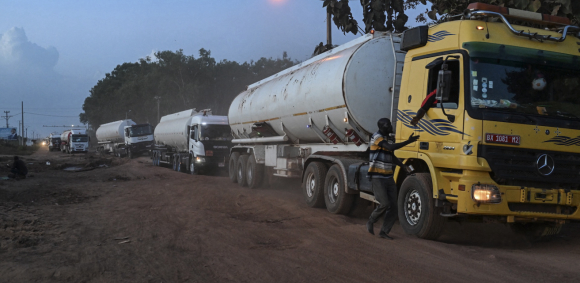
Since September 2025, JNIM has focused on targeting fuel convoys along strategic supply routes in western and southern Mali. These attacks destabilise commerce and, if they keep spreading, could harm West African economies.
West African nations are tightly interconnected through trade. Coastal state ports serve as the primary gateways for landlocked Sahelian countries. Road corridors linking these ports to Sahelian capitals and beyond function as vital lifelines, but most cross areas where JNIM operates.
The Dakar–Bamako corridor is strategically important for both Senegal and Mali, and currently appears the most impacted by insecurity in western Mali.
In 2024, Mali was Senegal’s top customer, alone absorbing 26.5% of Senegalese exports—roughly 802.8 billion FCFA (US$1.42 billion). Over the first nine months of 2025, cumulative Senegalese exports to Mali reached an estimated 662 billion FCFA (US$1.17 billion).
Between September and November 2025, Dakar port recorded a daily blockage of about 120 containers bound for Mali, costing Senegal an estimated 15 billion FCFA (US$26.54 million) per month. By late November 2025, over 2,000 containers were stuck in Dakar. By February 2026, around 4,000 empty containers were stranded in Bamako, as truck drivers feared the dangerous return journey to Dakar.
This situation severely reduces Mali’s supply of petroleum products, refined goods, hydraulic cement, and foodstuffs. It also undermines the livelihoods of thousands of drivers, traders, and freight forwarders. Other corridors—especially those linking ports in Côte d’Ivoire, Ghana, Togo, and Bénin to the Sahel—face similar risks.
In 2025, Mali remained Côte d’Ivoire’s top customer within the West African Economic and Monetary Union (UEMOA). The Abidjan–Bamako corridor is crucial for supplying Mali with petroleum and food products. By late 2025, about 1.47 million tonnes of goods had moved along this route, which is now being targeted by JNIM attacks in the Sikasso region.
Côte d’Ivoire is also Burkina Faso’s top African supplier, mainly of petroleum, electricity, and fertilisers. Burkina Faso’s imports come from or transit through Côte d’Ivoire, Ghana, and Senegal. On 14 February, seven Ghanaian tomato traders were killed in a JNIM attack in Titao, northern Burkina Faso, highlighting security risks on the road linking the two countries. For now, the terrorist threat is strongest on Malian soil, where authorities have taken several measures. Since November 2025, fuel convoys have received military escorts, allowing 200 to 300 tanker trucks to enter each week—down from nearly 1,200 before the attacks began.
The government signed a memorandum of understanding with Malian petroleum groups to streamline customs procedures. A fuel rationing system was introduced to combat the black market. Authorities are also working to ease pressure on Dakar and Abidjan ports by diverting some trade flows to other port facilities.
A truce between Bamako and jihadist groups was reported until Eid al-Adha, in exchange for releasing more than a hundred prisoners accused of terrorism. However, attacks continued and Malian authorities officially denied this information.
The 25 April attacks expose the limits of the military approach favoured by Malian authorities against terrorism. While JNIM and FLA set aside their differences to launch these major offensives, Sahelian and coastal states struggle to form alliances.
The regional consequences of JNIM’s blockade highlight the need for joint protection of cross-border trade corridors. Governments and regional organisations—including the Economic Community of West African States (ECOWAS), the Sahel States Alliance (AES), the Conseil de l’Entente, the Mano River Union, and UEMOA—must prevent this phenomenon from spreading to other road axes.
Countering terrorism could drive a much-needed revival of regional cooperation between Sahelian and coastal West African states.