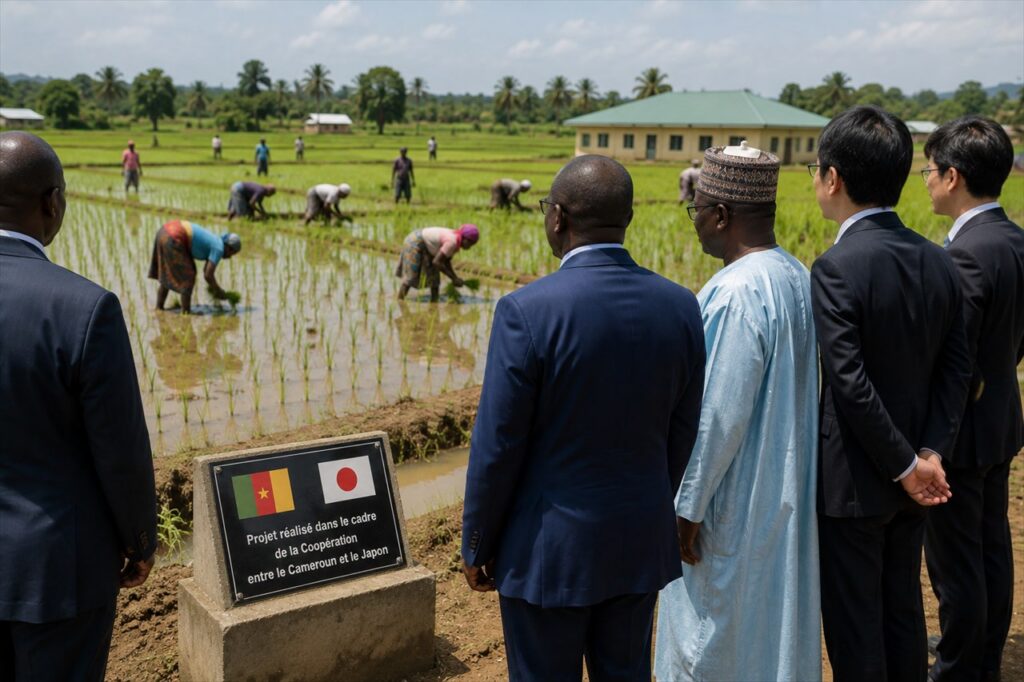

Japan has injected over 646 million dollars into Cameroon’s economy since establishing the Japan International Cooperation Agency (JICA) in 2006. The announcement came during a high-level meeting in Yaoundé between Cameroon’s Minister of Economy, Planning and Territorial Development, Alamine Ousmane Mey, and JICA Vice President Ando Naoki. The gathering marked two decades of JICA’s presence in Cameroon, alongside the Japan Overseas Cooperation Volunteers (JOCV) program.
The 646 million dollar figure encompasses more than just loans. Japan’s development cooperation blends grants, concessional loans, and technical expertise. A portion of the funds has been allocated as grants to build essential social infrastructure—schools, classrooms, health centers, and community facilities. Meanwhile, concessional loans offer low-interest financing with extended repayment terms and grace periods.
The majority of these funds target critical sectors: transportation and energy infrastructure. Japan’s support also extends to technical cooperation, which includes deploying Japanese experts, providing training, conducting feasibility studies, transferring advanced technologies, and sending volunteers to work alongside Cameroonian counterparts.
JICA’s initiatives reflect this multifaceted approach. According to official records, grants have helped construct over 120 schools and 1,500 classrooms across Cameroon. Concessional loans financed key projects such as the Mintom-Lele road, developed in partnership with the African Development Bank (AfDB), a corridor expected to boost trade between Yaoundé and Brazzaville. Technical cooperation has trained nearly 36,000 rice farmers to improve food security, guided around 1,500 businesses using Japan’s Kaizen methodology, and strengthened workforce capabilities across various industries.
Future directions in Japan-Cameroon partnership
The meeting also explored ways to deepen collaboration in priority areas outlined in Cameroon’s National Development Strategy (SND30) 2020–2030. Discussions focused on agriculture, fisheries, education, infrastructure, environmental sustainability, human capital development, and business competitiveness—sectors aligned with the country’s long-term growth ambitions.
Recent initiatives underscore this evolving partnership. In late May 2026, JICA launched a technical cooperation project aimed at restoring savanna and forest landscapes through agroforestry. This program reflects Japan’s growing emphasis on climate resilience and sustainable resource management, while continuing to support infrastructure and capacity-building—the cornerstones of its two-decade engagement in Cameroon.
You may also like
Can Nigeria’s security forces ever shut down the kidnapping economy in the north?
Can Benin’s defense strategy survive on diversification alone?
Can the CEMAC capital market finally bankroll Cameroon’s real economy?
Mali: can justice deliver for civilians after Amnesty’s war crimes findings?
Mali’s fuel lifeline: can a single BOAD loan of 8 billion CFA truly steady the nation’s energy sector?