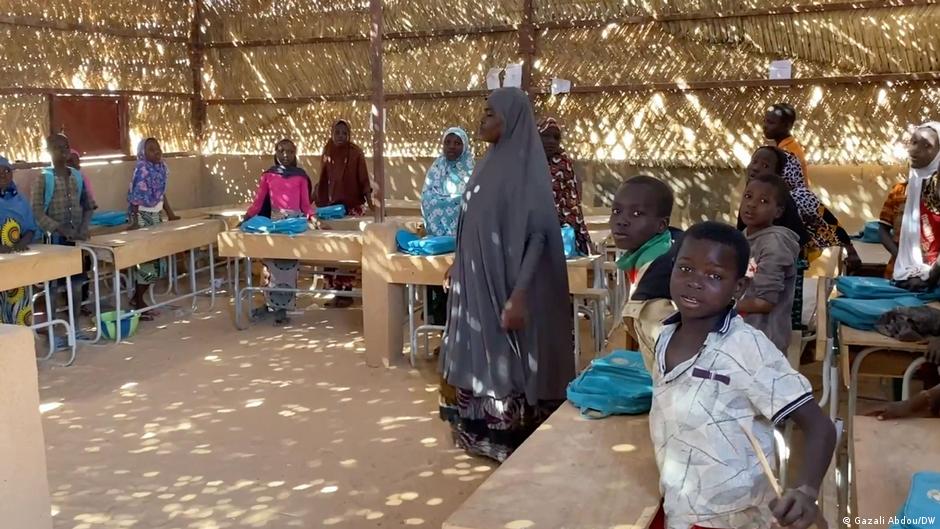
How Niger’s children learn about their rights in a Gaya classroom
In the southwestern Niger town of Gaya, a school is teaching children about their rights. This report was done on the occasion of the Day of the African Child.
The bell has just rung to mark the end of class, but for these 9 to 12-year-olds, the reflection on the day’s theme continues in the corridors of the Gaya mission school:
“Before this lesson, I thought rights were for adults—like driving or voting.”
“Yes, we have the right to medical care when we’re sick, and no one has the right to hurt us.”
“Friends, we can speak too, so parents and teachers have to listen to us. If we need something, we can explain without being scolded.”
Today, the teacher brought up children’s rights during the moral education class—a special subject that doesn’t end at the classroom door.
For Aïssatou, the teacher, the effects of this lesson are visible immediately after the notebooks are closed: “Indeed, the discussion continues because, after class, I noticed the students were excited to learn that they themselves have rights. You know, children learn a lot from moral lessons. They memorize and put into practice everything we teach them,” she explains.
Passing on values to young learners
Rights are taught using the APC pedagogical method—competency-based approach according to level, explains advisor Omar: “From kindergarten, we teach children their rights through stories, little songs, all that. I have the right to education, to health. Gradually, when they reach secondary school, it’s civic education and moral lessons. In primary school, it’s only moral lessons. Through that, we give them the basics of human rights.”
Lack of awareness of their rights
But not all children have the chance to reach secondary school. Some drop out and continue growing up without ever accessing these notions of rights. We meet, for instance, an 11-year-old boy in the street collecting plastic bottles. Off microphone, he confides that “rights are for adults.” This shows the urgency of educating children beyond classrooms and blackboards.
You may also like
Can anyone justify Moussa Kaka’s arrest in Niger? Alioune Tine says absolutely nothing does
Can OL Lyonnes still top the group after Chelsea stalemate?
Can Togo’s mediation still deliver peace in eastern DRC after Tshisekedi’s latest letter to Gnassingbé?
Mali: did the JNIM ambush on Africa Corps near Niono expose a fatal gap in Russia’s Sahel strategy?
Will Mali’s 73.6 million dollar funding gap decide the fate of millions by 2027?